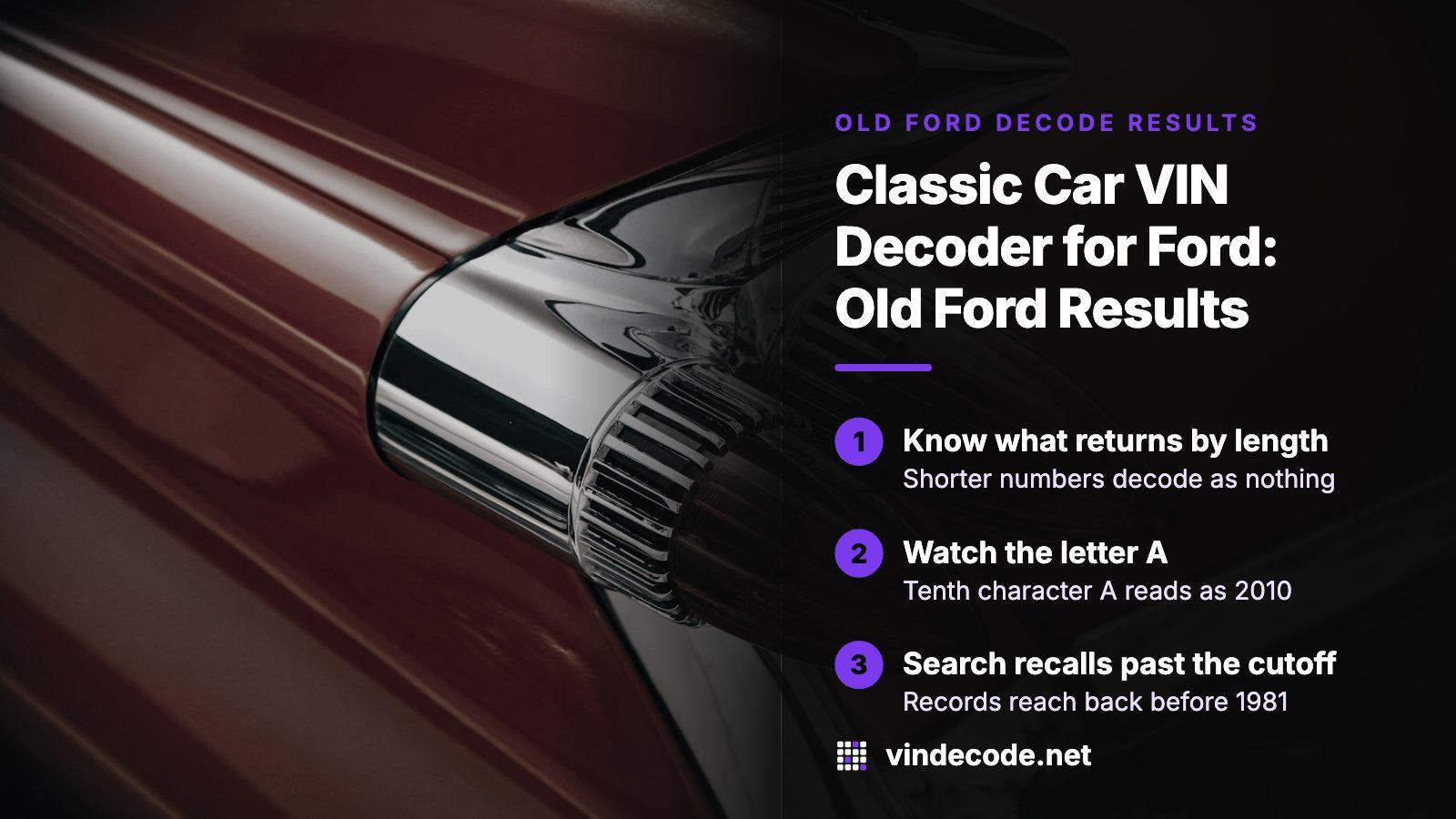
THE SHORT ANSWER
A classic car VIN decoder for Ford reads 17-character numbers, meaning 1981 models and newer. Enter yours above for the model, body, engine and plant. A Ford from 1980 or earlier carries a shorter number, and NHTSA's decoder holds nothing for it, so the result is an error or a wrong guess. For those cars, work from the plate, the title and a recall search by year, then check the title record.
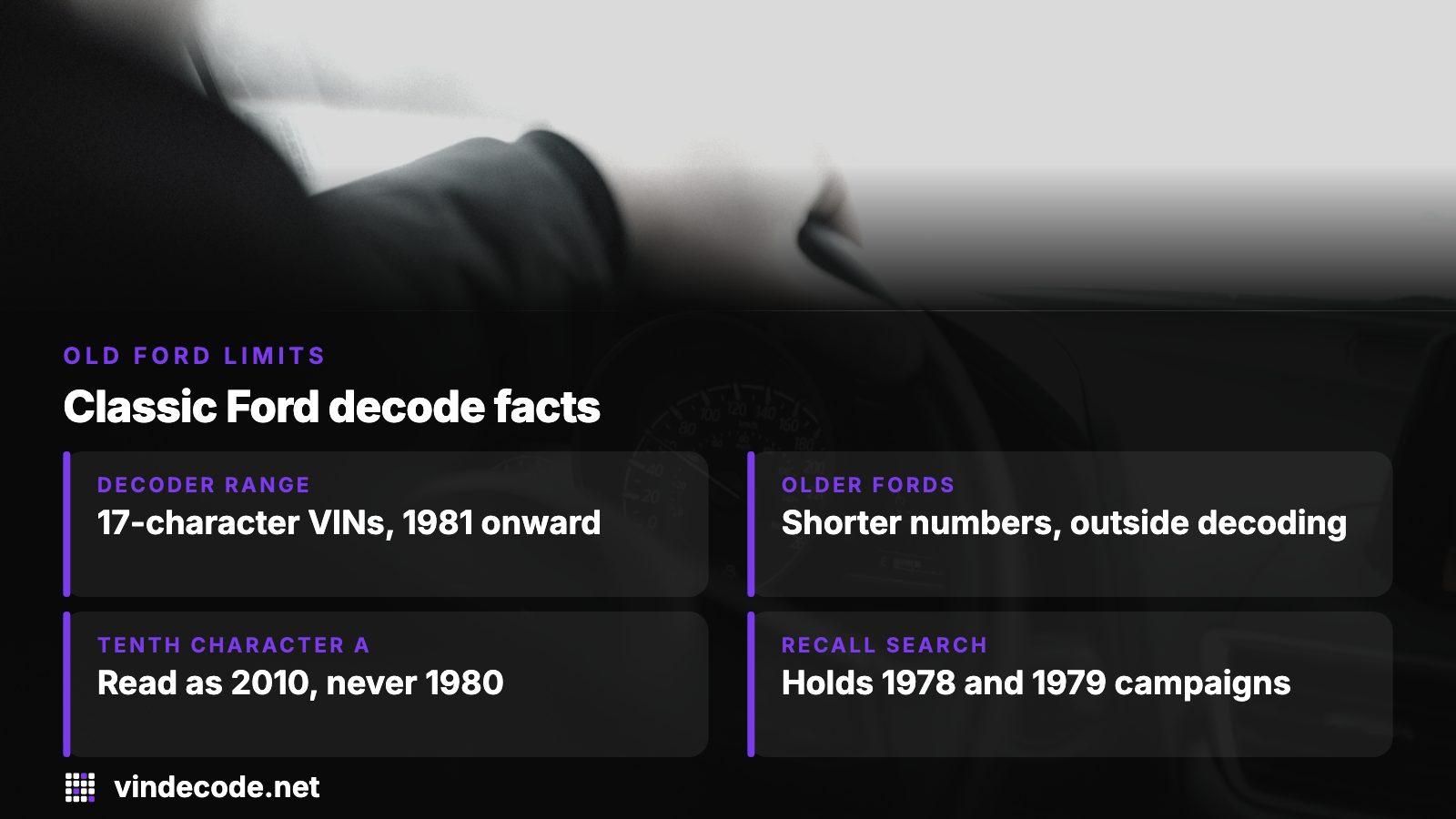
- Decoder range
- 17-character VINs, model year 1981 onward
- Older Fords
- Shorter numbers, outside NHTSA's decoding
- Tenth character A
- Read as 2010, never as 1980
- Recall search
- Holds campaigns from 1978 and 1979
What an old Ford returns, by number length
Whether a classic Ford decodes depends on the number stamped on it, not on the badge or the age that feels old. NHTSA says its decoding platform was designed around model years from 1981 on, and cars built to the earlier VIN scheme sit outside it. A Ford from the 1980s with a full-length VIN is therefore inside the tool, and a Fairlane or an early pickup is outside it.
| What is on the car | What the decoder does | Your move |
|---|---|---|
| 17 characters, 1981 or later | Returns model, body, engine, plant and year | Run the history report on the number |
| A shorter number | Errors out or guesses a wrong maker | Work from plate, title and recall search |
| 17 characters, no match | Usually one misread character | Retype it from the metal, not the advert |
What the decoder said to five Ford test numbers
To see the range for myself I ran test numbers built on real Ford patterns, with invented serial digits, through NHTSA's public decoder. A fully valid F-150 string, 1FTEF14N8GNA12345, came back clean: a 1986 pickup with a 5.0 liter gasoline V8, four-wheel drive, built in Norfolk, Virginia. The others carried a made-up serial, so the check digit failed, yet each still returned its build.
| Model and year | Engine | Plant |
|---|---|---|
| 1986 Mustang | 2.3 liter gasoline | Dearborn, Michigan |
| 1989 Mustang | 2.3 liter, 4 cylinders | Dearborn, Michigan |
| 1985 Bronco II | 2.8 liter, 6 cylinders, 4WD | Louisville, Kentucky |
| 1987 Thunderbird | 3.8 liter, 6 cylinders | Lorain, Ohio |
A failed check digit did not stop the decode. It marked the number as probably mistyped, which is your cue to compare the string with the car again before you trust any of the build details.
Why the tool fails on a shorter number
NHTSA's web decoder even carries an alert for this case, headed as an invalid year submitted, and blocks any year typed below 1981. The data behind it comes from build specifications that manufacturers filed under the federal 565 standard, so an older Ford has no filed pattern for the tool to match.
I fed it 5F07F100001, a short string shaped like an older Ford number. The reply listed an incomplete VIN, a year character that is not valid, and invalid characters. It also named a sidecar motorcycle company as the maker. Read that as noise, not as news about the car.
A blank or odd result is not a verdict
The tool has no data for the car, so it cannot say the number is real or fake. Judge an older Ford by the plate, the tags and the paperwork instead.
The letter A in position 10 reads as 2010
Year letters repeat on a long cycle, so one character can point at two decades. I tested a 17-character Ford string with an A in the tenth place. The decoder read it as 2010, returned no model and no plant, and flagged errors. It never offered 1980.
Federal rule 49 CFR 565.15 requires the seventh character of a car or light-truck VIN to be a letter, and that is the clue the 1981-and-later layout hangs on. If a number you were given has a digit there and an A in the tenth position, treat the year as unproven until the car itself confirms it. The rule also defines model year as the maker's designation, regardless of the calendar year a car was built, so a late-year build can wear the next year's code.
Recall records reach back past the decoder's cutoff
Even where the decoder is blind, NHTSA's recall search still holds old campaigns. A search on a 1979 Mustang lists seven records, among them a cooling fan campaign from October 1978 and a campaign from February 1979 over a steering gear flange that could slip and cause loss of steering control. A search on a 1986 Mustang lists campaign 87V139000, opened in September 1987, over a spring lock fuel line coupling that might not be properly engaged.
- Search by make, model and year, since the VIN lookup will not help on a short number.
- Expect recalls on parts as well as cars: the 1986 list includes aftermarket fuel pumps, and the 1966 list holds only a wheel spindle campaign from a parts company.
- Try the model name as NHTSA spells it. A 1978 F-150 search returned nothing.
What a decode cannot tell you: two owners' reports
A decode describes how a Ford left the factory. It does not say what ignition parts, cables or fuel lines have been through since, and NHTSA's owner complaints show how that plays out on 1980s cars.
From an NHTSA owner complaint
The owner of a 1986 Mustang told NHTSA in 2022 that the car stalled at about 20 MPH, then lost power and would not restart. A mechanic replaced ignition parts, then the timing belt and gears, and the distributor had to be rebuilt because no replacement was available. The failure came back at about 62,000 miles.
Ask a seller for the repair history on any 1980s Ford and what was done to the ignition, because parts for these cars can be scarce.
From an NHTSA owner complaint
A 1984 F-150 owner reported in 2015 that the truck stalled at 35 MPH with a clicking noise at the pedal. The throttle cable had fractured, the repair did not hold, and the cable detached again at 264,070 miles.
High mileage on an old truck is normal. What you want is a record of what was replaced, which a decode never carries.
Clones, replicas and what the history record adds
A VIN on a classic can be genuine and still sit on the wrong car. The Justice Department's NMVTIS page describes a theft ring that put numbers lifted from matching cars onto stolen ones, and a South Florida case that recovered approximately 250 cloned, stolen vehicles. A clone carries a valid number, so the decode looks perfect.
NMVTIS fills in what a decode lacks. It shows the title with its brand history, the newest mileage reading, whether it was ever declared a total loss by an insurer, and whether a salvage yard ever took it. A brand a state has applied becomes permanent in that national file. The same page warns that some states exempt older vehicles from titling, so the file on a very old Ford may be thin.
Replicas are a separate matter. A replica's builder must report which car is being copied, by maker, name and year, so the number on a tribute build may describe the new car, not the original.
What it costs and a sensible order of work
The preview for a 17-character VIN costs nothing to look at. The report is bought once, covering one classic or a batch of 3, 5 or 10, and there is no renewal. See the pricing page for amounts. For a pre-1981 Ford, begin with the plate and the title.
- Transcribe the VIN from the Ford itself and compare it with the title.
- Decode it if it has 17 characters, and note the plant and engine.
- Search NHTSA recalls by make, model and year.
- Look at the preview, then order the history report if the car holds up.
- Have a mechanic you chose inspect it before you pay.

Where this information comes from
- NHTSA: vPIC VIN decoder — States the 1981-and-forward range, the pre-1981 alert and where its patterns come from.
- eCFR: 49 CFR Part 565 — The federal rule on what positions 1 to 8 identify, the letter in position 7 and replica makers.
- NHTSA: recalls — Recall records by make, model and year, including campaigns from 1978, 1979 and 1987.
- NMVTIS: consumer information — What a title-database report holds, how cloning works and why older cars may have thin records.
- NHTSA owner complaint 11486404 — owner experience, paraphrased
- NHTSA owner complaint 10786869 — owner experience, paraphrased
Sources and photos: Facts checked against the sources above in November 2026. Photos by Clem Onojeghuo, Scott Graham and Miles Loewen on Unsplash; diagrams by VINDecode.
Keep reading
- Ford VIN Decoder: Decode a Ford VIN, Then Check Its HistoryPrefixes, engine character and plant for every Ford built since 1981.
- Mustang VIN Decoder: Read the Build, Then Check the HistoryThe Mustang case in full, including older cars with shorter numbers.
- Classic Car VIN Decoder: Which Years It Reads and What Comes AfterHow the tool treats short pre-1981 numbers across all makes.
- VIN Decoder Year Chart: Position 10 Codes for 1980 to 2039The full year-letter cycle, including the tenth-character repeats.
Frequently asked questions
How do I decode a classic Ford VIN?
Read all 17 characters from the car and enter them in the decoder above if it is a 1981 or later Ford. With a shorter, older number, rely on the plate, the title and a recall search by make, model and year.
Why does my old Ford VIN return an error?
NHTSA's decoding covers 1981 and forward, and older numbers are shorter and were never filed under that standard. An error on a pre-1981 Ford means the car predates the data. It does not mean the number is false.
Will the decoder tell me if my classic Ford is original?
No. It reports the build as Ford filed it for that number. It cannot show whether the engine was swapped, the body was changed or the car is a clone. Check the engine and tags against the decode yourself.
Does a 1980s Ford decode as the right model?
Yes where Ford filed the pattern, as the Mustang, F-150, Bronco II and Thunderbird tests above show. Fields Ford never filed come back blank, which means no data, not a missing feature.
Does the history report cover a classic Ford?
It reads title, odometer, salvage and theft records on the VIN you enter, so a 17-character Ford gets a full lookup. Very old cars may have thin records where a state exempts them from titling. The preview is free, so check what turns up first.
Now check the car itself
The guide explains what to look for. The report shows what this VIN has on record.