
THE SHORT ANSWER
To decode a Camaro VIN, enter all 17 characters in the box above. You get the year, trim, body style, engine and plant. Camaros from a US plant start 1G1 and those from a Canadian plant start 2G1, with the year in character 10 and the plant in character 11. Cars through 1980 carry shorter numbers the tool cannot read, and what happened after the factory belongs to a history report.
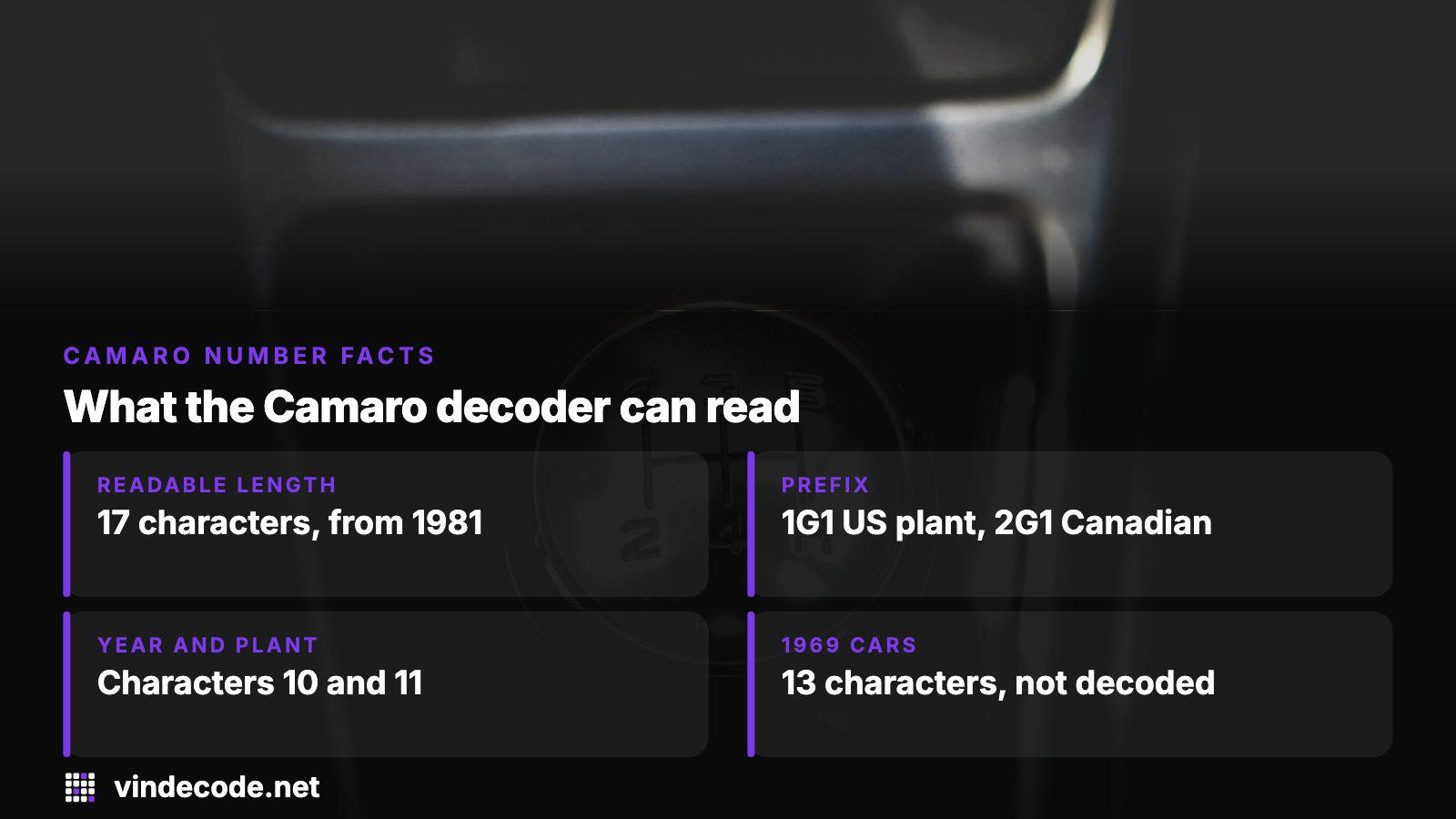
- Readable length
- 17 characters, from the 1981 model year
- Prefix
- 1G1 from a US plant, 2G1 from a Canadian plant
- Year and plant
- Characters 10 and 11
- 1969 cars
- 13 characters, not read by the decoder
What the Camaro decoder returns
The tool looks up the record General Motors filed with NHTSA for your VIN's pattern and returns the build as fields. On a Camaro that settles what an advert likes to blur: the year, coupe or convertible, the cylinder count and where the car was built.
| Field | What it settles on a Camaro |
|---|---|
| Year and body | Whether the year and the coupe or convertible body match the listing |
| Trim | The line GM filed, such as LS, LT or SS, when one is given |
| Engine and fuel | Cylinders and fuel, to set against the seller's claim |
| Drive and gearbox | Rear-wheel drive or not, manual or automatic, when filed |
| Plant | Michigan or Ontario, one input when a recall covers only some cars |
Fields the maker never filed come back blank. A blank is a gap in the record, not a defect in the car.
Read the VIN off the car and count it
Take the number from the car, not the advert, since one wrong character returns an error or a different vehicle.
- A 1981 or later Camaro repeats its VIN in two easy places: a plate you can read from outside at the base of the glass, driver's side, and a sticker on the driver's door pillar.
- A 1969 car keeps its plate on the dash, driver's side, readable through the glass, with a body plate in the door jamb behind it.
- Count the characters. Seventeen goes into the decoder. Thirteen means an older maker-set number.
- Photograph every plate and tag whole.
Match each reading to the title. If plate, label and paperwork disagree, the sale waits until the seller explains.

Older Camaros: the 13-character number
Federal rule 49 CFR 565 set the 17-character layout from 1981. Earlier numbers came from each maker, and a decoder built on the later layout returns an error or nothing for them. The second generation, 1970 to 1981, straddles the change: short numbers through 1980, then 17 characters. This is how a 1969 number reads.
| What it states | Where | Value |
|---|---|---|
| Model line | 1 to 3 | 124 |
| Body style | 4 and 5 | 37 coupe, 67 convertible |
| Year | 6 | 9, for 1969 |
| Plant | 7 | N for Norwood, Ohio, L for Van Nuys, California |
| Build order | 8 to 13 | Six-digit sequence |
Engine, transmission and trim are missing from it. No 1969 number names an SS or a Z/28, so that claim rests on the cowl tag, the engine pad stamping and original paperwork. GM's Heritage Center offers vehicle information kits with factory records for older cars.
A modern Camaro VIN, character by character
From 1981 the federal layout applies, with GM choosing the descriptor characters. In NHTSA's records, Michigan-built Camaros start 1G1 and Ontario-built ones start 2G1: the first character names the country, G stands for General Motors, and the third marks a Chevrolet car.
| Characters | What they carry |
|---|---|
| 1 to 3 | Maker and origin, 1G1 or 2G1 here |
| 4 to 8 | Model line, body and engine in GM's own coding, the engine sitting in place 8 |
| 9 | Check digit, a sum derived from the rest |
| 10 | Model year, a letter or a digit |
| 11 | Plant |
| 12 to 17 | This car's own serial number |
The year character never uses I, O, Q, U, Z or 0, and a 2019 Camaro shows K. Because the letters repeat over time, read the letter against the car's generation.
When the decode and the car disagree
A decode earns its keep beside other evidence. Set the result against the advert, the title and the car, and treat each mismatch as a question for the seller.
- A model year that differs from the advert or the title.
- A body style or cylinder count unlike the car in the driveway.
- SS badges on a car whose decode names a lower trim.
A pass is not proof
A number that clears every test has only survived so far. On a 1969 car the cowl tag, engine pad and paperwork carry the proof, and a premium for an SS or Z/28 justifies a specialist's fee.
A tribute priced as a tribute is a fair buy. A clone sold as original is the costly case, and NICB's VINCheck can flag a retagged car whose borrowed identity was reported stolen.
Recall groups follow the VIN, not the badge
Safety recalls name their cars by VIN group, so two Camaros of one model year can fall on opposite sides of the line. The decode gives the year, plant and engine to read up on; NHTSA's lookup, fed the full VIN, answers for that one car. Repairs on an open recall carry no charge to the owner.
From an NHTSA owner complaint
The owner of a 2018 Camaro told NHTSA in October 2025 that the power steering cut out at random, with a service message on the dash and the gauges dropping to zero. The owner had seen a recall for the same fault on that make, model and year, yet GM said the car's VIN was outside the group, leaving the owner baffled that "mine's not included". The dealer could not reproduce the fault, and GM's only advice was to pay for a repair. The owner asked GM to widen the group.
Take from it that a recall headline is a reason to check your own VIN, never proof of coverage. The reverse holds too: an empty lookup means no open recall on that number today.
Where the decode stops and the history report starts
A decode describes the car as built. Later events sit in other records, which the report searches under the same number.
| Record | What it tells you |
|---|---|
| Title brand | Ever branded salvage, flood or rebuilt |
| Accident and damage | Where it was hit and how badly |
| Mileage | Whether odometer readings climb believably |
| Auction history | Any salvage auction, with photos |
| Theft and liens | A theft report, or a lender or impound lot with a claim |
A Camaro can decode as the right year, trim and engine and still wear a branded title. The decode confirms the advert; only the report shows the car's past.
Cost and a sensible order for a used Camaro
After you enter the VIN, a preview opens with no payment and no card. Buying the report is one charge covering a single report or a multi-report bundle of 3, 5 or 10, with no renewal. Amounts are on the pricing page.
- Decode the VIN you read on the car and compare year, trim, body and engine with the listing.
- Ask for a photo of the car's RPO label, which lists factory options a VIN leaves out.
- Run NHTSA's recall lookup on the full number.
- Open the preview, then buy the report if the build adds up.
- Have a mechanic you choose inspect the car before money moves.
From an NHTSA owner complaint
An owner of a 2012 Camaro told NHTSA that the airbag warning light had come on with no obvious cause. A VIN lookup showed an airbag recall on the car, yet a dealership said no recall applied and wanted payment for the work. The owner asked where to turn for help.
Keep a dated screenshot of the lookup, campaign number showing, before any dealer visit.
Where this information comes from
- NHTSA: vPIC VIN decoder — The federal database behind the model, trim, engine and plant fields, and the source of the 1G1 and 2G1 plant examples.
- NHTSA: recalls lookup — Checks one VIN for open recalls, which the manufacturer repairs without charge.
- NHTSA: VIN standardization (49 CFR 565) — The federal rule behind the 17-character layout from 1981.
- NHTSA owner complaint 11691941 — owner experience, paraphrased
- NHTSA owner complaint 10836678 — owner experience, paraphrased
- GM Heritage Center: vehicle information kits — Factory documentation packages for classic Chevrolets, the strongest paper evidence on a pre-1981 car.
- NICB: VINCheck — A theft and total-loss screen that can expose a borrowed identity.
Sources and photos: Facts checked against the sources above in November 2026. Photos by Mohamed Gado, Cole Keister and Hidde van Esch on Unsplash; diagrams by VINDecode.
Keep reading
- Chevrolet VIN Decoder: Decode a Chevy, Then Check Its HistoryThe brand-wide layout: prefixes, engine character and plant for every Chevy.
- Classic Car VIN Decoder: Which Years It Reads and What Comes AfterHow the tool treats short pre-1981 numbers and what to read in their place.
- Corvette VIN Decoder: Read the Build, Then Check the PastThe other GM sports car, with a numbering history of its own.
- Sample reportA finished report, to see what the history adds once the decode is done.
Frequently asked questions
How do I decode a Camaro VIN?
Enter all 17 characters in the decoder above. It reads the record GM filed with NHTSA and returns year, trim, body, engine and plant, for the 1981 model year and later. A history report on the same number then adds title, accident and mileage records.
Does a Camaro VIN show whether it is an SS?
On a 17-character car the decode names the trim line where GM filed one, so an SS appears as an SS. A 1969 number cannot, since it holds no engine or trim. For those cars the cowl tag and paperwork must prove an SS or Z/28.
What do 1G1 and 2G1 mean on a Camaro?
Both mark a Chevrolet car; the first digit gives the assembly country, 1 for the US and 2 for Canada. NHTSA's records show Michigan-built Camaros opening with 1G1 and Ontario-built ones with 2G1, so the prefix points to the plant's country.
Can the decoder read a 1969 Camaro VIN?
No. That number runs 13 characters in a layout GM set for itself, and the federal 17-character standard began in 1981. Work through the table above by hand, then check the cowl tag, the engine pad and any factory paperwork.
Does decoding a Camaro VIN show accidents or recalls?
Neither. The decode describes the build; accident and title records belong to the history report. Recalls attach to VIN groups, so put the full number through NHTSA's lookup, which costs nothing.
Now check the car itself
The guide explains what to look for. The report shows what this VIN has on record.