THE SHORT ANSWER
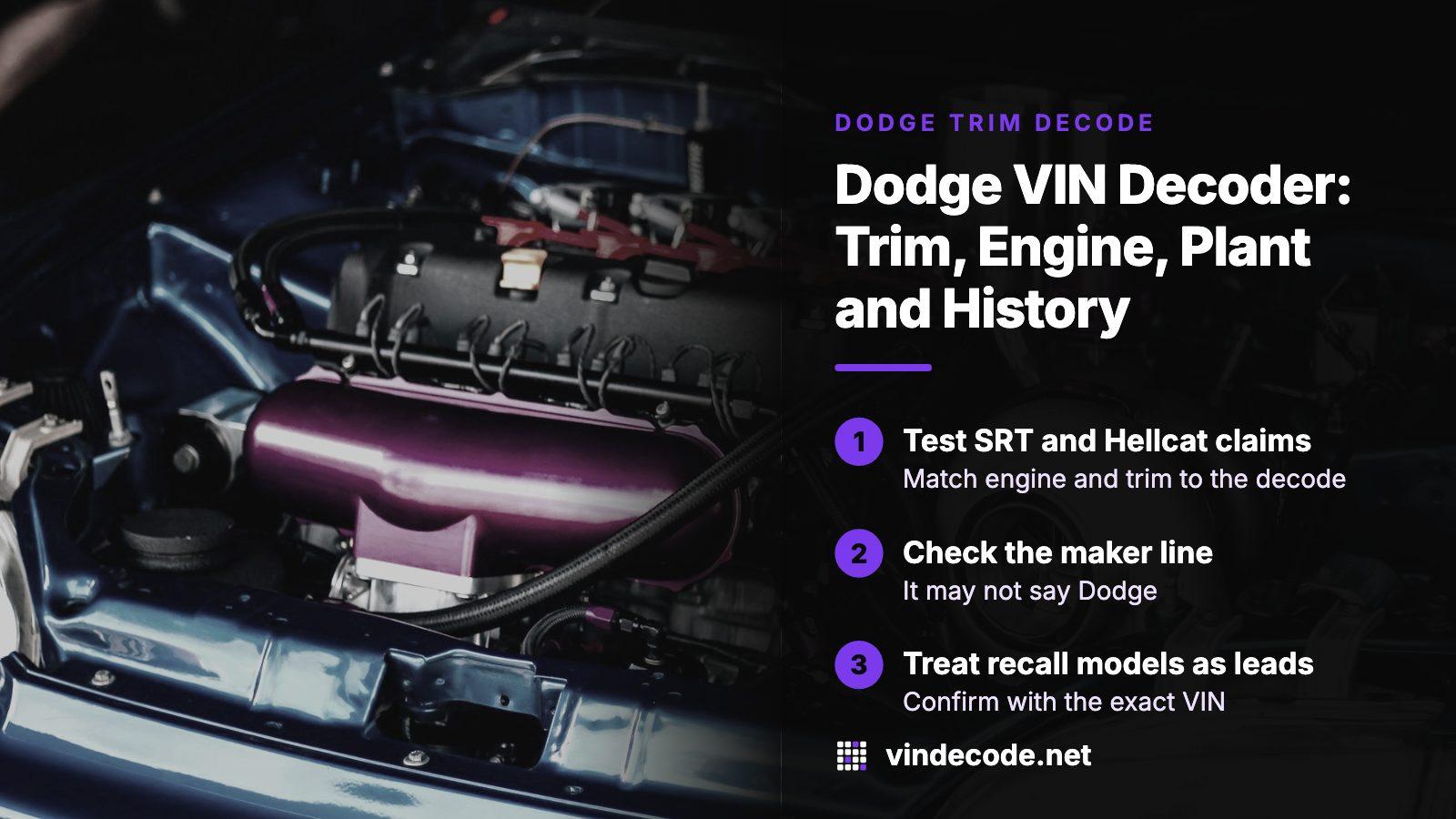
To decode a Dodge VIN, enter all 17 characters in the box above. Characters 1 to 3 name the maker, 4 to 8 describe model, body and engine, 10 gives the model year and 11 the plant. On an SRT or Hellcat, check the trim and engine that come back before you discuss price. Pickups from 2010 to 2012 decode as a Dodge Ram, later ones do not. The decode shows the build only: title brands, crashes and mileage need a report.
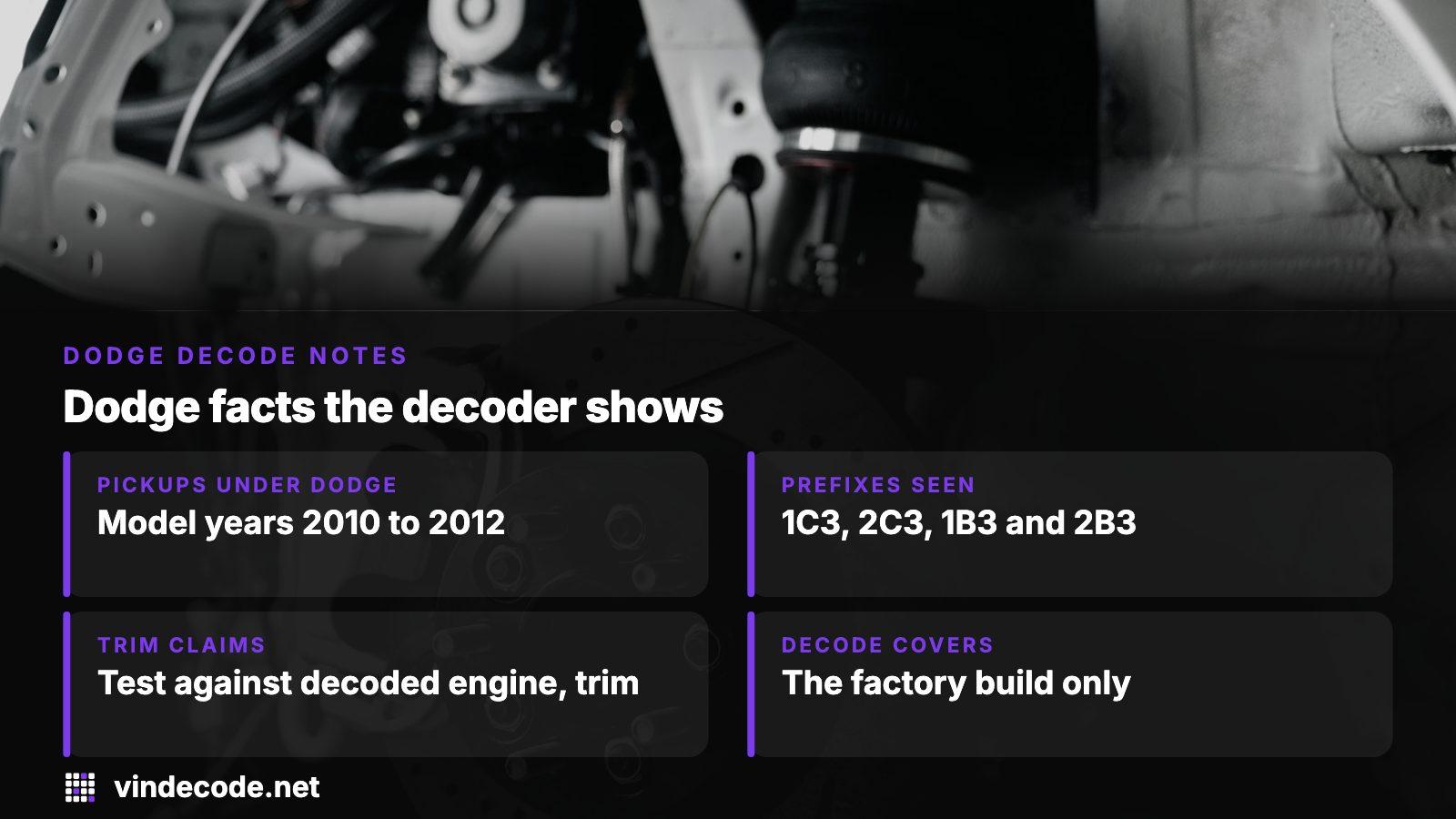
- Pickups under Dodge
- Model years 2010 to 2012, as the Ram
- Prefixes seen on Dodges
- 1C3, 2C3, 1B3 and 2B3
- Trim claims
- Test them against the decoded engine and trim
- Decode covers
- The factory build, not the car's later life
What the decoder returns for a Dodge build
Dodge files the structure of its VINs with NHTSA, and the decoder reads that filing back: year, model and body, engine size and cylinders, driven wheels, plant, and on many performance builds a trim name. Three examples, decoded from the first 11 characters of VINs that NHTSA publishes beside owner complaints:
| Build | Trim returned | Engine | Plant |
|---|---|---|---|
| 2008 Avenger | SXT | 2.4 L, 4 cylinders | Sterling Heights, US |
| 2016 Challenger | SRT Hellcat | 6.2 L, 8 cylinders | Brampton, Canada |
| 2021 Charger | Scat Pack | 6.4 L, 8 cylinders | Brampton, Canada |
Partial numbers still decode but come back flagged as incomplete, so enter all 17 characters on your own car.
Getting the VIN off the car and into the box
Take the number off the vehicle itself. A typo in an advert returns an error or a different car.
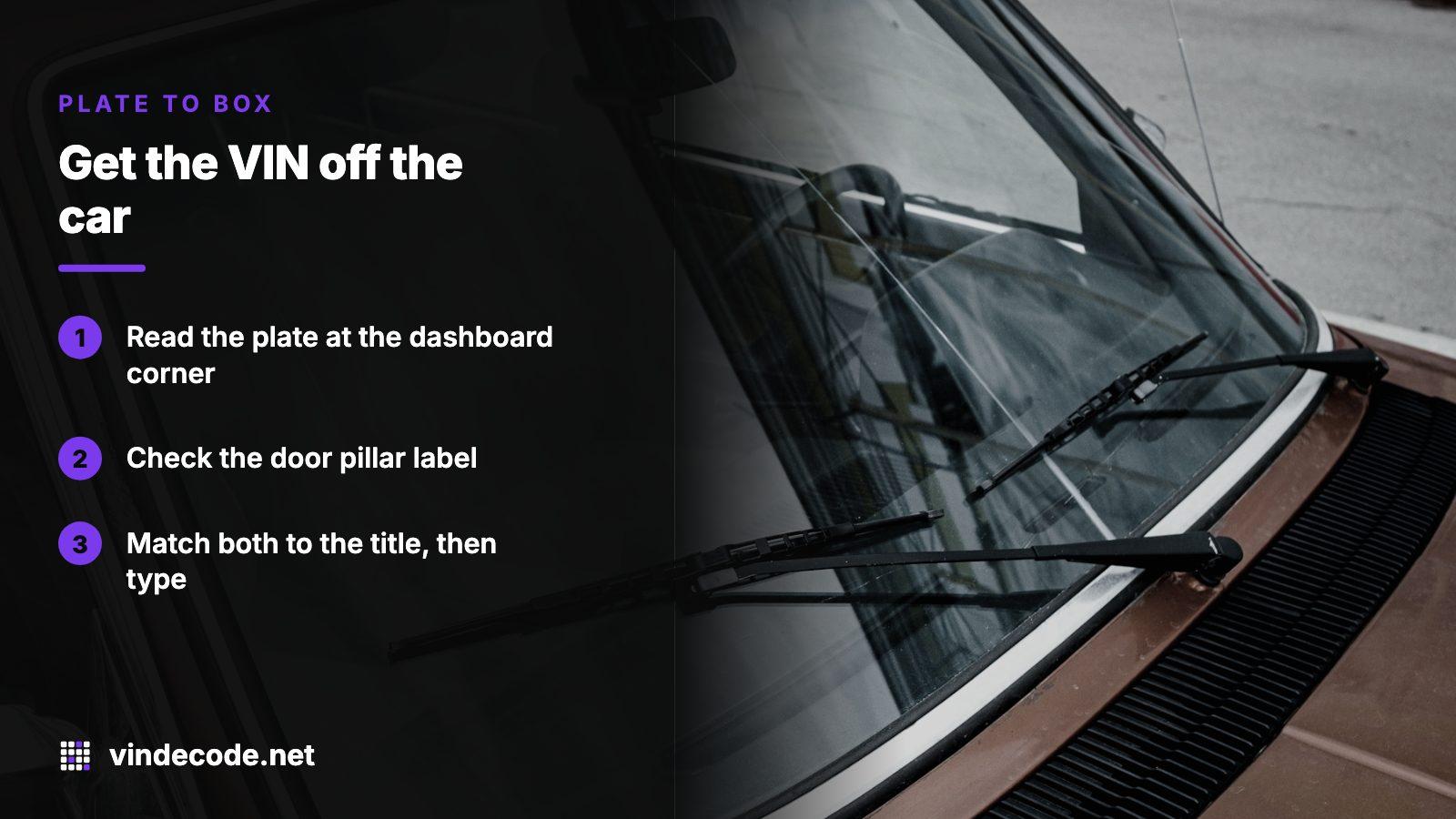
- Stand outside the driver's door and read the plate at the dashboard corner through the glass. Photograph it.
- Check the label on the door pillar, which should agree with the plate.
- Match both to the title, character by character, then type all 17 characters into the decoder.
Older classics with shorter serial numbers fall outside this decoder, and the Mopar page deals with them.
Why the maker line may not say Dodge
Characters 1 to 3 identify the maker and the assembly country, which is the company rather than the brand. NHTSA's current table reads four prefixes found on Dodge-badged vehicles like this:
| Prefix | Assembled in | Maker NHTSA lists | Makes it lists |
|---|---|---|---|
| 1C3 | United States | FCA US LLC | Dodge, Chrysler, Fiat and Lancia |
| 2C3 | Canada | FCA Canada Inc | Dodge, Chrysler, Fiat and Lancia |
| 1B3 | United States | FCA US LLC | Dodge |
| 2B3 | Canada | FCA Canada Inc | Dodge |
A Canadian prefix on a Charger or Challenger is normal
Several rear-drive performance models are built in Canada, and the sample decodes above name Brampton as the plant for a 2016 Challenger and a 2021 Charger. The digit says where the car was assembled, nothing more.
Older tools often print the group as Chrysler for these prefixes, a labelling habit and not a fault. A maker from outside the group would deserve a second look.
Testing an SRT or Hellcat claim before talking price
Wheels, hoods, spoilers and badges are cheap to order, so a base Dodge can be dressed as a Hellcat, while the real car carries a premium of tens of thousands of dollars. The engine the factory fitted cannot be faked with a catalog order.
| The seller says | The decode should show | If it does not |
|---|---|---|
| Hellcat | SRT Hellcat trim and a 6.2 L V8, as in the 2016 sample | A lesser car dressed up |
| Scat Pack | Scat Pack trim and a 6.4 L V8, as in the 2021 sample | Price the engine that came back |
| Engine swapped | An engine unlike the factory's | Ask for paperwork; unrecorded swaps hurt value and insurance |
Then confirm the engine under the hood, since a supercharger is hard to miss. If trim is still unclear, a dealer parts counter can pull the factory build record for the VIN, though neither the decoder nor the history report produces it.
Dodge pickups: a 2011 Ram that decodes as a Dodge
Ram was split off as a separate marque with the 2010 model year, yet NHTSA's decoder kept the pickups where they were. In its records for 2010, 2011 and 2012, each pickup appears as a Dodge with the model name Ram, and those entries stop at 2013. The 11 characters NHTSA published for a 2010 Ram 1500 complaint decode that way: Dodge, Ram, pickup, four-wheel drive, 4.7 L V8, built in Warren, United States.
So decode the year first, then search under the matching brand. A seller who says Dodge trucks ended with 2009 will send you looking in the wrong place, since a 2011 pickup is still filed under Dodge.
A model on a recall list is only a lead
A recall covers a range of VINs, so finding your model on a list proves little about your car. Group campaigns can span several brands where a part is shared, so a headline about one Dodge is a prompt to check yours. NHTSA's lookup takes the exact VIN and costs nothing, and an open recall is fixed by the maker without cost to the owner.
From an NHTSA owner complaint
An owner of a 2008 Avenger told NHTSA that the stalling and the airbag light both appeared on the recall list for the model. On the phone, the owner wrote, the warranty line said the car's VIN "was not listed" although the year, make and model were. A diagnostic charge followed, and the stalling and warning light stayed.
Run the exact number before you buy; the model list will not answer it.
Theft risk on the performance trims
Top-of-range Chargers and Challengers draw thieves more than the average car, since they are valuable, in demand and easy to spot. Price that in before you buy.
From an NHTSA owner complaint
The owner of a 2016 Challenger wrote to NHTSA that the car was stolen in December 2023 and later recovered. The owner was then told that a software update to the radio frequency hub module, which the owner understood stops thieves programming a new key fob, did not apply to this car because it is a manual. Decoded, the partial VIN NHTSA publishes with that complaint reads as an SRT Hellcat.
Whether a fix applies can turn on build details such as trim and transmission, so decode first, then have a dealer check the exact VIN for open campaigns.
- Request an insurance quote using the VIN itself, before you settle on a price.
- Run NICB's VINCheck for theft before money changes hands.
What the decode misses and a history report finds
A Dodge can decode exactly as advertised and still have been stolen, crashed or sold at auction. The decode ties the car to the listing; the report covers what happened next.
| Record | In the decode | In a history report |
|---|---|---|
| Title brands | Not there | Whether the title was ever branded |
| Crash history | Not there | Accident and damage records, plus auction photos |
| Theft | Not there | A theft record, if one was filed |
| Odometer | Not there | Readings over time, so a drop shows |
From an NHTSA owner complaint
The owner of a 2021 Charger told NHTSA that thieves took the car and crashed it, and the insurer would not pay. The theft and crash now appear on the car's history report, the owner wrote. One online buyer declined the car and another offered roughly half the purchase price.
A record like that stays with the VIN and reaches the next buyer, so read the report before you pay a seller.
Cost, and an order that suits a used Dodge
The preview after you enter a VIN is free and asks for no card. You then pay once, for a single report or, if you are comparing cars, a pack of 3, 5 or 10. No subscription starts. Prices are listed on the pricing page.
- Decode the VIN from the car and check each field against the listing.
- On a performance trim, settle engine and trim before any talk of price, then run NHTSA's recall lookup.
- Read the preview, buy the report only if the car still looks right, and have a mechanic you picked inspect it before paying.
Where this information comes from
- NHTSA: vPIC VIN decoder — The federal database behind the model, trim, engine, plant and manufacturer fields, including the prefix table and the Dodge model list by year.
- NHTSA: recalls lookup — Checks one VIN for open recalls, which the manufacturer repairs without charge.
- NICB: VINCheck — A theft lookup by VIN, worth running on any private sale of a performance Dodge.
- NHTSA owner complaint 10744786 — owner experience, paraphrased
- NHTSA owner complaint 11564738 — owner experience, paraphrased
- NHTSA owner complaint 11445578 — owner experience, paraphrased
Sources and photos: Facts checked against the sources above in November 2026. Photos by Willian Cittadin, Max Tokarev and Erik Mclean on Unsplash; diagrams by VINDecode.
Keep reading
- Ram VIN Decoder: Cummins Diesels, Mexican Plants and the Dodge SplitWhere the pickups sit once they leave the Dodge list, decoded under their own brand.
- Chrysler VIN Decoder: Pacifica, Voyager and 300 BuildsThe other badge from the same group, with its own prefixes and models.
- Mopar VIN Decoder: Reading Chrysler, Dodge, Jeep and Ram NumbersFor classic Dodges whose numbers predate the 17-character format.
- Sample reportA finished report, to see what follows the decode.
Frequently asked questions
How do I decode a Dodge VIN?
Enter all 17 characters in the decoder at the top of this page. NHTSA holds the structure Dodge filed, so model year, body, engine, drive wheels, trim where one exists and plant come back in seconds.
Why does my Dodge VIN show a different maker?
Characters 1 to 3 name the manufacturing company, not the brand. Prefixes such as 1C3 and 2C3 resolve to the FCA group, and some older tools still print Chrysler.
Does the VIN prove a Charger is an SRT?
It is the best test available, because trim and engine come from the factory record while badges, wheels and body kits fit any car. Still confirm the engine under the hood.
Where did Dodge trucks go in the decoder?
Ram split off for the 2010 model year, yet NHTSA's records still carry those pickups as Dodge Rams through 2012. From 2013 they sit under Ram, so decode the year first.
Will decoding show if a Dodge was stolen or crashed?
No. A decode reads the build and stops there. Theft, crash damage, title brands and mileage come from a history report.
Now check the car itself
The guide explains what to look for. The report shows what this VIN has on record.