THE SHORT ANSWER
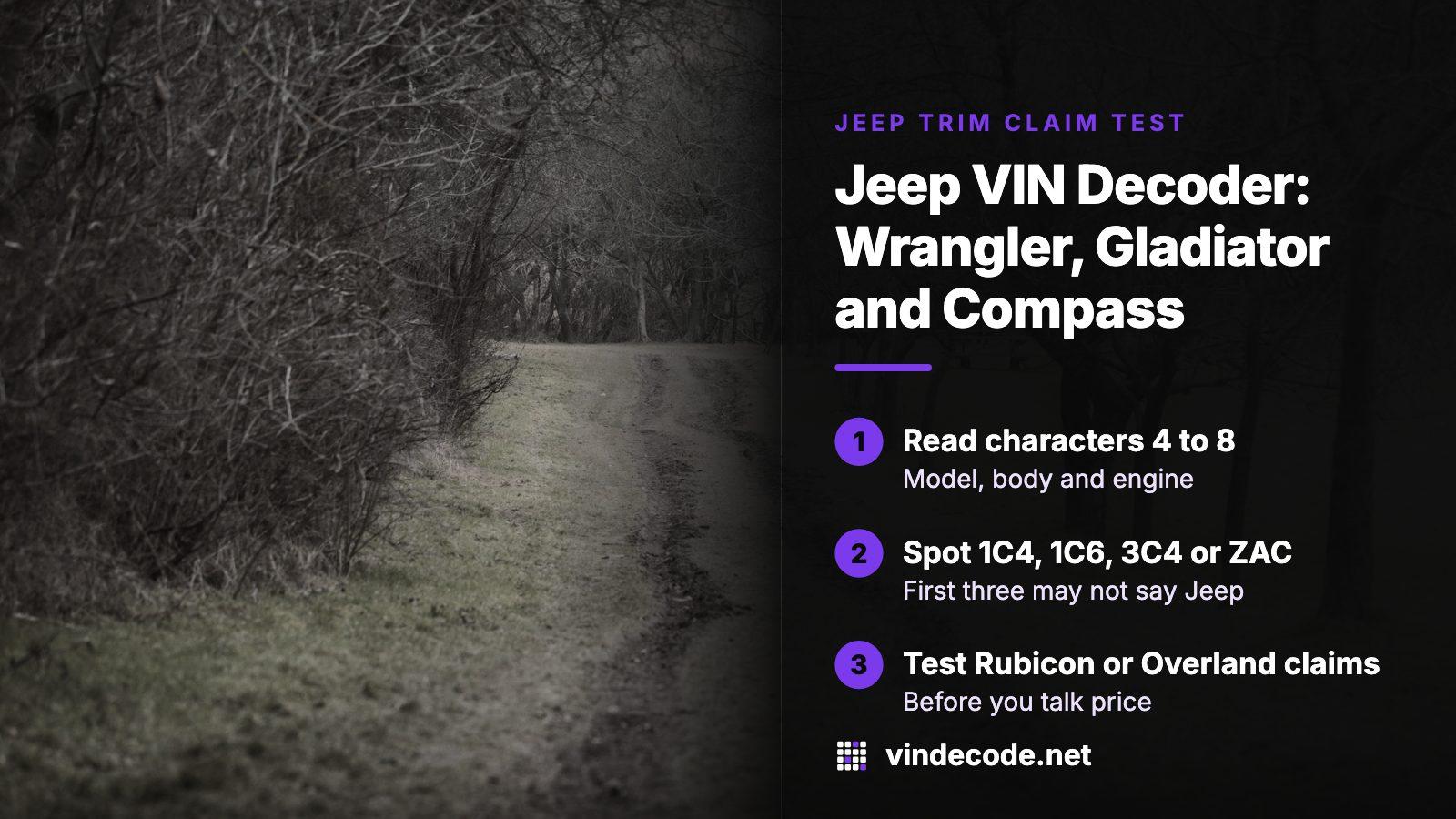
To decode a Jeep VIN, type all 17 characters into the decoder above. Characters 4 to 8 describe model, body and engine, character 10 gives the model year and 11 the plant. Read model, series and year together, because a 2018 Wrangler can be either generation. The decode shows the build alone. Title brands, crashes, mileage and theft need a history report, which begins with a free preview.
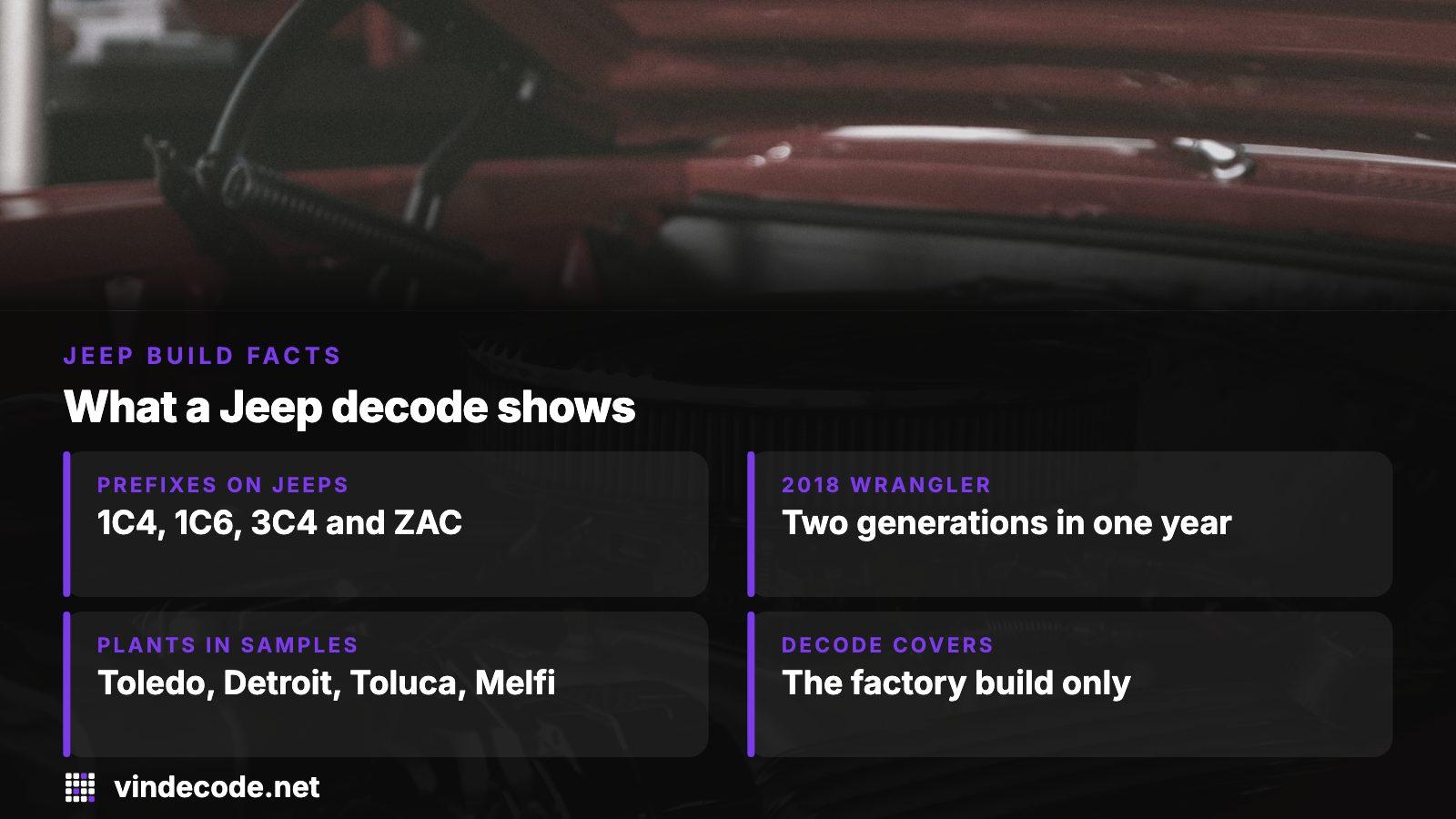
- Prefixes on Jeeps
- 1C4, 1C6, 3C4 and ZAC
- 2018 Wrangler
- Two generations in one model year
- Plants in the samples
- Toledo, Detroit, Toluca and Melfi
- Decode covers
- The factory build, not the Jeep's later life
What the decoder reads back for a Jeep build
The decoder asks for the full number and returns the record Jeep filed with NHTSA: year, model, trim where one is on file, engine, driven wheels and plant. Here are five Jeeps decoded from the leading eight characters of VINs that NHTSA publishes beside owner complaints, with the model year taken from each complaint.
| Jeep | Trim returned | Engine and drive | Plant |
|---|---|---|---|
| 2018 Wrangler | Unlimited Rubicon | 3.6 L, 6 cylinders, 4WD | Toledo, United States |
| 2016 Grand Cherokee | Limited, series WK | 3.6 L, 6 cylinders, 4WD | Detroit, United States |
| 2017 Renegade | Latitude | 2.4 L, 4 cylinders, AWD | Melfi, Italy |
| 2019 Compass | Limited | 2.4 L, 4 cylinders, 4WD | Toluca, Mexico |
| 2020 Gladiator | Overland, pickup body | 3.6 L, 6 cylinders, 4WD | Toledo, United States |
Those were partial numbers, so NHTSA marked each answer incomplete. All 17 characters from your own Jeep give a firmer record; one wrong character returns an error or another vehicle.
Reading the number off the Jeep itself
Copy the number off the Jeep itself, not an advert. Wrangler and Gladiator doors are made to come off, and the pillar label can leave with them, so a Jeep with its doors in the garage has not lost its identity.
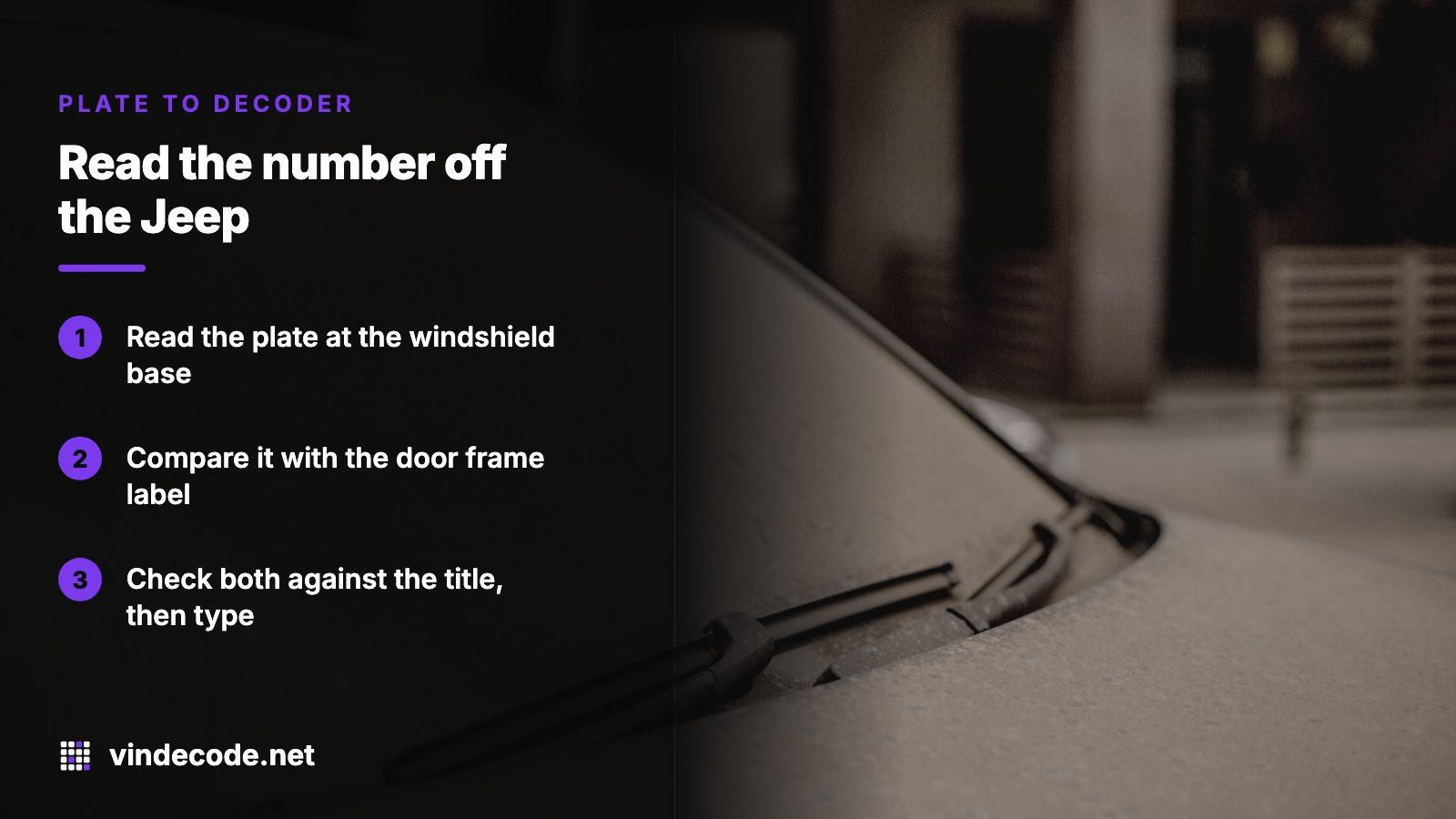
- Look in at the lowest corner of the windshield beside the driver's seat; the VIN plate can be read through the glass.
- Then read the label inside the driver's door frame and make sure the two agree.
- Check both against the title, then type all 17 characters into the decoder.
An older Jeep with a short serial falls outside this decoder; the classic car decoder page covers those.
Why a Jeep's first three characters may not say Jeep
Characters 1 to 3 name the manufacturer and country of assembly: the company, not the brand. NHTSA's maker table shows the pattern on Jeeps.
| Prefix | Maker NHTSA lists | Makes it covers |
|---|---|---|
| 1C4 | FCA US LLC | Dodge, Chrysler, Volkswagen, Jeep, Fiat, Ram and Lancia |
| 1C6 | FCA US LLC | The same seven, as trucks |
| 3C4 | Chrysler de Mexico Toluca | The same seven |
| ZAC | Stellantis Europe SpA | Dodge, Jeep, Fiat and Ram |
A ZAC or 3C4 start is normal on a small Jeep
The Renegade sample above begins ZAC and was assembled in Italy, while the Compass begins 3C4 and came from Mexico. A prefix from an unrelated maker on a Jeep sold here is a reason to press the seller.
The 2018 Wrangler: two generations, two decode labels
Jeep owners sort Wranglers by generation, JK before the redesign and JL after it, and 2018 holds both. Running the same leading characters of a JK-style number through NHTSA's decoder shows the label shifting with the year:
| Number entered | Model year | Model returned | Series and trim |
|---|---|---|---|
| 1C4BJWDG, JK style | 2016 | Wrangler | Series JK, Sport |
| 1C4BJWDG, JK style | 2018 | Wrangler JK | Unlimited Sport |
| 1C4HJXDG, JL style | 2018 | Wrangler | Unlimited Sport |
From an NHTSA owner complaint
A 2018 JL Wrangler owner wrote to NHTSA in April 2026 that Jeep switched from the JK to the JL during that model year, leaving two quite different 2018 Wranglers. Corroded door hinges on that car, the owner said, match a defect Jeep accepted for later JL years, yet it was "unjustly excluded by build date."
Before you order parts or read a recall notice for a 2018, settle which Wrangler you have. The decoded model, series and trim answer it.
Testing a Rubicon or Overland claim before you talk price
Badges, wheels and bumpers are cheap to order, and Jeep buyers pay real money for the trim with the capable hardware. The trim filed for the build is harder to fake than a fender.
| The seller says | The decode should show | If it does not |
|---|---|---|
| Rubicon | Rubicon in the trim field, as in the 2018 sample | A lesser Jeep wearing the badge, so price the trim that came back |
| Overland pickup | Overland and a pickup body, as in the Gladiator sample | Recheck the year and the characters you typed |
| Four-wheel drive | 4WD in the drive field | Look underneath for a front driveshaft and a transfer case control |
| Original engine | The size and cylinders the factory filed | Ask for paperwork; an undisclosed swap can affect cover and resale |
Trim names are marketing labels, and the decode does not list lockers, axle ratios or sway-bar disconnects. A dealer parts counter may be able to pull the factory build record; the decode and the history report do not.
A recall follows the VIN rather than the model name
A campaign covers a range of VINs, often cut by plant and build date, so spotting your model in a news story proves little. NHTSA's recall lookup takes the exact number, and the maker repairs an open recall at no cost to the owner.
Owner complaints show where the cut can fall. Owners of 2018 Wranglers and 2020 Gladiators describe one pattern: a cluster that goes dark, campaign 24V652000 cited, a VIN outside the population.
From an NHTSA owner complaint
In May 2026 a 2018 Wrangler owner told NHTSA that the instrument cluster went black while driving, hiding the speedometer and warning lights. The dealer asked for a new cluster plus a diagnostic fee. The owner found two recalls for that fault, but Jeep's help line called the vehicle ineligible, "because of where it was made."
The decode names your plant, which helps when a notice limits a campaign by build location. Run the number before you buy and again later, since campaigns get added.
Where a Jeep decode stops
A decode states what the Jeep was when it left the plant. Jeeps are modified and driven off pavement more than most vehicles, so the gap to the one in your driveway can be wide.
- Lift kits, larger tires and regearing, which change how it drives and wears and appear on no record.
- Trail damage: bent skid plates, dented rocker panels, damaged control arms.
- Title brands and odometer rollback.
- Insurance claims and the repairs that followed.
- Liens and theft, where NICB's VINCheck is a free screen worth running too.
The first two need your own eyes and a trusted mechanic. The rest are records tied to the VIN, which a history report gathers.
What the history report adds after the decode
Once the build matches the listing, the question becomes what happened to the Jeep. The report reads the same VIN against title, damage and auction records.
| Record | In the decode | In the history report |
|---|---|---|
| Title brands | Not there | Salvage, flood or other brands, where recorded |
| Accidents and damage | Not there | Damage records, plus auction photos where they exist |
| Odometer | Not there | Readings over time, so a drop shows |
| Theft and liens | Not there | Theft records and liens, where filed |
A sample report on this site shows a finished one.
Cost, and an order that suits a used Jeep
No card is needed for the preview after you enter a VIN, and it costs nothing. Payment happens once, whether you want one Jeep report or a pack sized 3, 5 or 10, and nothing bills monthly. Figures sit on the pricing page.
- Decode the VIN from the Jeep and check each field against the advert, settling the generation on any 2018 first.
- Run NHTSA's recall lookup on the same number, and test any Rubicon or Overland claim against the trim returned.
- Read the preview, buy the report only if the Jeep still looks right, and have a mechanic you picked inspect it, underneath included, first.
Where this information comes from
- NHTSA: vPIC VIN decoder — The federal database behind the model, series, trim, engine, plant and maker-prefix fields shown in the samples.
- NHTSA: recalls lookup — Checks one VIN for open recalls, which the manufacturer repairs without charge.
- NICB: VINCheck — A theft lookup by VIN, a sensible extra step on any private-party Jeep.
- NHTSA owner complaint 11730357 — owner experience, paraphrased
- NHTSA owner complaint 11737095 — owner experience, paraphrased
Sources and photos: Facts checked against the sources above in November 2026. Photos by Ahmet Yüksek ✪, JavyGo and Victor Hughes on Unsplash; diagrams by VINDecode.
Keep reading
- NHTSA VIN Decoder: What It Returns, Where It Stops, What Comes NextHow the federal decoder behind these fields works, and where its answers stop.
- Chrysler VIN Decoder: Pacifica, Voyager and 300 BuildsAnother brand from the same group, with its own models and prefixes.
- Ram VIN Decoder: Cummins Diesels, Mexican Plants and the Dodge SplitRam pickups, which share a maker table with Jeep.
- Sample reportA finished report, to see what follows the decode.
Frequently asked questions
How do I decode a Jeep VIN?
Enter all 17 characters in the decoder at the top of this page. NHTSA holds the structure Jeep filed, so year, model, trim where one exists, engine, driven wheels and plant come back in seconds.
Can a VIN tell me whether a Jeep is a Rubicon?
Often, because the decode returns a trim name for many builds, as it did for a 2018 Unlimited Rubicon sample. Trim names are marketing labels, so treat the answer as a strong test and check the hardware yourself.
Why does my Jeep VIN start with ZAC or 3C4?
Those prefixes name the maker and country of assembly. ZAC belongs to Stellantis Europe, and the Renegade sample came from Melfi, Italy. 3C4 belongs to Chrysler de Mexico Toluca, and the Compass sample came from Toluca. Both are normal on Jeeps built abroad.
Which generation is a 2018 Wrangler?
It can be either. Jeep moved from the JK to the JL partway through that model year, so read model, series and trim from the decode and compare the number with the plate on the Jeep before buying parts.
Will a Jeep decode reveal crashes or branded titles?
No. A decode reads the factory build and stops there. Crashes, title brands, odometer readings, theft and liens are records that attach to the VIN afterward, and a history report gathers them.
Now check the car itself
The guide explains what to look for. The report shows what this VIN has on record.