
THE SHORT ANSWER
To decode a Corvette VIN, type all 17 characters into the box above. You get the year, trim, body style, engine and plant, and on the patterns tested the plant read Bowling Green, Kentucky. Corvettes built before the 1981 model year carry shorter numbers that no federal decoder reads, and there is no 1983 model year to decode at all. Whatever happened after the factory, such as salvage or odometer history, belongs to a history report.
- Readable length
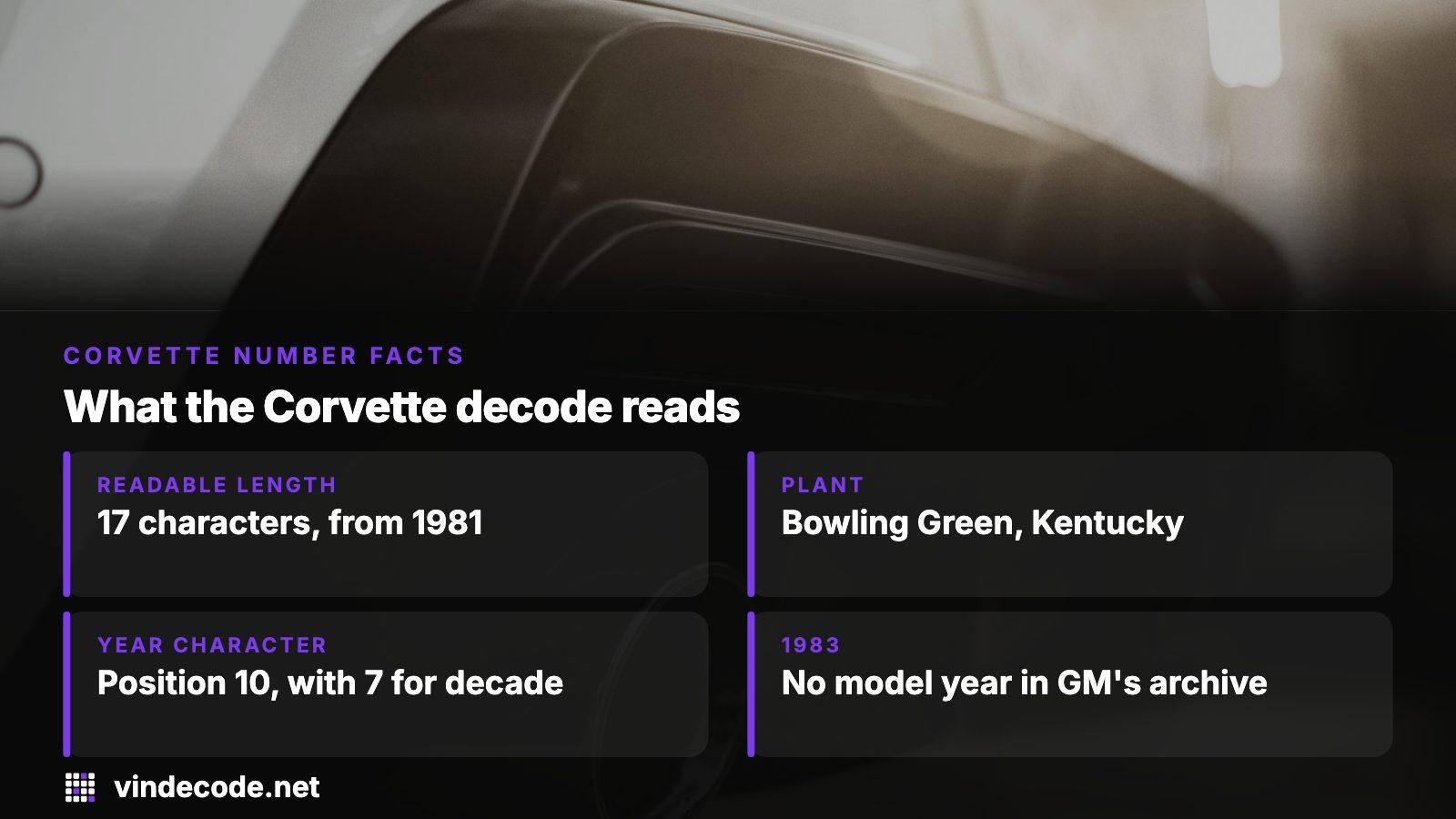
- 17 characters, from the 1981 model year
- Plant
- Bowling Green, Kentucky, wherever the decode returned one
- Year character
- Position 10, with position 7 settling the decade
- 1983
- No Corvette model year; GM's archive skips from 1982 to 1984
What the Corvette decoder returns
The tool reads the filing GM made with NHTSA for your number. On a late Corvette that goes past year and make, because GM filed the trim level too. To see how it reads, number patterns with the check digit left open went through NHTSA's own decoder.
| Pattern tested | Year | Trim as filed |
|---|---|---|
| 1G1YM2D7*F5 | 2015 | Stingray 3LT w/Z51 |
| 1G1YS2D6*G5 | 2016 | Preferred 2LZ w/Z06 |
| 1G1Y62D4*L5 | 2020 | Standard 1LT |
| 1G1Y72D4*L5 | 2020 | Preferred 2LT |
| 1G1Y82D4*L5 | 2020 | Premium 3LT |
Each came back as a Corvette coupe with eight cylinders and 6.2 liters, built in Bowling Green, Kentucky. The three 2020 patterns differ only in the fifth character, which is where the trim level shows. Drive type read rear-wheel on the 2020 patterns and blank on the older two; a blank means NHTSA holds no entry, not that the feature is missing.
Which Corvettes the decoder can read
A federal rule fixes the layout at seventeen characters, and from the 1981 model year a Corvette wears the same format as any other car. Before that, GM set its own numbers.
| Corvette years | Number on the car | Decoder |
|---|---|---|
| 1953 to 1962 | Short serial plates; the 1953 run was only 300 cars | Cannot read |
| 1963 to 1980 | 13 characters in GM's own scheme | Cannot read |
| 1981 onward | 17 characters with a check digit | Year, trim, engine, plant |
A 13-character number put through NHTSA's decoder returned no make, model or year, only errors about an unregistered maker and invalid characters. That is the tool's limit, not a verdict on the car.
A modern Corvette number, position by position
Every Corvette pattern tested opened with 1G1, and each one that returned data named the same assembly plant. Positions 4 to 8 follow GM's own coding.
| Positions | What they carry |
|---|---|
| 1 to 3 | Maker and country of origin |
| 4 to 8 | Model, body, engine and trim; on 2020 cars the fifth character separates 1LT, 2LT and 3LT |
| 9 | Check digit, which catches a mistyped number |
| 10 | Model year, as a letter or a digit |
| 11 | Assembly plant |
| 12 to 17 | The car's own serial number |
Year letters repeat on a long cycle, so E marks both 1984 and 2014. Position 7 settles it: a digit points to 1980 through 2009 and a letter to 2010 or later. The 1984 pattern tested held a 7 there and returned 1984, while the 2014 pattern held a D and returned 2014. A seller who quotes only the letter has not told you the year.
Older cars and the missing 1983 model year
For a Corvette from 1953 through 1980, the plate identifies the car but no public decoder explains it. GM's heritage archive offers downloadable vehicle information kits for the Corvette, and that factory paper is the better first stop for an older car.
- 1983 has no entry. The archive lists Corvettes for 1982 and then 1984, and a pattern carrying the 1983 year letter returned no Corvette model from NHTSA.
- The usual account is that Chevrolet skipped the 1983 model year and titled cars built in that period as 1984 models, so an advert for a 1983 Corvette deserves a direct question.
- Collectors also read the partial VIN on the engine pad and the casting dates on major parts, which no decoder sees.
Recalls follow the build window, not the badge
NHTSA's VIN search answers for one car, listing an unrepaired recall or reporting that none is open. A Corvette recall can reach only the cars made in a narrow stretch, and one 2015 suspension recall covered 43 cars built within about a week.
From an NHTSA owner complaint
An owner of a 2015 Corvette told NHTSA in August 2018 that the driver-side rear suspension dropped onto the road at about 40 mph during a Colorado trip. The owner knew of a recall for that very fault, but the car, built in August 2014, was "not included." Extra sway in corners had been put down to a software upgrade days earlier, and the owner says a dealer visit would have followed had that been known to be wrong.
Take from it that a recall headline is a reason to run your own number, never proof of coverage. The build date mattered as much as the badge.
What the recall lookup leaves out
NHTSA's page names what a VIN search skips: repaired recalls, recalls over 15 years old except where the maker adds coverage, and manufacturer campaigns that are not safety recalls. That last gap is where a used Corvette buyer can be caught.
From an NHTSA owner complaint
An owner of a 2014 Corvette told NHTSA in November 2025 that a fuel pump flange had cracked and leaked. GM had run special coverage program 17469 for that fault, but its warranty extension had lapsed. The owner bought the car used from a non-GM dealer in 2018 and says no notices ever arrived. The repair came to $5,300, and GM declined to pay. A passenger remarking on a gasoline smell sent the owner to the dealer.
Ask the seller, and a Chevrolet dealer, whether any coverage program applies to that VIN. A history report counts open recalls, as the lookup does, so a coverage extension is a separate question.
What a history report adds for a Corvette
A decode describes the car as built. Everything after that sits in other records, and each claim in an advert maps onto one of them.
| The advert says | The record that can confirm it |
|---|---|
| Low miles | Odometer readings over time |
| Clean title | Any brand the title has carried, salvage and flood included |
| Never hit | Damage and accident entries, with photos from any salvage auction |
| Paid off | Liens and impounds |
| Never stolen | Theft records |
| No recalls | The count of open recalls |
Two checks from others cost nothing and run first: NHTSA's recall search, and NICB's VINCheck, which screens for theft and for salvage or flood reports from participating insurers. NICB itself says it is not a complete history, so a clean result leaves most of the table unanswered.
Cost, and a sensible order of work
The preview comes first and costs nothing. It names the car's year, make, model and trim, then counts any open recalls and title or auction records on file. The report itself is bought separately, once, with nothing renewing afterward: pick one report, or take 3, 5 or 10 at once. Prices sit on the pricing page.
- Read the VIN off the car itself, photograph it, and set it beside the title and the advert.
- Decode it above and set the year, trim and engine against the listing.
- Run NHTSA's recall search on the full number, then NICB's VINCheck.
- Open the preview, then buy the report if the build adds up.
- Pay a Corvette specialist you choose to inspect the car, and ask for factory paperwork on anything pre-1981.
A history report is built around standard 17-character numbers, so a pre-1981 Corvette leans on its plate, its paperwork and an inspection instead.

Where this information comes from
- NHTSA: vPIC VIN decoder — The federal database behind the year, trim, engine and plant fields, and where the pattern tests were run.
- NHTSA: recalls lookup — Checks one VIN for unrepaired recalls and lists what that search does not show.
- eCFR: 49 CFR Part 565, VIN requirements — The federal rule for the 17-character layout, the check digit, the year codes and the plant position.
- GM Heritage Archive: vehicle information kits — Factory kits listed by year and model, with Corvettes for 1982 and 1984 but none for 1983.
- NICB: VINCheck — A theft and salvage screen from participating insurers that NICB says is not a full history.
- NHTSA owner complaint 11119281 — owner experience, paraphrased
- NHTSA owner complaint 11699673 — owner experience, paraphrased
Sources and photos: Facts checked against the sources above in November 2026. Photos by Johnathan Kaufman, Owen Michael Grech and Farhan Abid on Unsplash; diagrams by VINDecode.
Keep reading
- Chevrolet VIN Decoder: Decode a Chevy, Then Check Its HistoryThe brand-wide layout: prefixes, year character and plant for every Chevrolet.
- Classic Car VIN Decoder: Which Years It Reads and What Comes AfterHow the tool treats short pre-1981 numbers and what to read in their place.
- Sample reportA finished report, to see what the history adds once the decode is done.
- PricingHow the preview and the one-time report prices work, with the pack sizes.
Frequently asked questions
How do I decode a Corvette VIN?
Type all 17 characters into the decoder above. The check digit in position 9 rejects most typing slips, so a failed number usually has a misread character. Count first: 13 characters means a car from before 1981, which the tool cannot read. Then run a history report on the same number.
Does a Corvette VIN show a Z06 or Z51 package?
On newer cars it can. In NHTSA's records the 2015 and 2016 patterns tested carried those packages in the trim text, as in Stingray 3LT w/Z51 and Preferred 2LZ w/Z06. A blank trim field means NHTSA has no entry, so confirm any package against the paperwork.
Where is the VIN on a Corvette?
A modern Corvette prints its number at the driver's end of the windshield base, and NHTSA adds that the registration card repeats it. Midyear cars used a plate on the instrument brace or hinge pillar, and chrome-bumper cars moved it to the windshield pillar.
Is there a 1983 Corvette?
Not as a production model year. GM's heritage archive lists kits for 1982 and 1984 but none for 1983, and NHTSA's decoder returned no Corvette model for the 1983 year letter. The usual account is that cars built then were titled as 1984 models, with one prototype at the National Corvette Museum.
Can a history report confirm a matching-numbers Corvette?
No. Matching numbers means the partial VIN on the engine and the casting dates on major parts agree with the car's build, which only an inspector or documents can show. A report searches records tied to the VIN, such as salvage brands, odometer history, theft reports and open recalls. A specialist judges originality.
Now check the car itself
The guide explains what to look for. The report shows what this VIN has on record.