THE SHORT ANSWER
To decode a Cadillac VIN, type all 17 characters into the box on this page. You get back the engine, drivetrain, body class, year, restraints, plant and any open recall. The first three characters name the division and vehicle type: 1G6 is a US-built car, 1GY a multipurpose vehicle, 3GY the Mexican-built one. Title brands, accidents and mileage come from a history report on the same number.
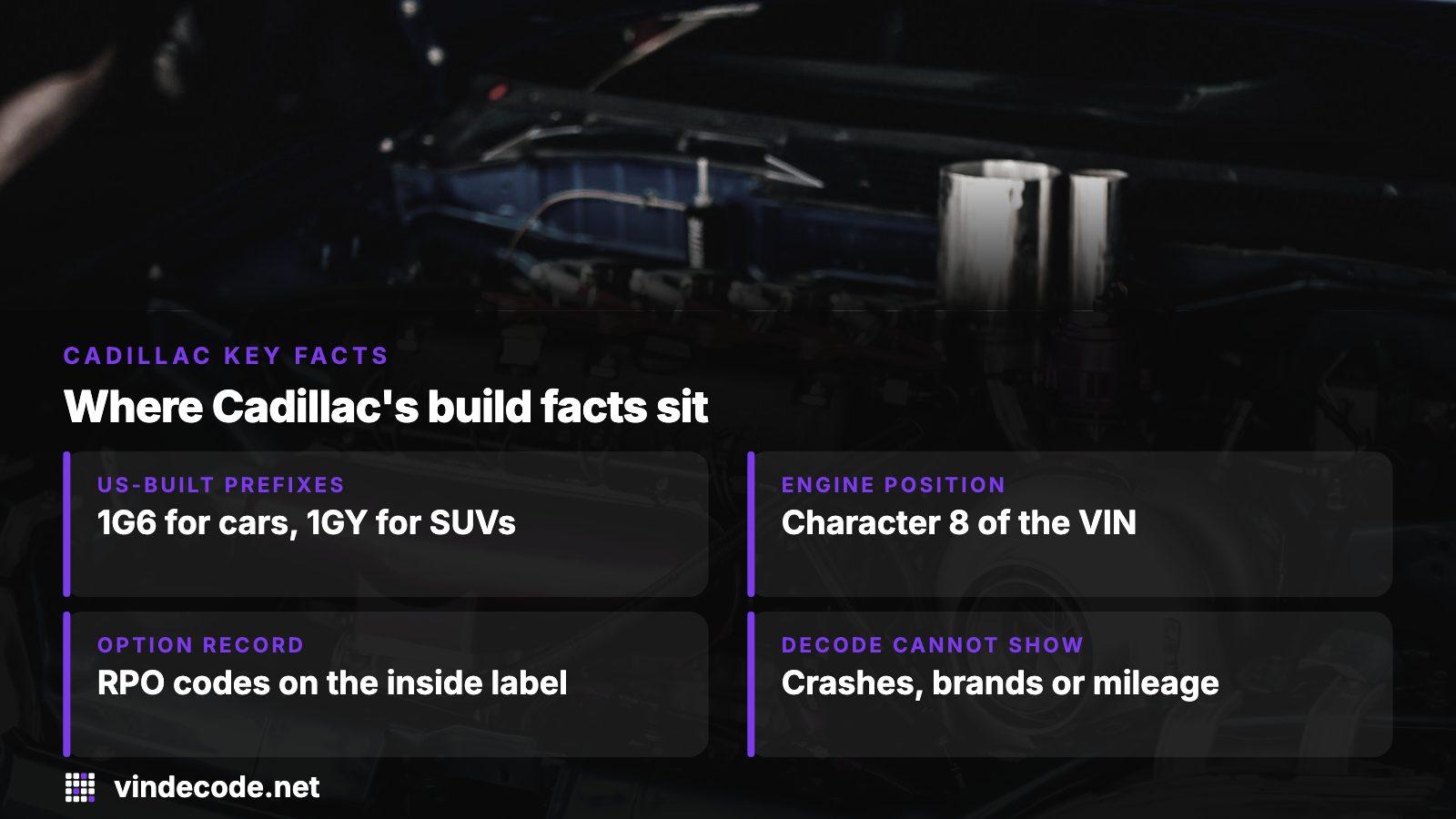
- US-built prefixes
- 1G6 for cars, 1GY for SUV models
- Engine position
- Character 8 of the VIN
- Option record
- RPO codes on the label inside the car
- A decode cannot show
- Crashes, title brands or mileage
What the decoder reads off a Cadillac VIN
The decoder works from the structure General Motors filed with NHTSA, so it describes the car as the factory specified it. That is a firm outline, not a dealer's option list. You learn the powertrain and the plant, then hold them up against the advert.
| Decoded field | What it settles |
|---|---|
| Model year, model and body class | Whether the car is the generation the seller names |
| Engine size, cylinders and fuel | Which powertrain to research before a drive |
| Rear-wheel or all-wheel drive | The layout the factory fitted |
| Restraint system | Airbags and belts as built |
| Country and plant | Where the car was assembled |
| Open safety recalls | Campaigns still unrepaired on that exact VIN |
Find the number on the car, not in the listing
A listing can carry a typo, and one wrong character returns an error or a different vehicle. Take the number from the car itself.
- Find the plate where the dashboard meets the windshield on the driver's side.
- Check the sticker on the door jamb, which repeats the number.
- Match each one against the title or registration, a character at a time.
- Type all 17 characters into the decoder and run it.
If the two locations differ by even one character, stop until the seller explains why. A mismatch is a warning sign, and nothing the decoder returns is worth much until it is resolved.
1G6, 1GY, 3GY and LRB: what the first three characters say
These three characters are the world manufacturer identifier. The first shows the country, the second General Motors, and on a Cadillac the third records the division. NHTSA's vPIC lists each code below under that division.
| Starts with | Federal listing | Plain reading |
|---|---|---|
| 1G6 | Cadillac, passenger car | Passenger Cadillac, US plant |
| 1GY | Cadillac, multipurpose vehicle | SUV models, US plant |
| 3GY | Cadillac, multipurpose vehicle | Multipurpose Cadillac, Mexican plant |
| LRB | Buick and Cadillac, multipurpose vehicle | Shanghai General Motors, shared by two makes |
A division code cannot be swapped like a badge
Trim badges come off with a screwdriver. The division character does not. If the trunk lid says Cadillac while the VIN opens with another division's code, the car was rebadged at some point, and the seller should be able to say how and when.
V-Series or V-Sport: the engine line settles it
V-Series is Cadillac's full performance variant, engineered with a powertrain, chassis and brakes of its own. V-Sport is a lighter package that sits between a standard model and a V-Series. The names are close enough that listings blur them, and the gap in what they sell for is wide.
BMW draws the same line between M and M Sport. The decoder gives you the engine the factory installed, which answers the question before money comes up.
- Read the engine line of the decode before you discuss price.
- Photograph the option label and find the performance equipment codes on it.
- Compare the brake hardware with what a genuine V-Series carries, since it differs between the tiers.
- Offer money for the engine the factory fitted, whatever the trunk lid says.
Super Cruise: hardware and a subscription
Super Cruise is Cadillac's hands-free driving system for highways, and sellers misdescribe it more than any other feature, usually without meaning to. It needs two separate things: hardware fitted when the car was built, which was optional on many models, and an active connected-services subscription.
| Situation | Result |
|---|---|
| Equipment fitted, subscription active | Working. Verify it on a supported road when you test drive. |
| Equipment fitted, subscription lapsed | Dormant. Switching it back on means a recurring cost that becomes yours. |
| No hardware | It cannot be added, so a seller who calls the car capable is mistaken. |
Make the seller show you
A VIN cannot tell you whether a subscription is active. Ask to try the system on the test drive, and if it cannot be demonstrated, price the car as though the feature is absent.
The option label inside the car
Cadillac uses General Motors' Regular Production Option system, the same one behind Chevrolet, GMC and Buick. Look for the Service Parts Identification label. It is normally in the glove box, though some cars keep it in the trunk or the console, and it lists every factory option as a three-character RPO code.
The label also carries the paint code and axle ratio, plus the equipment packages, including performance and driver-assistance content, which is where much of a used Cadillac's value sits. A photo of it from the seller settles an equipment claim faster than a week of messages. The Chevrolet decoder page explains RPO codes in full, and all of it applies here.
What the history report adds after the decode
A VIN describes the car on the day it left the plant. Later events sit in other records, which a decode cannot surface. The history report pulls them together under that same number:
- Title brands, plus accident and damage records
- Odometer readings over time
- Theft and insurance records
- Liens and impounds
- Auction and salvage appearances, with photos
- Ownership and use type
- Open recalls, market value and factory specs
On a Cadillac the two halves answer different questions. The decode may confirm a V-Series powertrain, and the report then shows whether that expensive car carries a brand on its title or an odd jump in its mileage. One tells you what it is, the other what it has been through.
What it costs, and the order to run the checks
Entering a VIN brings up the preview, which is free and needs no card. The full report is a single payment. A single Cadillac report works for one car, while bundles of 3, 5 or 10 fit a buyer comparing several. No subscription follows. See the pricing page for the figures.
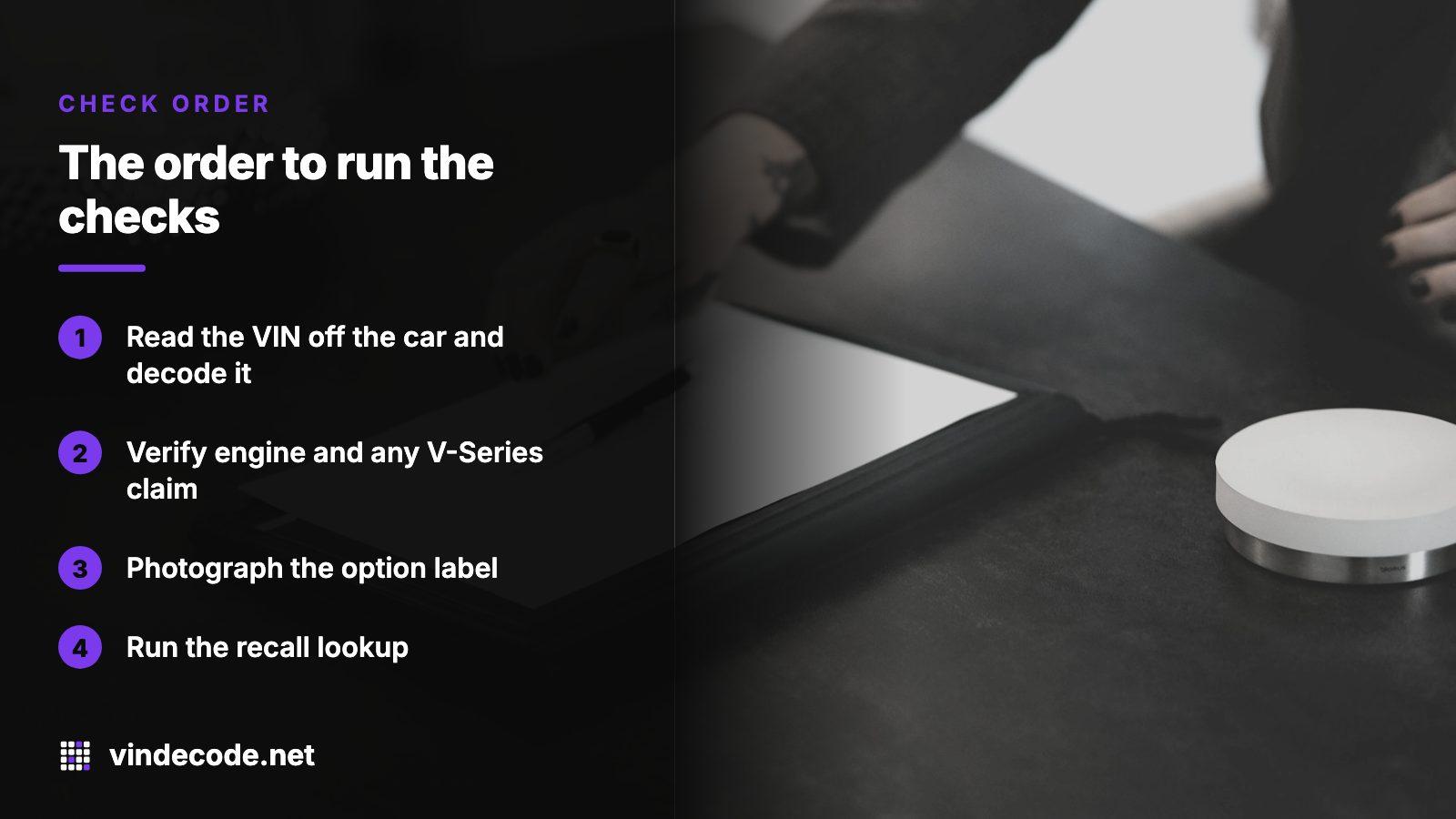
- Read the VIN off the car and decode it.
- Compare engine, year and prefix with the listing, and verify any V-Series claim.
- Photograph the option label and try Super Cruise on the test drive.
- Run NHTSA's recall lookup.
- Open the history preview, then buy the report if the build adds up.
- Hire an independent mechanic of your own choosing to go over the car before you hand over payment.
Where this information comes from
- NHTSA: vPIC VIN decoder — The federal database behind the model, engine and plant fields, where each Cadillac prefix can be looked up.
- NHTSA: recalls lookup — Checks a single VIN for open recalls, which the manufacturer repairs at no cost to the owner.
- EPA: fueleconomy.gov — Official economy figures by engine and drivetrain, useful once the decode names the powertrain.
Sources and photos: Facts checked against the sources above in November 2026. Photos by Tigran Shishmanyan, Annika Wischnewsky and Willian Cittadin on Unsplash; diagrams by VINDecode.
Keep reading
- Chevrolet VIN Decoder: Decode a Chevy, Then Check Its HistoryThe full explanation of RPO option codes, which work the same way on a Cadillac.
- GM VIN Decoder: Decode Any GM VIN, Then Check Its HistoryThe prefix map across every General Motors division.
- Buick VIN Decoder: Read the Build, Then Check the HistoryThe other badge the shared LRB prefix can return.
- Sample reportA finished report, to see what the history adds after the decode.
Frequently asked questions
How do I decode a Cadillac VIN?
Enter all 17 characters into the decoder on this page. GM registered its Cadillac VIN layout with NHTSA's public vPIC database, so the result covers engine, drivetrain, body class, year and plant. Take the number from the car's own plate or door sticker, not from a listing.
Why does my Cadillac VIN start with 1GY and not 1G6?
The code also records vehicle type. Under NHTSA's listing, 1G6 is a Cadillac car and 1GY a Cadillac multipurpose vehicle, which covers the SUV models. Both are General Motors and both are US-built, so neither one means the car is anything other than a Cadillac.
Can the decode prove a Cadillac is a real V-Series?
It returns the engine the factory installed, and V-Series cars carry their own powertrain, so the engine line is strong evidence. Pair it with the option label in the glove box. Badges can be added to any trunk lid, but the factory option codes cannot be faked by a sticker.
Is Super Cruise still active on a used Cadillac?
Only when two conditions hold: the hardware was fitted at build, and the connected-services subscription is active. Equipment alone leaves the system dormant. Ask to see it work on a supported road during the test drive, and treat anything the seller cannot demonstrate as missing.
Will a Cadillac VIN decode show accidents or mileage?
No. A decode describes how the car was built. Crash records, brands, mileage, liens and theft reports live in separate databases, and the history report gathers them under the same VIN. Decode first to confirm the car matches the advert, then open the preview.
Now check the car itself
The guide explains what to look for. The report shows what this VIN has on record.