THE SHORT ANSWER
Type all 17 characters of the Buick's VIN into the box on this page. Back come the factory's model year, body style, engine, drivetrain, safety restraints and assembly plant, plus any recall still open. The first three characters carry the country: 1G4 and 5GA mean the United States, 2G4 Canada, 3G4 Mexico, KL4 South Korea, LRB China, W04 Germany. Accidents, brands and mileage need a history report.
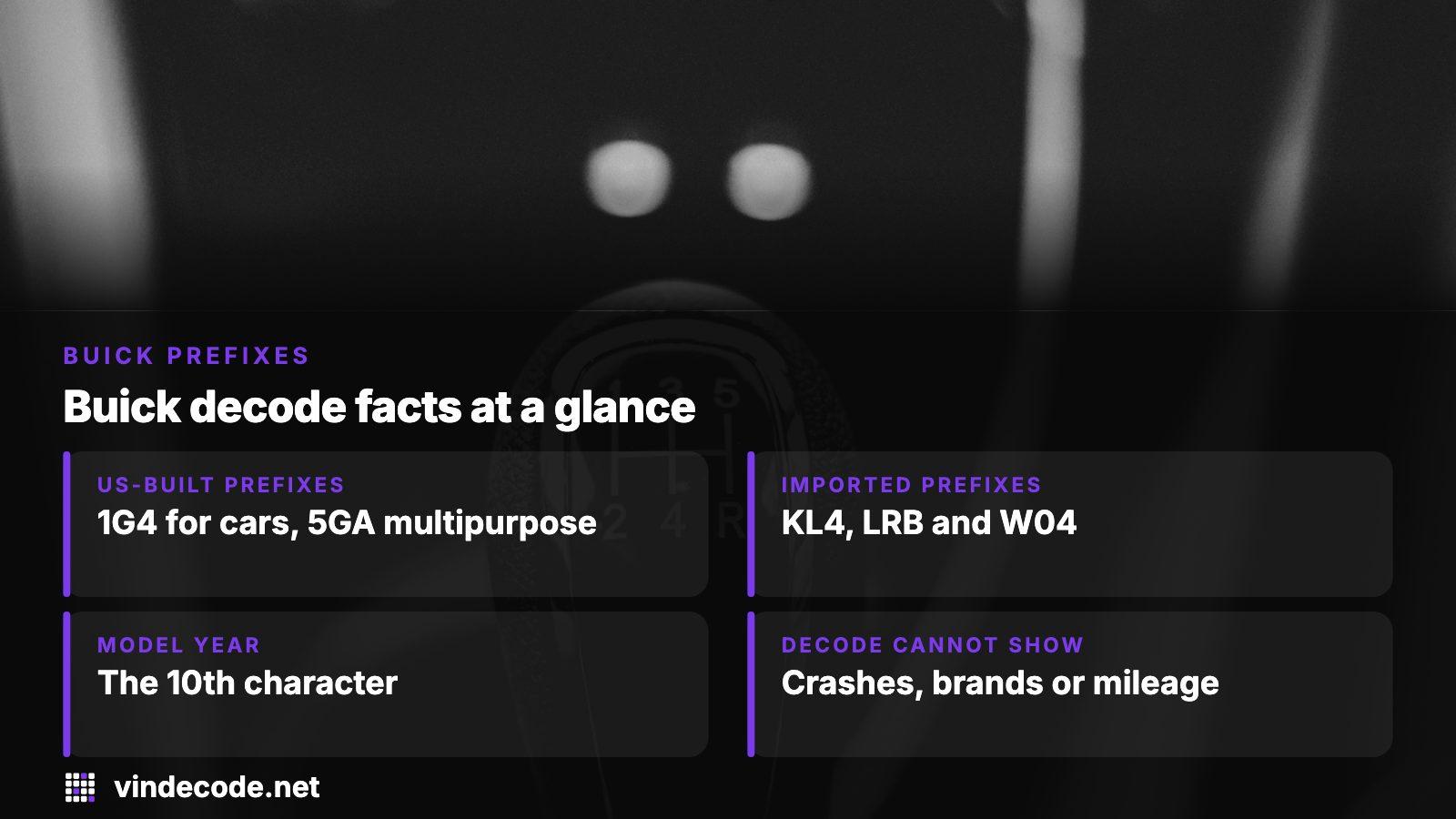
- US-built prefixes
- 1G4 for cars, 5GA for multipurpose vehicles
- Imported prefixes
- KL4, LRB and W04
- Model year
- The 10th character
- A decode cannot show
- Crashes, title brands or mileage
What you get back when you decode a Buick
The answer comes from the layout General Motors registered with NHTSA, so it reflects the car as built, not as advertised. Characters four through eight use shorthand that General Motors chose itself, which means you receive a firm outline of the car and not a dealer's equipment list.
| Field | What it settles |
|---|---|
| Model year and body style | Whether the car is the generation the advert names |
| Engine and drivetrain | Which powertrain to read up on before a drive |
| Restraints | Airbags and belts as fitted at the factory |
| Plant and country | Where it was assembled |
| Open recalls | Safety campaigns still unrepaired on that VIN |
Find the VIN and read it twice before typing
One wrong character gives an error or a different car, so never copy the number from an advert.
- Look through the windshield at the plate on the driver's side.
- Check the label on the frame of the driver's door. It repeats the VIN and gives the build month.
- Match both to the title or registration.
- Enter all 17 characters in the box and run the decode.
If the plate and the door label disagree on a single character, walk away until someone explains it. That mismatch is a classic mark of a cloned or rebuilt identity, and no decode result means much until it is resolved.

Seven Buick prefixes, six countries
Run each Buick identifier through NHTSA's vPIC and all seven come back as General Motors. They differ in vehicle type and, by the leading character, in country. Only two of the seven are US codes, which surprises anyone who thinks of Buick as a domestic badge.
| Country | Prefix | Federal vehicle type |
|---|---|---|
| Canada | 2G4 | Passenger car |
| China | LRB | Multipurpose passenger vehicle |
| Germany | W04 | Passenger car |
| Mexico | 3G4 | Passenger car |
| South Korea | KL4 | Multipurpose passenger vehicle |
| United States | 1G4 | Passenger car |
| United States | 5GA | Multipurpose passenger vehicle |
LRB needs a second look. The federal database lists its make as Buick and Cadillac together, so those three characters cannot name the badge alone. The descriptor characters after them finish the job.
Why the United States has two Buick codes
Under the federal rule, the opening three characters identify who built the vehicle and what kind of vehicle it is. Cars and multipurpose vehicles count as different kinds, and one General Motors identifier cannot stand for both. The US therefore gets 1G4 for cars and 5GA for the multipurpose class.
A filing category, not a size
A crossover built on a sedan's platform may be filed as a multipurpose vehicle while the sedan stays a car. Two Buicks that drive much alike can open with different prefixes.
The country letter is convention, not regulation. Part 565 speaks of manufacturer and type, and NHTSA has SAE International coordinate who receives identifiers. On a Buick, a leading K, L or W still reads as South Korea, China or Germany.
The remaining fourteen characters, position by position
| Positions | Content |
|---|---|
| 4 to 8 | Descriptor characters chosen by General Motors |
| 9 | Check digit, a calculation on the rest of the number |
| 10 | Model year, as a letter or digit |
| 11 | Assembly plant |
| 12 to 17 | Production sequence at that plant |
The year character cycles every 30 years, and I, O, Q, U and Z are skipped. On a recent Buick, P is 2023, R is 2024, S is 2025 and T is 2026, while A is 2010. Because a letter recurs across decades, read it next to the prefix and the body style.
Model year is not build date
Production of a model year starts early, so a Buick with R in position ten may have been assembled before 2024 began. The door label shows the true month.
Position eleven and the recall question
Recalls attach to ranges of VINs, so asking whether a model was recalled misses the point. Ask whether this car has one open. NHTSA's lookup checks a single VIN at no cost, and the manufacturer repairs a safety defect free of charge for whoever owns the car.
Plenty of campaigns cover one plant over a span of build dates, because that is where a faulty batch of parts entered production. Two Buicks from the same year and trim level can stand together on a lot with only one inside the campaign. The plant character and the date on the door label decide it.
Plant letters have been reassigned as sites were built, shut down and given new models, so a decode, which weighs the character against model year and vehicle line, beats a fixed table. Learning that a recall does not apply is as valuable as learning that it does, since you skip an inspection you do not need.
What the assembly country changes, and what it leaves alone
Do not read too much into the first letter. It says where the car was put together, and the rest depends:
- Warranty terms follow the car as sold in this market, not the plant.
- Recall duties are identical whichever country assembled it.
- Parts supply can differ on older cars, especially European-built ones such as a W04 sedan.
- Recall scope can hinge on the plant, so origin decides whether a campaign applies.
- Model year, upkeep and use predict durability far better than the leading character.
- Resale value tracks model, mileage and condition.
An imported Buick is not a worse Buick. The aim is to know what you are buying before you order parts for the wrong car. A seller who calls a Korean-built crossover American-made is seldom lying, since few people check, but it hints at how much else needs verifying.
Where the decode stops and the history report starts
A VIN describes the car at the factory gate. Everything later lives in other records, and decoding will never surface them. A vehicle history report gathers them by the same number:
- Title brands and the accident and damage record
- Odometer readings over time, where a rollback would stand out
- Salvage and auction appearances, with photos
- Liens, impounds, theft and insurance claims
- Ownership and use type
- Market value, the factory spec sheet and open recalls
What it costs, and a sensible order for a used Buick
The preview that appears after you enter the VIN costs nothing and needs no card. Buying the full report is a single payment, with a bundle of 3, 5 or 10 on offer beside a lone report, and nothing renews afterward. Prices are on the pricing page.
- Decode the VIN you read off the car itself.
- Compare year, engine and prefix with the advert.
- Run NHTSA's recall lookup and note the plant and build month.
- Open the preview, then buy the report if the build adds up.
- Pay a mechanic of your own choosing to inspect it before handing over money.
A pack makes sense when you are comparing several Buicks.
Where this information comes from
- NHTSA: vPIC VIN decoder — The federal database behind the model, engine and plant fields, and the place each Buick prefix can be looked up.
- eCFR: 49 CFR Part 565 — The VIN rule that fixes the sections of the number and the check digit, and defines manufacturer and vehicle type.
- NHTSA: recalls lookup — Where to check a VIN for open recalls, repaired at no cost by the manufacturer.
- NICB: VINCheck — A no-charge theft and salvage lookup fed by participating insurers.
Sources and photos: Facts checked against the sources above in November 2026. Photos by Erik Andersson, Thibault Valjevac and Alok Sharma on Unsplash; diagrams by VINDecode.
Keep reading
- GM VIN Decoder: Decode Any GM VIN, Then Check Its HistoryThe prefix map across every General Motors division, not just Buick.
- Cadillac VIN Decoder: Confirm the Build, Then Check the HistoryThe other badge the LRB prefix can return.
- VIN Decoder: Decode a VIN Number Online, Then Check Its HistoryAll 17 positions explained, including the check digit and the year character.
- Sample reportA finished report, to see what the history adds after the decode.
Frequently asked questions
What does the start of a Buick VIN tell me?
The opening three characters name General Motors as the maker and give the vehicle type, and on a Buick they also show the country. The US uses 1G4 and 5GA, Canada 2G4, Mexico 3G4, South Korea KL4, China LRB and Germany W04. All seven decode to General Motors.
Why is the first character of my Buick VIN a letter?
The car was assembled outside North America. A K is South Korea, an L is China and a W is Germany. That does not make it any less of a Buick than a car starting 1G4, because the character records the place of assembly. Check the model details in the rest of the decode.
Does a Chinese-built Buick carry a different warranty?
No. Coverage depends on how the car was sold here, so a new Buick from a US dealer gets the same terms whichever country built it. Recall duties match too. The plant matters mainly for parts on older cars and for which build dates a given recall takes in.
Will the decoder work on a Buick from before 1981?
Usually not. The 17-character format only became mandatory with the 1981 model year, and older Buicks used shorter numbers set by General Motors. Public databases, NHTSA's included, generally leave them out. For a classic, rely on marque documentation and the cowl tag instead.
Will a Buick VIN decode show accidents or mileage?
No. A decode describes how the car was built. Crashes, brands on the title, odometer history, liens and thefts are kept in separate databases, and a history report gathers them under the same VIN. Run the decode first to confirm the car is what the advert says, then open the preview to see its past.
Now check the car itself
The guide explains what to look for. The report shows what this VIN has on record.