
THE SHORT ANSWER
Enter all 17 characters of the Audi's VIN. The decoder reports the model year, model, engine, drivetrain and plant, and WAU is the usual prefix on a German-built car. Trim, option codes and paint color are not in the number, so read the PR sticker, often under the trunk floor. Crashes and mileage are not in it either, so open the free preview of a history report next.
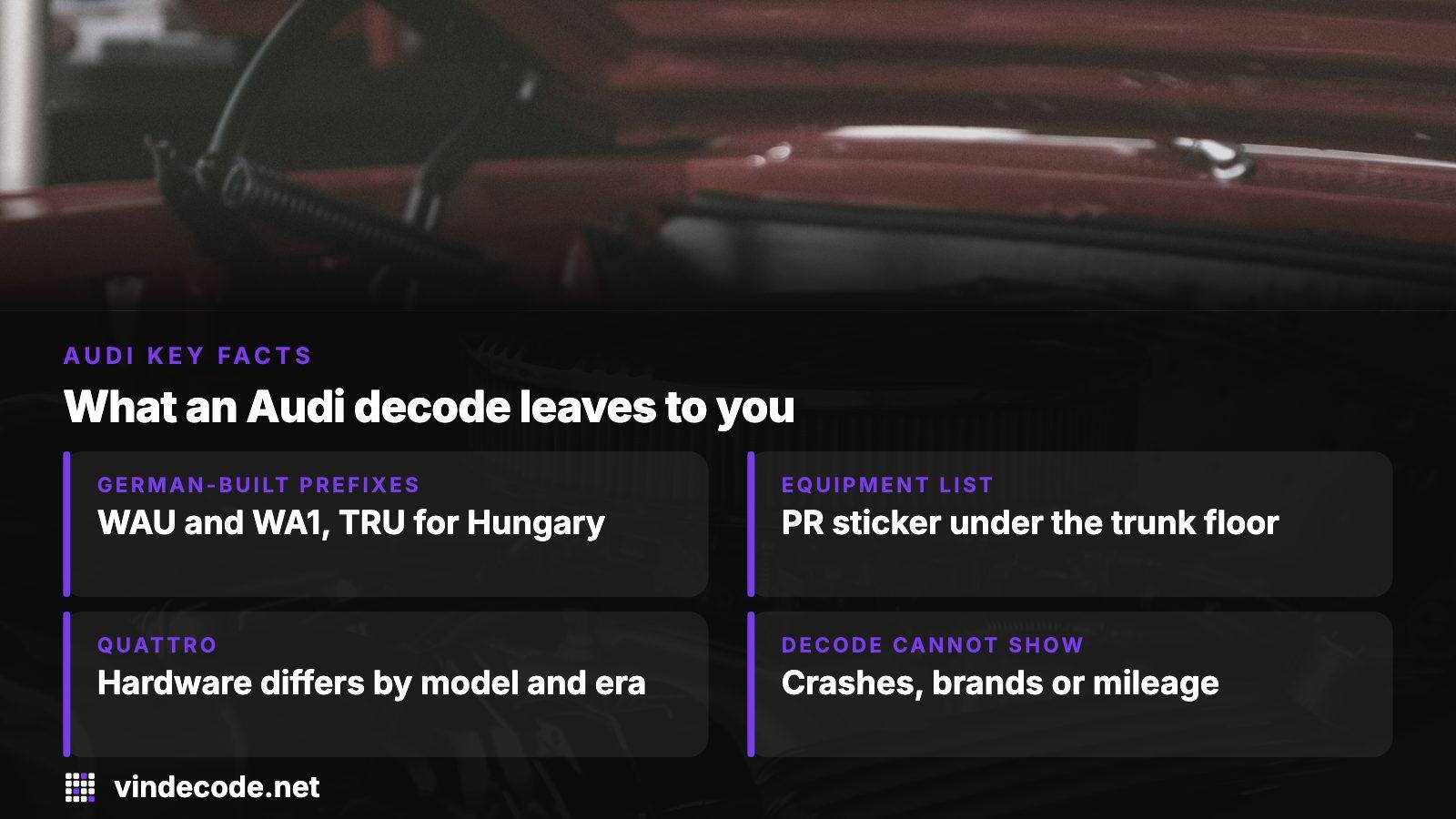
- German-built prefixes
- WAU and WA1, with TRU for Hungary
- Equipment list
- PR sticker, usually under the trunk floor
- quattro
- Different hardware by model and era
- Decode cannot show
- Crashes, brands or mileage
What the decoder hands back on an Audi
The decoder checks your VIN against the layout Audi filed with NHTSA. The result is the car as specified at the factory, which is why it beats the listing: an ad can say anything, while the number has to agree with the metal.
| Field | Why it matters on an Audi |
|---|---|
| Model year, model and body class | Proves the car is the generation the seller is describing |
| Engine size, cylinders and fuel | Names the engine family to research before you drive out |
| Drivetrain | Front-wheel or all-wheel drive, though not which quattro hardware |
| Restraint system | As fitted at the factory |
| Country and plant | Which prefix the car carries and where it was assembled |
| Open recalls | Campaigns still unrepaired on that exact car |
Trim is only partly in the number. Premium and Prestige are marketing packages sitting on top of the underlying codes, so the VIN narrows the trim without naming it. The option list and paint color are missing entirely.
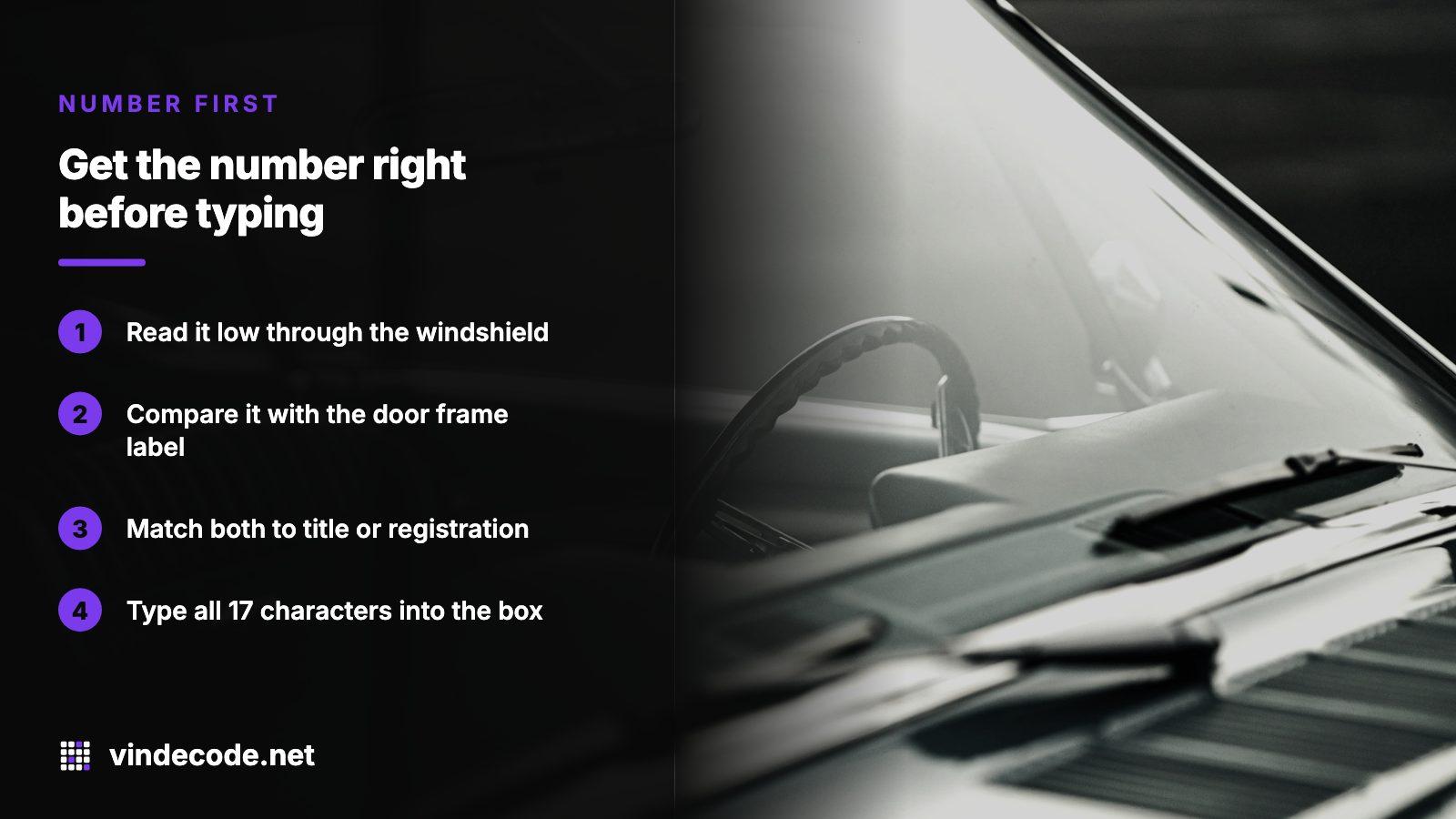
Getting the number right before you type it
One wrong character returns an error or a different car, so read the VIN off the vehicle itself, not the advert.
- Stand outside the car and read through the windshield, low on the driver's side.
- Compare it with the label on the frame where the driver's door closes.
- Match both to the title or registration.
- Type all 17 characters into the box on this page.
On an Audi, the eighth character points to the engine as built. The ninth is a check digit, which is how a decoder catches a mistyped number. Character ten encodes the model year and character eleven marks the plant.
WAU, WA1 or TRU: what the opening letters say
The first three characters name the country and the manufacturer. On Audi the W stands for Germany, and these prefixes turn up most:
- WAU is an Audi built in Germany and the commonest code on US-market cars.
- WA1 is a German-built multipurpose vehicle, which in practice means the SUV models.
- TRU is an Audi built in Hungary, where certain models are produced.
A Hungarian prefix is no reason to mark a car down: it is an ordinary Audi made to the same standard. Audi holds identifiers beyond these three, so decode an unfamiliar prefix instead of reasoning from it. The real warning sign is a mismatch, such as an Audi badge on a number that decodes to another make.
The PR code sticker lists what the VIN cannot
Equipment on a Volkswagen group car is catalogued with PR codes, and Audi prints each car's complete set on a label attached to the vehicle. The decode cannot give you that list. The label also carries the paint code, since no manufacturer puts color into the VIN.
- Start in the trunk: raise the floor panel and check around the spare wheel.
- The service book is next, because the list is often reprinted there.
- Photograph the whole label, including the codes you do not recognize.
No sticker at all
Ask a dealer's parts department whether it can pull the factory record from the VIN. Until you have that or the label, treat every equipment claim in the ad as unproven.
quattro is a name, and the platform is shared
A decode will say a car is all-wheel drive and stop there. Audi has put different mechanical systems behind the quattro badge over the years, depending on the model line and the generation, and they do not behave alike on the road or in the workshop.
- Pin down the model and generation, then read up on the drivetrain that pairs with them.
- Look for a service record that mentions the driveline specifically.
- Mixed tire brands or uneven wear put extra load on the system.
- Ask whether a differential or transfer unit has ever been swapped.
The Volkswagen group connection works in an owner's favor. Audi shares platforms, and often engines, with sibling marques, so mechanical parts are easier to find than the badge implies and independent shops know the hardware. A fault documented on a sibling with the same engine probably applies to yours.
Engine codes and the carbon bill that comes later
Audi identifies engines by letter code. The code stamped on the engine is the one a parts desk will want, so research the engine itself instead of the model name. The same engines turn up across the group, and what owners have documented attaches to the engine.
Direct injection puts fuel into the cylinder instead of the intake port, so the back of the intake valves never gets rinsed and carbon gradually collects there. Treat it as scheduled upkeep rather than a flaw, and a fair offer allows for it.
- Ask if intake cleaning has been done, and at what mileage.
- Symptoms to ask about: a rough cold start, misfires, and economy that slowly gets worse.
- Timing component service differs by engine and cannot be skipped.
- A turbocharged engine wants strict oil changes, so ask about intervals and the oil used.
S and RS money: make the hardware match the badge
Performance variants carry large premiums, and badges are cheap. The gap between a genuine one and a well-dressed base model runs to thousands of dollars, so check before you talk price.
Badges bolt on, hardware does not
The engine in the decode, the brake and suspension codes on the PR sticker and the interior equipment it records should all agree with the badge. None of that can be added to a sticker printed at the factory, so a disagreement is your answer.
The spec sheet also forecasts the bills: air suspension is excellent until it fails, big wheels mean pricey tires, and all-wheel drive adds parts to service. Price the generation and engine, not the badge.
After the decode: recalls, then the car's past
A recall follows a span of VINs, not a model name, and one campaign can cover several group brands when they share the part. NHTSA's lookup checks a single VIN at no cost, and the manufacturer repairs the car free of charge whoever owns it now. Check it first.
Past that, the decode runs out of road. A salvage brand, a crash, a wound-back odometer or a lien is not in the number. The history report gathers those records:
- Salvage and auction history, photos included
- Title brands, plus accident and damage records
- Odometer readings over the car's life
- Liens, impounds, theft and insurance records
- Who has owned it and how it was used
- Open recalls, market value and factory specs
Cost, and what to do once the decode checks out
Type the VIN into the box above and a preview appears first. The preview costs nothing and takes no card details. The full report is paid once, for one report or for a bundle of three, five or ten, with no subscription behind it. Current prices sit on the pricing page.
For a used Audi, a sensible order is to decode, compare with the ad, photograph the PR label, look up recalls, and buy the report once the build matches and the seller still looks straight. A bundle suits you if you are weighing several cars. Finish with an independent specialist's inspection.
Where this information comes from
- NHTSA: vPIC VIN decoder — The federal database where manufacturers file how their VINs are structured, behind the model, engine and plant fields.
- NHTSA: recalls lookup — Where to check a VIN for open recalls, which the manufacturer repairs at no cost.
- EPA: fueleconomy.gov — Official economy figures by engine and drivetrain, useful once the decode names the configuration.
Sources and photos: Facts checked against the sources above in November 2026. Photos by Iain, Dylan Michaud and Victor Hughes on Unsplash; diagrams by VINDecode.
Keep reading
- VIN Decoder: Decode a VIN Number Online, Then Check Its HistoryAll 17 positions explained, including the check digit and the year character.
- Volkswagen VIN Decoder: Decode a VW, Then Check Its HistoryThe group's volume brand, built on much of the same engineering.
- Porsche VIN Decoder: WP0, WP1, Plant, Engine and 911 GenerationAnother group marque where the option list drives value.
- Sample reportA finished report, to see what the history adds after the decode.
Frequently asked questions
How do I decode a VIN on an Audi?
Type all 17 characters into the VIN box above. The decoder checks them against the layout Audi filed with NHTSA's vPIC database and returns the year, model, body style, engine size, drive type and assembly plant. One wrong character gives an error or the wrong car, so recheck the door-frame label.
Why does my Audi VIN start with WAU?
The car is a German-built Audi, and the first letter, W, is Germany's country code. WA1 is the German-built SUV code, and TRU is Hungary. Other plants carry other prefixes, and an unfamiliar one is a reason to run the decode rather than to worry.
Where do I find the PR codes on an Audi?
Look for a label in the trunk, normally beneath the floor covering near the spare wheel. It lists the equipment the car was built with, which the VIN does not identify, and it is where the paint code is printed. Photograph the whole label before you leave.
Will an Audi VIN decoder show accidents or mileage?
No. A decode describes how the car was built. Crashes, title brands and odometer readings live in history records, which a vehicle history report collects. Use the decode to confirm you are looking at the right car, then the report to learn what has happened to it.
Is quattro one system across every Audi?
No. Audi has fitted mechanically different all-wheel-drive systems under that name, depending on the model line and the era. A decode confirms all-wheel drive. Which of the systems the car carries, and what it costs to service, follows from the model and generation.
Now check the car itself
The guide explains what to look for. The report shows what this VIN has on record.