THE SHORT ANSWER
To decode a VW VIN, enter all 17 characters. The first three name the maker and the build country: WVW is a German-built car, 3VW a Mexican-built one and 1VW a United States-built one. Character ten is the model year and character eleven the plant. You get model, body, engine and drivetrain back. Options, crashes, title brands and mileage are not in the number, so read the trunk sticker, then open the history preview.
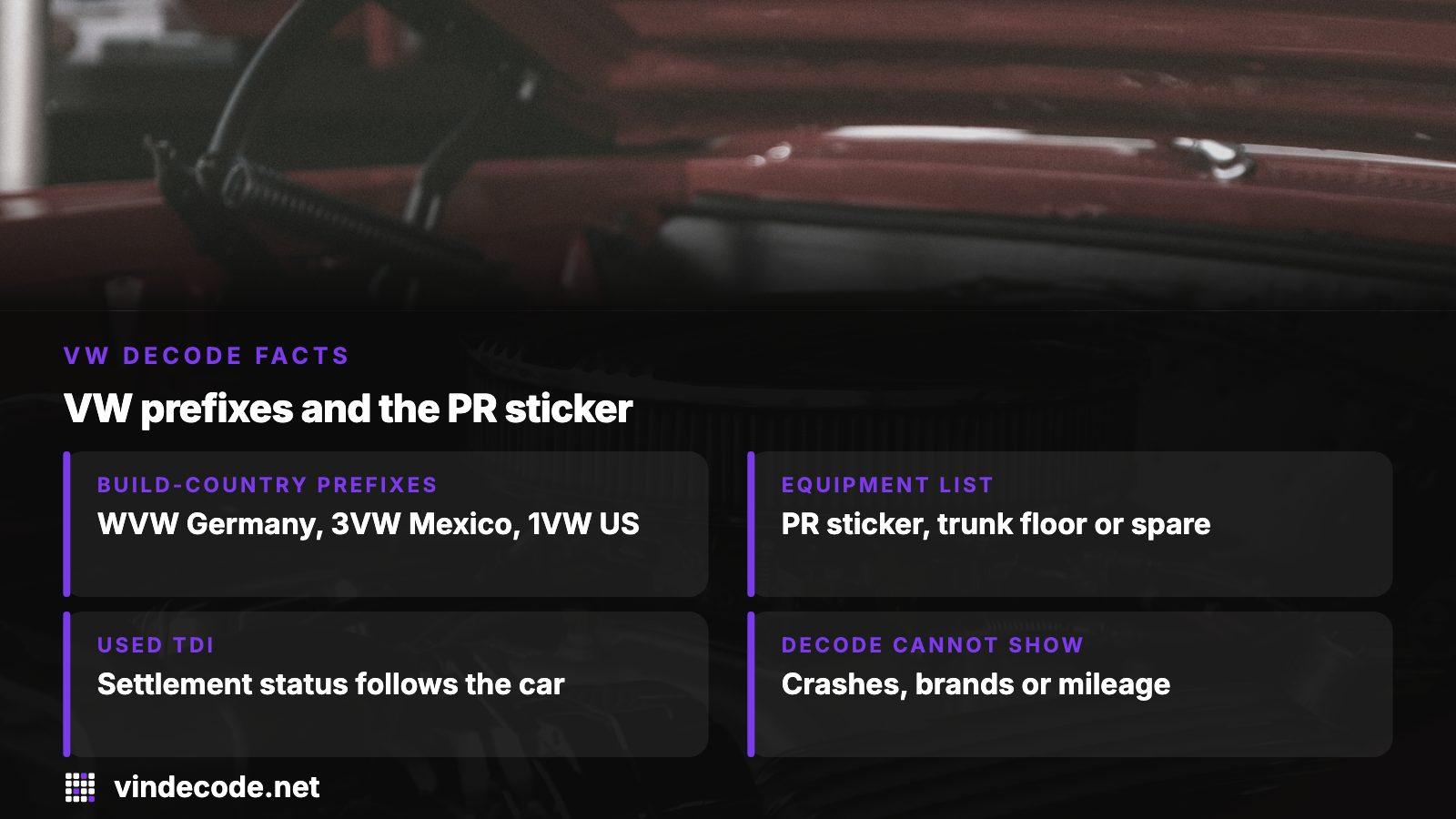
- Build-country prefixes
- WVW Germany, 3VW Mexico, 1VW United States
- Equipment list
- PR sticker, beneath the trunk floor or by the spare
- Used TDI
- Settlement status belongs to the car, not the model
- Decode cannot show
- Crashes, title brands or mileage
What the decoder hands back on a Volkswagen
The decoder checks your VIN against the pattern Volkswagen filed with NHTSA, so it describes the car as built, not as advertised. Compare each field with the listing.
| Field | What to check on a VW |
|---|---|
| Model year, model and body class | That the car is the generation the ad describes |
| Engine size, cylinders and fuel | A diesel entry is your cue for the TDI questions below |
| Drivetrain | Front-wheel or all-wheel drive, as filed at the factory |
| Country and plant | Whether the prefix fits the origin the seller claims |
| Open recalls | Campaigns still unrepaired on that exact car |
Reading the number off the car, then typing it
A single wrong character returns an error or another car entirely, so take the number from the vehicle, not the ad.
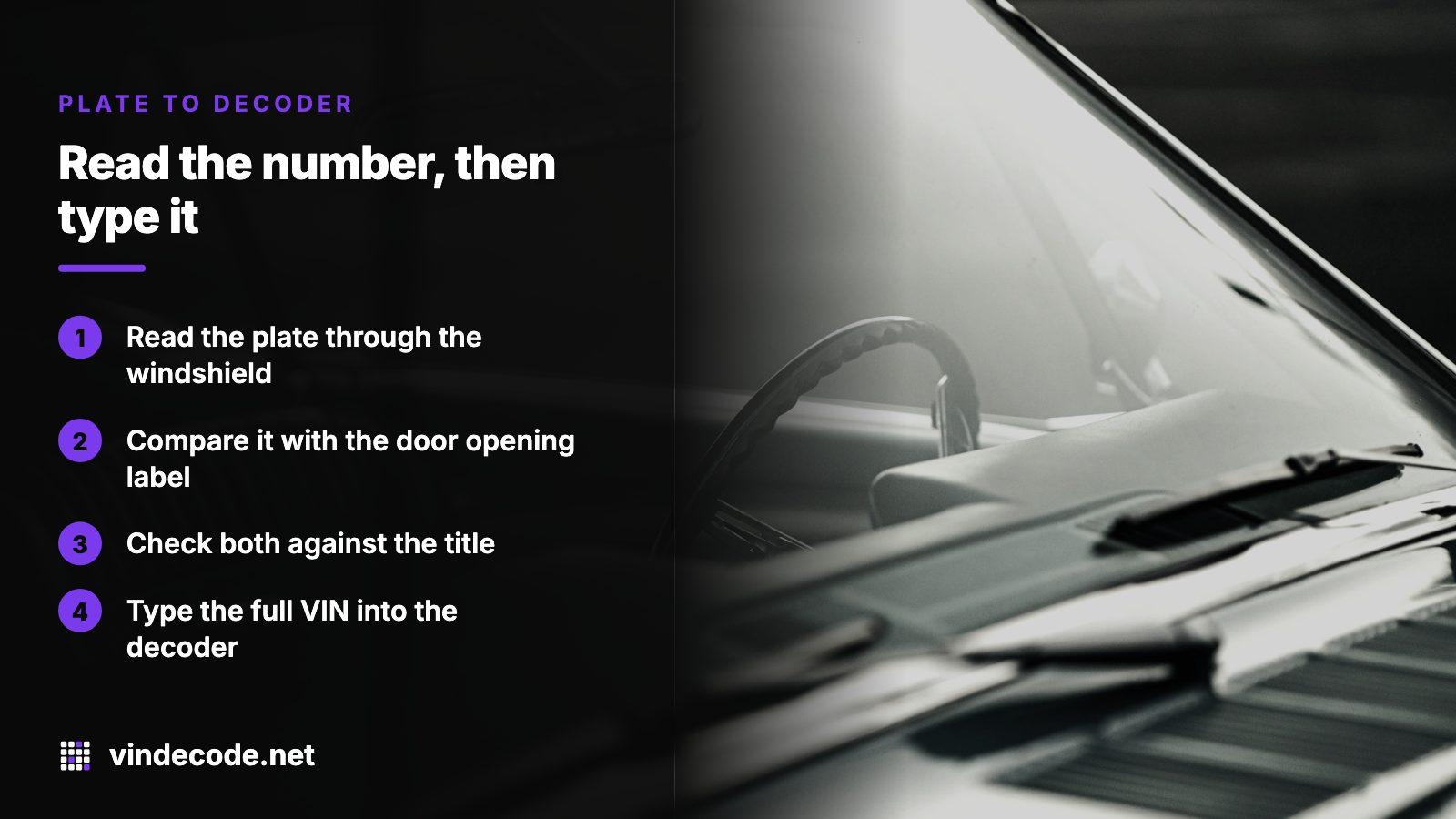
- Read the plate on the dash where it shows through the windshield.
- Compare it with the label inside the driver's door opening.
- Check both against the title or registration.
- Type the full VIN into the decoder at the top of the page.
The ninth character is a computed check digit, built from the other sixteen, so a mistyped VIN normally fails before any record is searched. The tenth is a model year, and federal rules ignore the calendar year of assembly, so a VW built in autumn often wears next year's code.
WVW, 3VW, 1VW, WV1 and WV2: what the opening characters say
NHTSA's registry lists each Volkswagen prefix with the company that filed it and its vehicle class. I queried every code below.
| Prefix | What the registry lists |
|---|---|
| WVW | Volkswagen AG, passenger car, German assembly |
| 1VW | Volkswagen Group of America, passenger car, United States assembly |
| 3VW | Volkswagen de Mexico, passenger car, Mexican assembly |
| WV1 | Volkswagen Group of America, filed as a truck |
| WV2 | Volkswagen Group of America, filed as a multipurpose passenger vehicle, the van class |
| 9BW | Volkswagen Group of America, passenger car, Brazilian assembly |
Volkswagen builds in Tennessee and Mexico for North America, so a US or Mexican prefix is routine. The class column matters more: it decides which federal standards applied at build, so a WV2 van and a WVW car are held to different rules.
The sticker that holds what five characters cannot
With only five slots in the descriptor block, a long options catalog cannot fit. Volkswagen prints the rest as PR codes on a sticker made for that one car.
- Lift the trunk floor covering and check around the spare wheel.
- Try the service book, which often repeats the list.
- Photograph the whole sticker, codes you cannot read included.
It ends four arguments that otherwise rest on the seller's word:
- Whether a trim claim is genuine or just a badge
- The paint code, which shows if a panel can be matched or was resprayed
- Which suspension and brake package the car left with
- Whether equipment sold as factory really was
No sticker in the trunk
If the service book carries the list, a bare trunk is normal. With neither, nothing is proven against the car, but every equipment claim stays unchecked.
A used TDI: settlement status belongs to one car
Volkswagen's diesel emissions case ended in a settlement covering many US TDI cars. Many were repurchased, some of those were modified and resold, and some owners kept theirs and took the modification instead. The question is about the car in front of you, not the nameplate.
- Decode the VIN. Diesel fuel plus the model year suggests whether the car was in the affected group, and a VW dealer can confirm it from the number.
- Ask for the paperwork showing the approved modification was carried out.
- Ask if a buyback ever happened and whether the car was then resold, and run the title for a leftover brand.
- Confirm it passes emissions where you live.
One detail favors the buyer. Modified cars gained an extended emissions warranty. As Volkswagen published it, the term is the greater of two measures, passes to later owners and reaches the engine long block. It also applies to a totaled car unless the earlier damage caused the fault. Ask a dealer to confirm coverage from the VIN.
Two owners, two disputes over the same paperwork
NHTSA's complaint file holds first-hand TDI accounts. Two show why the individual record matters, and each is one owner's claim, not a finding.
From an NHTSA owner complaint
The second owner of a 2013 Jetta TDI wrote that the car, bought in late December 2020, already had the emissions modification. The extended warranty was the reason for buying it. The owner says Volkswagen then refused to honor that warranty and asks to be repaid about $750 in warranty-related costs.
From an NHTSA owner complaint
A 2013 Passat TDI owner filed a complaint in January 2025 saying the modification was never done on the car. Since 2022 it has spent weeks at a time in the shop over the exhaust fluid system, and nobody mentioned the modification. The owner says Volkswagen turned down both the fix and the modification, and reads that as buying a car that was under a stop-sale.
Both disputes turn on a fact the decode cannot hold: whether this exact car was modified, and when. Get that answer in writing, with the VIN, before paying.
Engine code and model year: where the real differences sit
The eighth character points to the engine as built, and the code stamped on the engine is what a parts counter asks for. Volkswagen shares engines across its group, so a fault documented on a sibling with the same engine usually applies to yours.
- When were the timing components serviced, and with which parts?
- Has a direct-injection engine had its intake valves cleaned?
- Which oil specification was used, at what intervals?
- Is a transmission service on record for a DSG automatic?
| Model | Fewest owner complaints | Most owner complaints |
|---|---|---|
| Jetta | 2018 model year, 32 | 2009 model year, 905 |
| Passat | 2019 model year, 12 | 2013 model year, 749 |
Complaints are unproven owner accounts, so read that spread as a pointer for the inspection, not a verdict. It shows the tenth character can matter more than the badge.
After the decode: recalls, then the car's past
A recall follows a span of VINs, and one campaign can cross group brands when they share a part. NHTSA's lookup checks a single VIN at no charge, and the repair costs the owner nothing.
Then the decode runs out, because it records how the car was built. The questions that move the price sit in other records, which the history report collects:
- Accident and damage records
- Title brands, such as salvage
- Odometer readings over the car's life
- Auction history with photos, plus liens and impounds
Cost of the report, and the sensible order of steps
Enter the VIN above and a preview appears before any payment. It is free and asks for no card. The full report is one payment, and packs of 3, 5 and 10 are sold too. Nothing renews. Rates are on the pricing page.
For a used VW, decode first, match the ad, photograph the sticker and check recalls. Ask the TDI questions if it burns diesel. Buy the report once the build matches and the seller seems straight. A pack suits comparing several cars.
Where this information comes from
- NHTSA: vPIC VIN decoder — The federal registry holding Volkswagen's filed VIN pattern and the prefix entries queried for this page.
- eCFR: 49 CFR Part 565 — The federal rule that defines the check digit, the model year and what each VIN position must carry.
- NHTSA: recalls lookup — Where to run a VIN for open recalls, which the manufacturer repairs at no cost.
- EPA: Volkswagen diesel vehicle violations — The agency's hub for the diesel emissions case behind the TDI settlement.
- NHTSA: owner complaint counts by model year — The public complaint data behind the Jetta and Passat counts, read on the day of writing.
- NHTSA owner complaint 11422169 — owner experience, paraphrased
- NHTSA owner complaint 11639689 — owner experience, paraphrased
Sources and photos: Facts checked against the sources above in November 2026. Photos by Wesley Tingey, Dylan Michaud and Victor Hughes on Unsplash; diagrams by VINDecode.
Keep reading
- VIN Decoder: Decode a VIN Number Online, Then Check Its HistoryAll 17 positions explained, including the check digit and the year character.
- Audi VIN Decoder: Decode the Build, Then Check the HistoryA group sibling that shares PR codes, platforms and engines.
- Classic VW VIN Decoder: Chassis Numbers, Plates and the 1981 LineAir-cooled Volkswagens use chassis numbers that work differently.
- Sample reportA finished report, to see what the history adds after the decode.
Frequently asked questions
How do I decode a Volkswagen VIN?
Type all 17 characters into the box on this page. The decoder matches them to Volkswagen's filing with NHTSA and returns year, model, body, engine, drivetrain and plant. If it errors, recheck the door-frame label, since one wrong character is the usual cause.
What does WVW mean at the start of a VW VIN?
It marks a Volkswagen passenger car assembled in Germany, where the W stands for the country. A 3VW or 1VW start means a Mexican or United States build. Both are normal on cars sold here, so neither is a reason to haggle.
Does a VW VIN decoder show options or the paint code?
No. The number has too few characters for a full option list. The PR sticker lists the equipment codes and the paint code, and the service book may reprint it.
Can a decoder tell me whether a TDI was bought back?
No. A decode shows the diesel engine and the year, so the car may have been covered. Whether it was repurchased, modified or left alone is a per-car record. Ask a Volkswagen dealer with the VIN and check the title for a brand.
Will a Volkswagen VIN decode show accidents or mileage?
No. The 17 characters record the factory build. Collision damage, a branded title and odometer readings are filed elsewhere, and a history report pulls them together. Use the decode to confirm the car and the preview to learn its past.
Now check the car itself
The guide explains what to look for. The report shows what this VIN has on record.