THE SHORT ANSWER
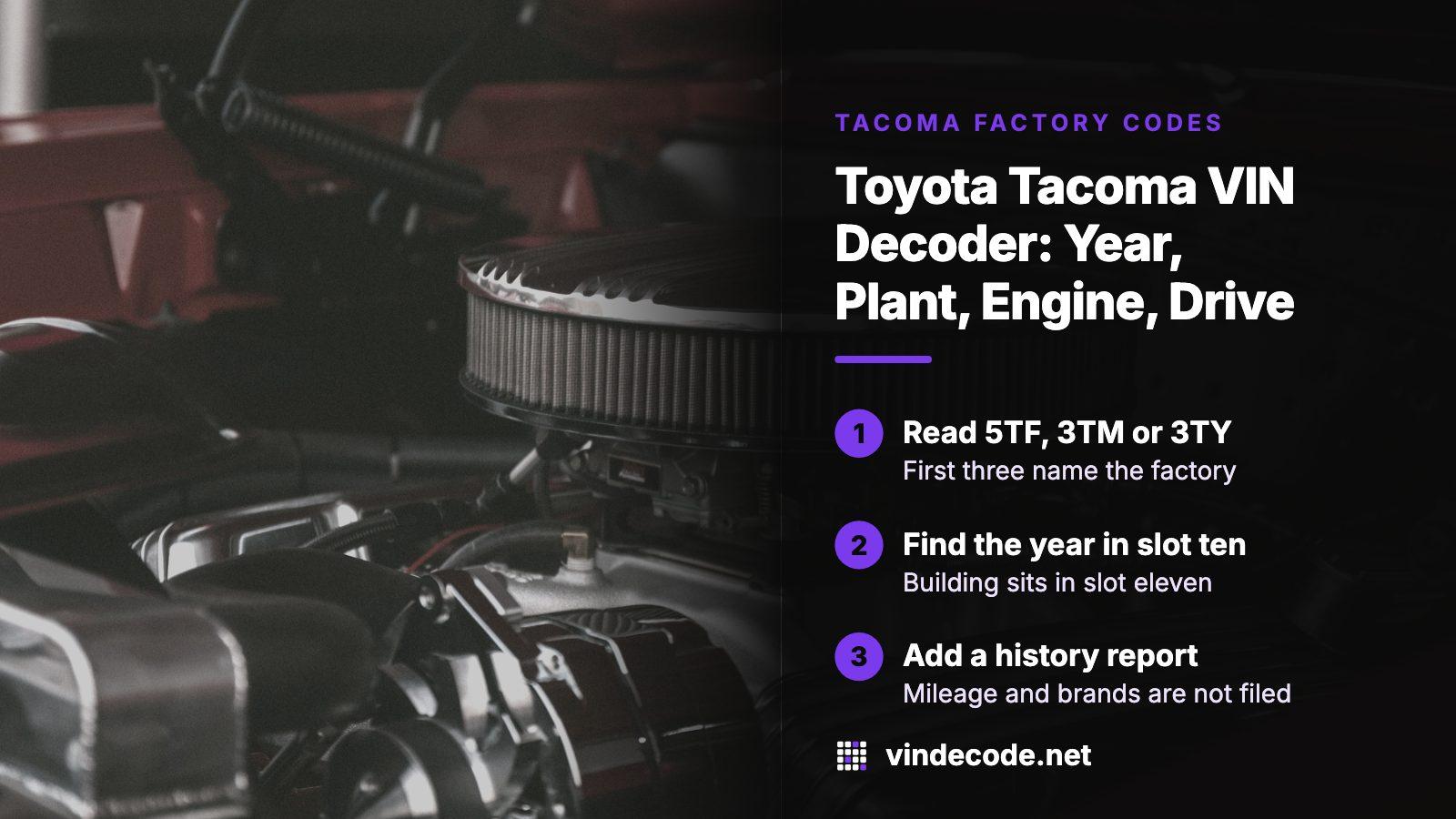
Type all 17 characters of the Tacoma's VIN into the decoder above. The first three show the factory: 5TF for Texas, 3TM for Baja California, 3TY for Guanajuato. Year sits in slot ten and the building in slot eleven. The result is the build as Toyota filed it. Mileage, title brands, damage and ownership are not in that filing, so a used Tacoma still needs a history report.
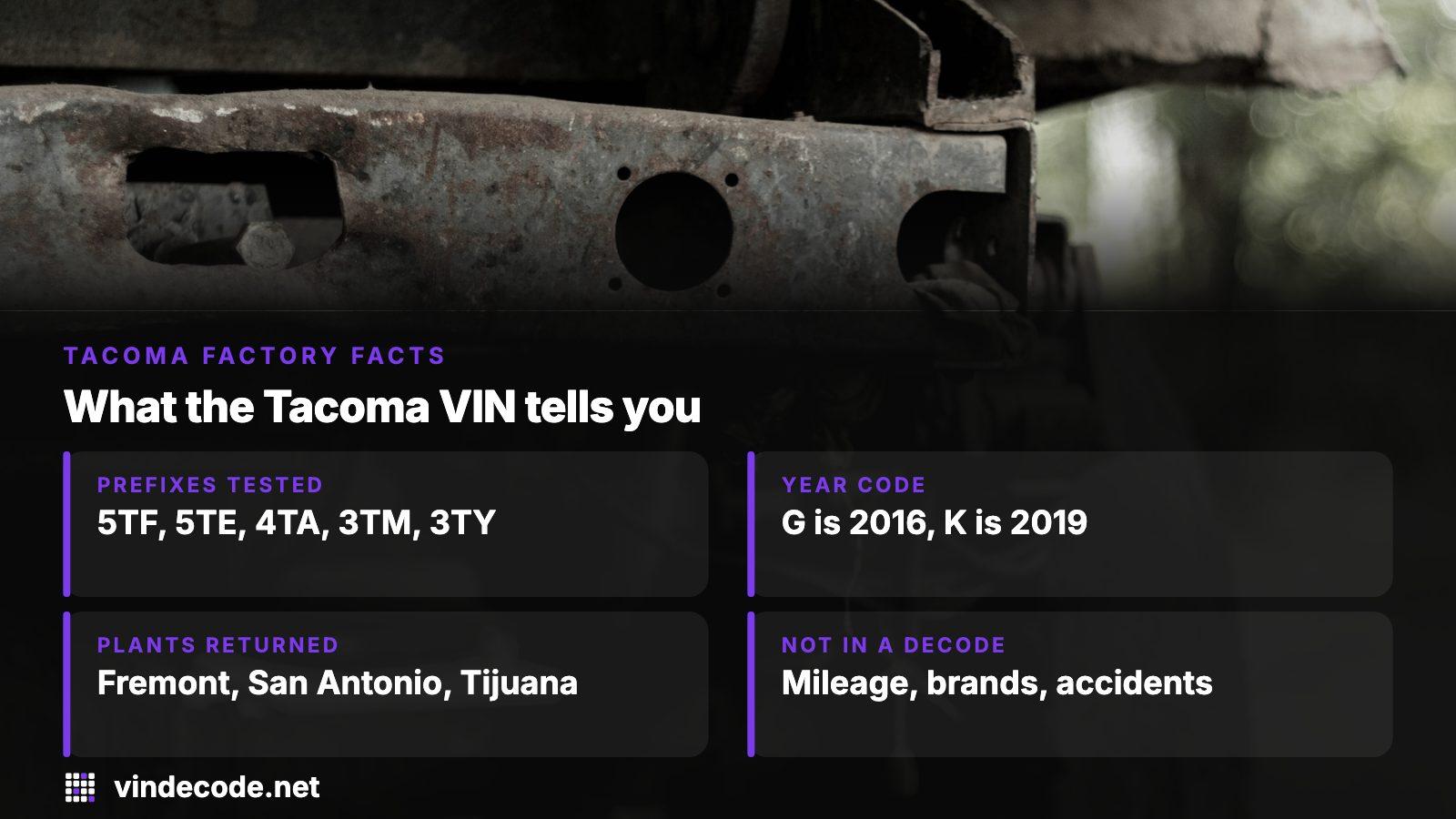
- Tacoma prefixes tested
- 5TF, 5TE, 4TA, 3TM and 3TY
- Year code
- Character 10: G is 2016, K is 2019, R is 2024
- Plants returned
- Fremont, San Antonio, Tijuana, Apaseo el Grande
- Not in a decode
- Mileage, title brands, accidents
The first three characters name the factory
A Tacoma VIN opens with a code that NHTSA ties to the plant company that built it. I looked up each prefix in the federal database, and the table shows what came back.
| Prefix | Maker named by NHTSA | Seen on |
|---|---|---|
| 4TA | TABC Inc. | 1995 and 1998 test strings, Fremont |
| 5TE | Toyota Motor Manufacturing, California | 2000 and 2006 test strings, Fremont |
| 5TF | Toyota Motor Manufacturing, Texas | 2016 test strings, San Antonio |
| 3TM | Toyota Motor Mfg de Baja California | 2008, 2019 and 2024 test strings |
| 3TY | Toyota Motor Manufacturing de Guanajuato | 2022 and 2026 test strings |
So the first character already tells you which country assembled the truck: 4 and 5 are United States, 3 is Mexico. If a seller says a 2022 Tacoma was built in Texas and the VIN starts 3TY, the VIN wins.
What the decoder returned for invented Tacomas from five eras
Every string below is made up with a valid check digit and the tail 100001, so no real truck wears it. Each came back as a Tacoma, apart from the oldest.
| Year | Engine | Drive | Plant |
|---|---|---|---|
| 1998 | 3.4 L V6 (5VZ-FE) | 4WD | Fremont |
| 2008 | 4.0 L V6 (1GR-FE) | 4x2 | Tijuana |
| 2016 | 3.5 L V6 (2GR-FKS) | 4x2 or 4WD | San Antonio |
| 2022 | 2.7 L four (2TR-FE) | 4x2 | Apaseo el Grande |
| 2024 | 2.4 L four (T24A-FTS) | 4x2 | Tijuana |
The shift from V6 to four-cylinder power shows up directly. A 2024 or newer string that returns a 3.5 L V6 deserves a question to the seller. A 1995 string I tried came back as a Pick-Up, not a Tacoma, because NHTSA's list for that year carries both names.
Reading the VIN yourself, before you trust the screen
The number sits on the dash, low on the driver's side, and a federal rule says you must be able to read it from outside, through the glass. VINs skip the letters I, O and Q, so what looks like one is a digit.
- Photograph the dash plate from outside the driver's door and read it against the title one position at a time.
- Look at character ten for the year: 8 means 2008, G means 2016, N means 2022, S means 2025.
- Check character seven. A letter there means 2010 or later; a number means 1980 to 2009.
- Read character eleven for the plant, then type all 17 into the decoder.
Slots four to eight are Toyota's own shorthand for body, engine and the like. No printed chart covers every Tacoma, so the decoder does the lookup.

Two 2016 strings that differ in drive and bed
Take 5TFAZ5CN7GX100001 and 5TFDZ5BN9GX100001. Both decode as 2016 Tacomas with the 3.5 L V6, both from San Antonio. The decoder separates them by series: GRN325L is a 4x2 with a short bed, GRN310L a 4WD with a long bed.
Those strings differ in the fourth and seventh characters, and the check digit changes with them. Notice what the decoder does not do: the trim text reads the same for both, a lumped SR5, TRD Off Road and TRD Sport label. Do not rely on a decode to tell you which trim you are looking at. Check the badge and the door sticker, then trust the VIN for the mechanical facts.
When the screen disagrees with what you typed
The decoder still fills in a build when the string is flawed, so read the status line before the specs.
- Ninth character wrong: the 2016 string still showed a V6 Tacoma, but the status said the check digit does not calculate. That usually means a typo.
- Sixteen characters: most fields filled in, with an incomplete-VIN warning.
- A plant letter Toyota never filed: city and country came back blank with two warning codes.
- A 2006 DLX string: it returned the plant and drive but no engine, with code 14, meaning the maker's filing does not explain some characters.
A blank is an unresolved field, not a defect. A clean result carries code 0 and the words VIN decoded clean.
Recalls are filed by build window, so one character can matter
NHTSA lists 10 campaigns for the 2005 Tacoma and 11 for 2006, but few apply to one truck. The clockspring recall 12V092000 covered 2005 through 2009 trucks built between 14 September 2004 and 29 August 2008. The leaf spring recall 14V604000 names model years 2005 to 2011 but reached only PreRunner and 4x4 trucks from a window of about thirteen months, ending 11 October 2010.
From an NHTSA owner complaint
A 2005 Tacoma owner reported the driver air bag light glowing and asked why the truck's VIN was missing from Toyota's air bag recall for Tacoma pickups. The complaint, filed in October 2016, names campaign 12V092000 and records no outcome.
That owner's question has a mechanical answer: coverage is decided by build dates, and the recall lookup keys on the full VIN. Toyota's own page takes a 17-digit VIN and reaches back through 1999 for safety recalls and service campaigns.
A VIN left off a notice is not the same as a sound truck
Another 2006 owner wrote that a recall notice about the subframe arrived but the truck's VIN was not on it. A dealer then found the subframe badly corroded and in need of replacing. NHTSA's record says it went unrepaired, at roughly 60,000 miles.
From an NHTSA owner complaint
The owner of a 2006 Tacoma got a subframe recall notice that did not list the truck's VIN. A dealer later called the subframe severely corroded and in need of replacement. The record shows no repair.
Take from this that an absent VIN, a decoder result and an inspection are three separate questions. Run the recall lookup, decode the build, and have a shop put the truck on a lift before you pay.
What the decode cannot see
The federal decoder describes the truck on its first day. A Tacoma that spent years towing, got hit, or changed hands through several states looks identical in the decode. The records below sit elsewhere.
| History record | Question for a used Tacoma |
|---|---|
| Odometer readings | Does the mileage fit the age and condition? |
| Title brands | Was it ever labeled salvage, junk or flood? |
| Accident and damage records | Was it hit hard or written off? |
| Open recalls | Is any campaign still unrepaired on this VIN? |
| Ownership and use | Private owner, fleet or rental? |
Many reports draw on NMVTIS, a Justice Department program built around catching title fraud and stopping thieves from reselling stolen trucks.
Running the check on a Tacoma you might buy
Decode first, so you know what the truck should be: year, engine, drive and plant. Confirm those against the truck and the title. When they match, run that VIN for the history preview, which carries no charge.
The report is paid once for the truck you enter, with multi-report packs for a longer shopping list. There is no subscription to cancel, and the pricing page shows the cost. Finish this step before any deposit changes hands.
Where this information comes from
- NHTSA: vPIC VIN decoder — Federal decoder and plant-company lookup behind every test string and status code on this page.
- eCFR: 49 CFR Part 565, VIN requirements — The federal rule on the 17-character format, year codes, the seventh-character rule and where a light truck's VIN sits.
- NHTSA: recalls — Federal recall lookup; campaign counts and build windows here come from NHTSA's recall data.
- Toyota: recall and campaign lookup — Maker's own lookup by VIN or plate, covering safety recalls and service campaigns since 1999.
- VehicleHistory.gov (NMVTIS) — Department of Justice site describing the federal title database and its purpose.
- NHTSA owner complaint 10911099 — owner experience, paraphrased
- NHTSA owner complaint 10794588 — owner experience, paraphrased
Sources and photos: Facts checked against the sources above in November 2026. Photos by Victor Hughes, Cole Keister and Zoshua Colah on Unsplash; diagrams by VINDecode.
Keep reading
- Toyota VIN Decoder: Check the Build, Then the Car's RecordPrefixes and codes across Toyota's whole line, not only the Tacoma.
- VIN Decoder Year Chart: Position 10 Codes for 1980 to 2039Every tenth-character code by model year, with the seventh-character rule.
- NHTSA VIN Decoder: What It Returns, Where It Stops, What Comes NextWhat the federal decoder returns, and what its error codes mean.
- Sample reportA finished report, so you can see the odometer and title sections first.
Frequently asked questions
How do I decode a Toyota Tacoma VIN?
Copy all 17 characters from the dash plate and match them to the title. Enter them in the decoder above, then read the status line before the specs. A check-digit warning usually means a mistyped character. Compare year, engine and drive with the truck itself.
Where is the VIN on a Tacoma?
Federal rules require it inside the cab, readable through the windshield beside the driver's-side pillar. The same number should appear on the title and registration. If the plate looks altered, or the numbers disagree with the paperwork, stop and ask the seller to explain.
Will the decoder tell me the Tacoma's trim?
Often only loosely. The 2016 strings returned one combined label for SR5, TRD Off Road and TRD Sport, so the decode could not separate them. Confirm trim from the badges and the door sticker, and use the decode for engine, drive and plant.
Does a Tacoma VIN decode show accidents or mileage?
No. It reflects what Toyota filed when the truck was built. Accidents, odometer readings, title brands and ownership appear in a history report, so a used truck usually deserves both a decode and a report.
How can I check Tacoma recalls by VIN?
Use Toyota's lookup with the 17-digit VIN, or NHTSA's recall search. Campaigns apply by model year and build window, so a truck may sit outside a recall that names its model year. Fix open recalls before buying; the dealer repair costs the owner nothing.
Now check the car itself
The guide explains what to look for. The report shows what this VIN has on record.