THE SHORT ANSWER
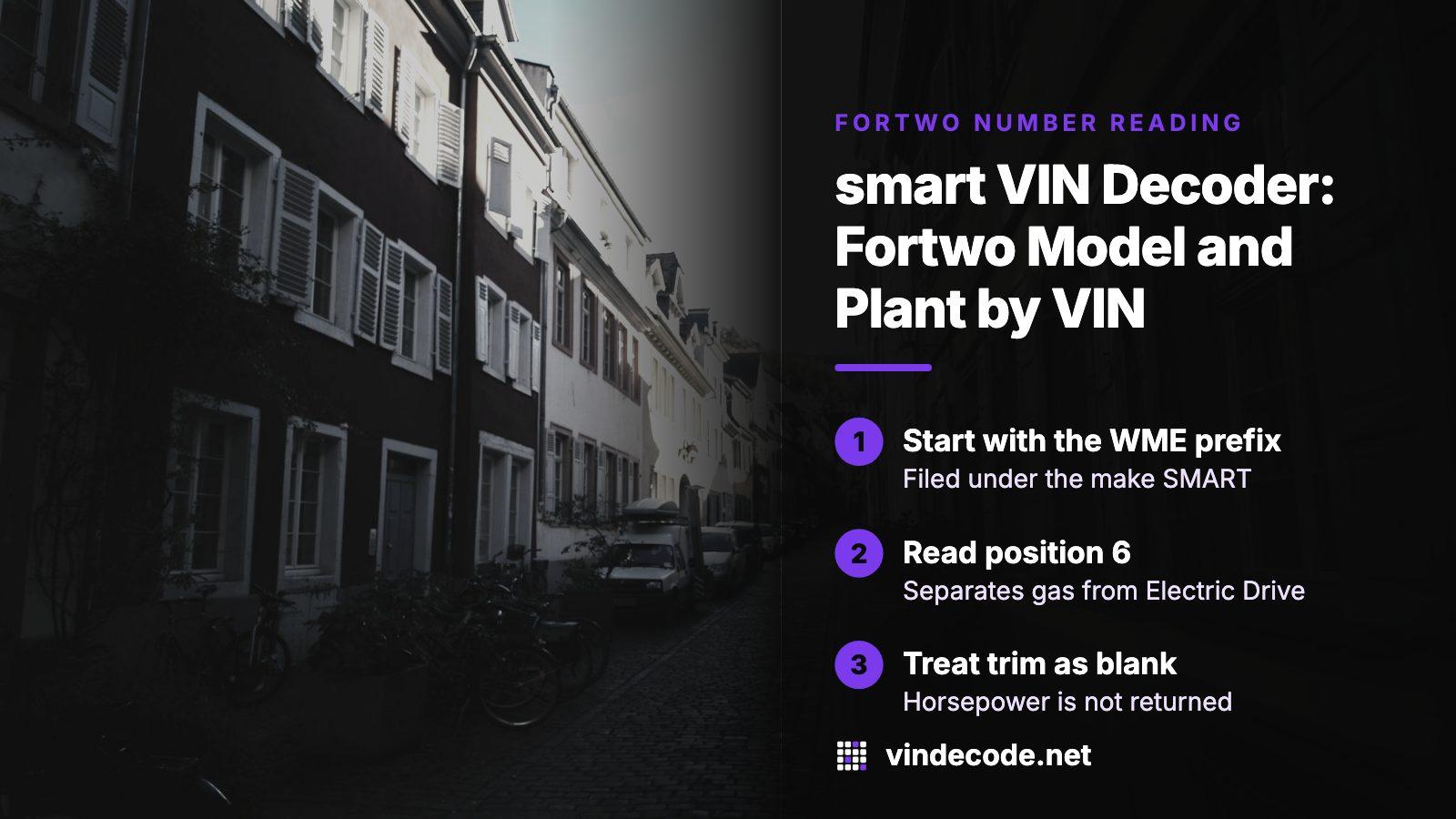
Type all 17 characters of the fortwo's VIN into the decoder on this page. NHTSA's vPIC data gives the model, coupe or cabriolet body, engine size on gasoline cars, an Electric Drive marker on battery cars, and the plant. Trim and horsepower come back blank. Crashes, title brands and mileage are not in a decode, so open the history preview for the same VIN before you pay.
- smart prefix
- WME, filed with NHTSA under the make SMART
- Samples decoded
- Seven fortwo VIN starts, 2013 to 2016, all built in Hambach, France
- Gas or electric
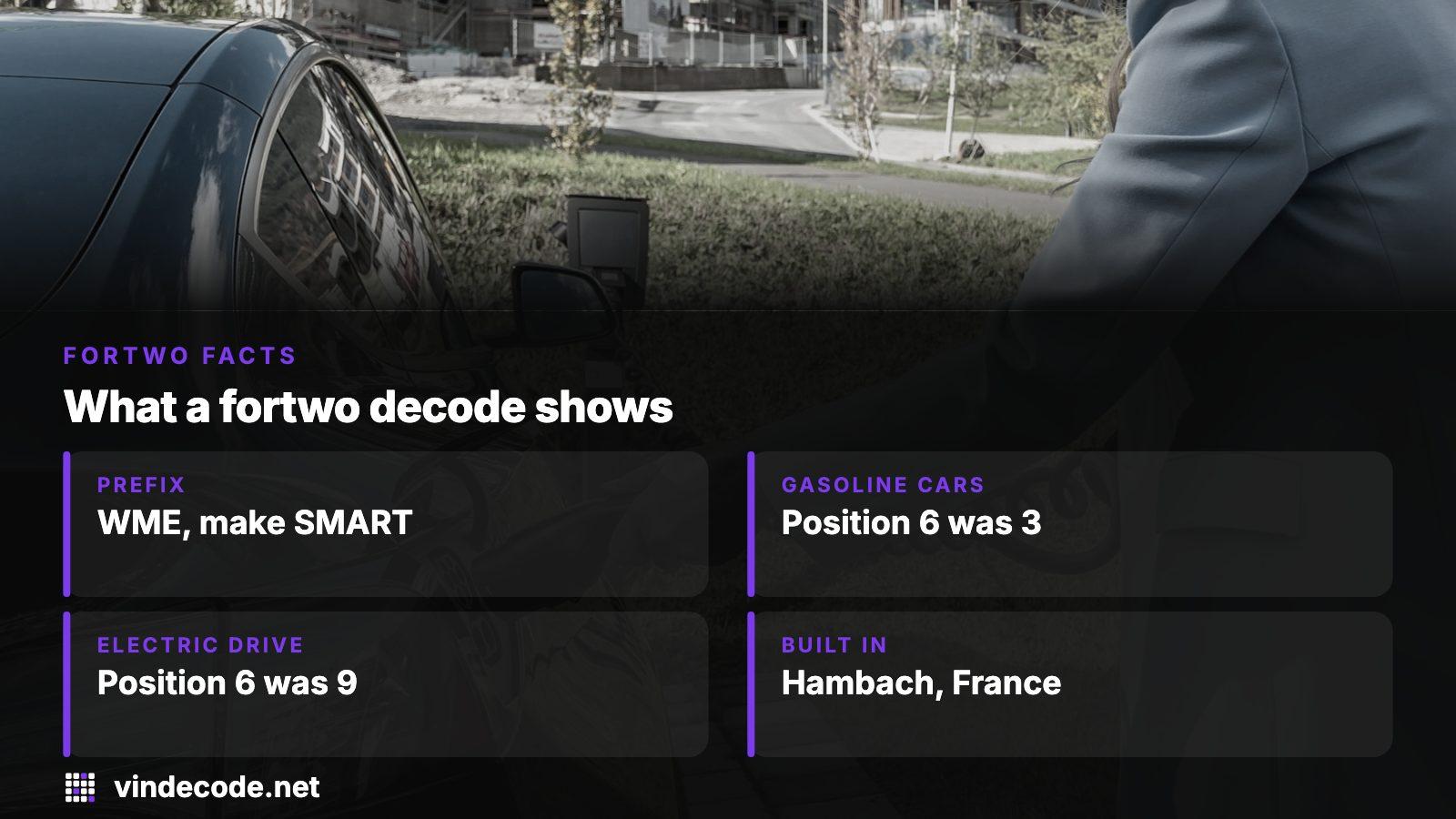
- Position 6 was 3 on gasoline cars and 9 on Electric Drive cars
- A decode cannot show
- Crashes, title brands or mileage
Which smart this decoder means
Type the word into NHTSA's model list and you get 17 entries. Only 3 belong to the car maker: smart, Fortwo and EQ Fortwo. The remainder are builders that happen to carry the word in their names, such as trailer makers, a tiny-house company and a motorcycle brand, and none of them make anything you would plug a VIN decoder into for a car purchase.
In six of the model years we queried (2008, 2010, 2013, 2015, 2016, 2017), NHTSA names one smart car, the Fortwo. The 2018 list adds the EQ Fortwo. If a listing calls the car a smart ForTwo, a smart car or a Pure or Passion, all of them are this same two-seater, and the decode will say Fortwo.
Check the make field first
If a decode comes back as a trailer, a tiny home or a motorcycle, the number was mistyped or belongs to another product. A smart car should show make SMART and a Mercedes-Benz Cars maker record.
What a fortwo decode returns
The decoder compares your number with the layout the maker filed under the federal VIN rules. For a passenger car those rules say the middle characters, positions 4 to 8, must let anyone work out the make, the model line, the body and the engine, among other things. That is the reason a decode can describe the car without any paperwork.
- Model name and, on battery cars, a series called Electric Drive
- Coupe or convertible body, and two doors
- Gasoline engine size and three cylinders, or a battery-electric marker with no engine size
- Plant city and country
- Model year, read from position 10
Trim, horsepower and transmission style were empty on every sample below, so a seller who says Passion or Brabus has to prove it with the build paperwork or a dealer.
Seven fortwo decodes, gas against battery
Each row is the first eleven characters of a VIN printed in a public NHTSA owner complaint, run through vPIC with the model year entered.
| Sample | Body and power | Plant |
|---|---|---|
| 2013, WMEEJ3BA9DK | Coupe, 1.0 L three-cylinder gasoline | Hambach, France |
| 2013, WMEEJ9AA5DK | Coupe, Electric Drive, battery electric | Hambach, France |
| 2013, WMEEK3BA4DK | Convertible, 1.0 L three-cylinder gasoline | Hambach, France |
| 2015, WMEEJ3BA0FK | Coupe, 1 L three-cylinder gasoline | Hambach, France |
| 2015, WMEEJ9AA8FK | Coupe, Electric Drive, battery electric | Hambach, France |
| 2016, WMEFJ5DA2GK | Coupe, 0.9 L three-cylinder gasoline | Hambach, France |
| 2016, WMEEJ9AA9GK | Coupe, Electric Drive, battery electric | Hambach, France |
Notice the 2016 gasoline car: the displacement falls from 1.0 to 0.9 liters, and its number starts WMEF instead of WMEE.
Reading the characters on a fortwo
NHTSA files the WME prefix under the make SMART, with Mercedes-Benz Cars as maker and Mercedes-Benz AG as parent. In our samples, the first four letters were WMEE or WMEF, and the fifth was J on coupes and K on the cabriolet.
| Position | What we saw |
|---|---|
| 6 | 3 on the 2013 and 2015 gasoline cars, 9 on every Electric Drive car |
| 9 | The check digit, never part of the lookup pattern |
| 10 | D for 2013, F for 2015, G for 2016 |
| 11 | K on all seven, the plant letter for Hambach |
Treat the position 6 pattern as an observation from seven numbers, not a rule, because only the maker's own filing is authoritative. What the federal standard does fix is the year code in position 10 and the plant in position 11. Because position 7 is a letter on these cars, the year code falls in 2010 to 2039.
Recalls that depend on which fortwo you have
The build you decoded determines which campaigns apply. NHTSA's recall records for the make include these:
- 08V390000, 2008: paint from a single batch missed specification, and dealers repaint the affected areas
- 18V273000, 2008 to 2009 coupes and cabrios: a loose rear insulation mat in the engine bay could touch hot exhaust parts and raise fire risk
- 15V192000, 2014 to 2015 coupes and convertibles, plus 2014 electric versions: steering gear mounting bolts that may break
- 17V448000, 2016: a parking brake cable lock nut that may loosen
- 17V447000, 2017: a cast steering knuckle that may fail on the left front
- 20V107000, 2019 Electric Drive: a weld in the high-voltage battery that may detach
The fixes are free at a dealer. Run the full VIN through NHTSA's recall search, because model labels differ between lists: a lookup by a label such as COUPE returned nothing for 2013 even though other labels showed campaigns.
What owners filed on the same numbers
From an NHTSA owner complaint
An owner of a 2015 electric fortwo coupe told NHTSA in May 2022 that the cable tying the driver's belt to its tensioner had frayed, and the car had not yet reached 49,000 miles. Six of its seven strands had snapped. The dealer said belts fall outside the warranty, so the owner paid $252.23 for a new tensioner assembly. Its VIN begins with the Electric Drive sample above.
From an NHTSA owner complaint
Another 2015 fortwo owner, filing in July 2023, spotted a frayed metal cable at the driver's door jamb while buckling up. The car was rarely driven and had about 65,000 miles. Nothing had been diagnosed or repaired. This VIN begins with the 2015 gasoline sample above.
Two cars, one gasoline and one electric, showed the same worn part. The takeaway is to inspect the driver's belt anchor on any fortwo you look at, and to ask a seller whether it was ever replaced.
What the decode leaves out
A decode describes the factory build. It says nothing about whether the car was written off after a crash, whether the title carries a brand, how far it has driven or how many people have owned it. Those answers live in title, insurance and auction records.
- Title brands such as salvage or rebuilt
- Accident and damage records
- Odometer readings over time
- Liens and theft reports
- Open recalls and ownership history
A tiny car can still be hit hard, and a gasoline fortwo advertised as electric, or the reverse, is a mismatch the decode catches in seconds. The history is what catches the rest.
What it costs and the order to run the checks
You can open the history preview at no charge. After that you pay once, either for this one car or for a bundle of three, five or ten reports, and nothing renews. Look up the amounts on the pricing page.
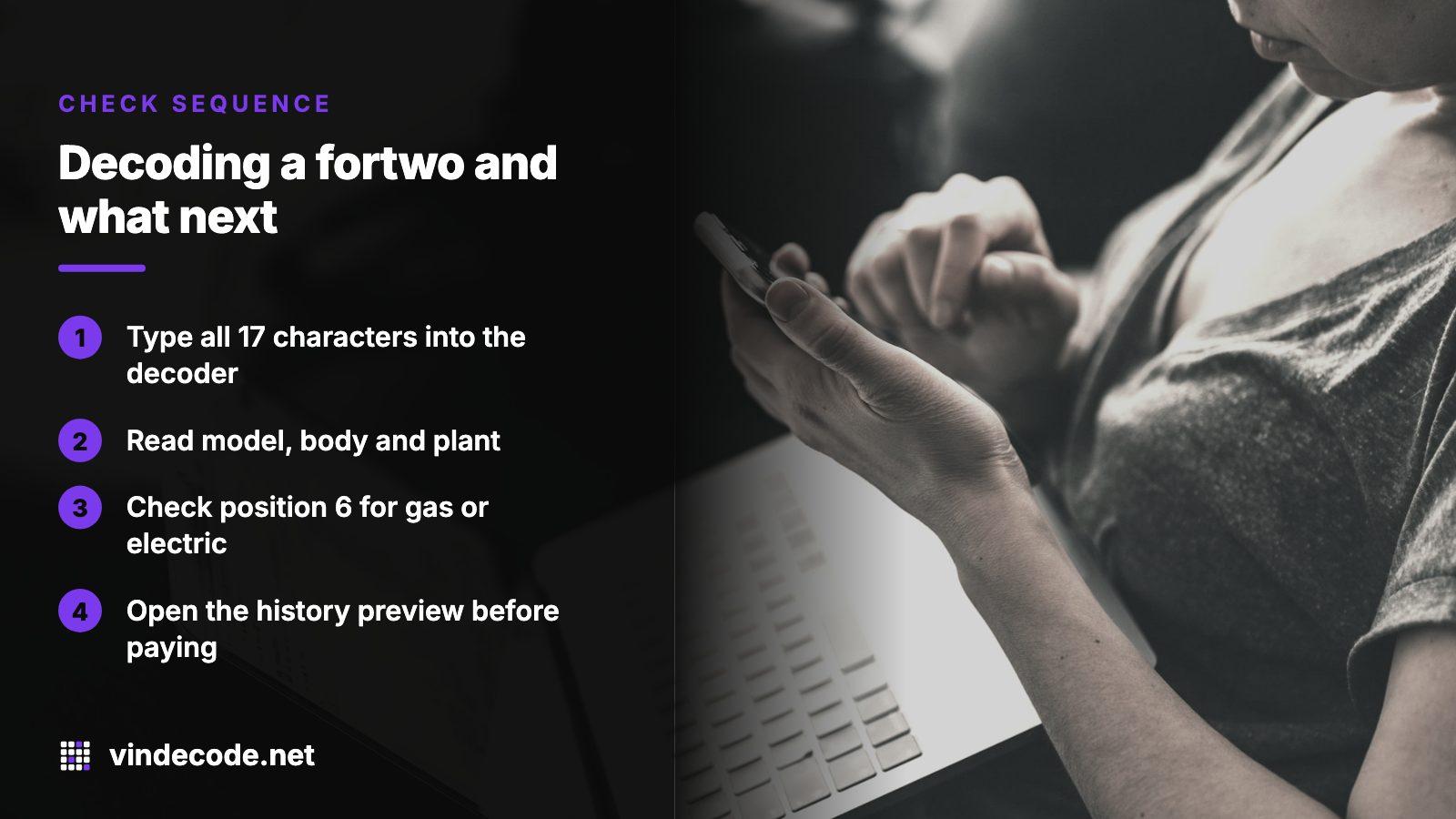
- Decode the VIN and compare model, body and gasoline or electric with the advert.
- Run the number through NHTSA's recall search.
- Open the history preview and look for title, damage and mileage problems.
- Buy the full report if the preview looks clean.
- Have a mechanic inspect the belts, steering and, on an electric car, the battery.
Where this information comes from
- NHTSA vPIC: VIN decoder — The public decoder behind the sample decodes, with the smart model lists and the WME prefix record.
- 49 CFR Part 565: VIN requirements — Federal rules for what positions 4 to 11 must carry, the check digit and the year code.
- NHTSA recalls data: smart fortwo 2016 — Campaign 17V448000 on the parking brake cable lock nut.
- NHTSA recalls data: smart fortwo coupe 2015 — Campaign 15V192000 on steering gear mounting bolts.
- NHTSA owner complaint 11463676 — owner experience, paraphrased
- NHTSA owner complaint 11532331 — owner experience, paraphrased
Sources and photos: Facts checked against the sources above in November 2026. Photos by Karwin Luo, Michal Biernat and smart-me AG on Unsplash; diagrams by VINDecode.
Keep reading
- MINI VIN Decoder: Cooper, Clubman and Countryman by VINAnother small European make whose model names shift from year to year.
- VIN Decoder Year Chart: Position 10 Codes for 1980 to 2039Every model-year letter for position 10 in one table.
- VIN Decoder Explained: What Decoding a VIN Means and How It WorksThe position-by-position method behind any decode.
- NHTSA VIN Decoder: What It Returns, Where It Stops, What Comes NextWhat NHTSA's public decoder covers and what it leaves out.
Frequently asked questions
How do I decode a smart VIN?
Enter all 17 characters into the decoder on this page. It reads them against the layout filed with NHTSA and returns model, body, engine or Electric Drive, and plant. If it errors, recheck each character against the car, since a single wrong letter changes the answer or returns nothing at all.
Can a VIN show whether a smart fortwo is electric?
Yes. In NHTSA's data the electric cars decode with a series called Electric Drive and a battery-electric marker, and they carry no engine size. In our samples they also had a 9 in position 6 where the gasoline cars had a 3. Confirm against the car itself.
Where is a smart car built?
All seven fortwo samples we decoded, from 2013 to 2016, returned Hambach, France as the plant, with Mercedes-Benz Cars as the maker. The decoder repeats what the maker filed, so if the paperwork names another country, ask the seller.
Does a decode show accidents or title brands?
No. It describes how the car was built. Crashes, salvage or rebuilt brands, mileage and past owners come from title, insurance and auction records, which is why the history preview is the next step.
Why does my smart VIN decode show no trim or horsepower?
Those fields came back empty on every sample we ran. The maker is only required to file enough to describe make, line, series, body, engine and restraints, so trim names and power ratings often need a dealer or the build paperwork.
Now check the car itself
The guide explains what to look for. The report shows what this VIN has on record.