THE SHORT ANSWER
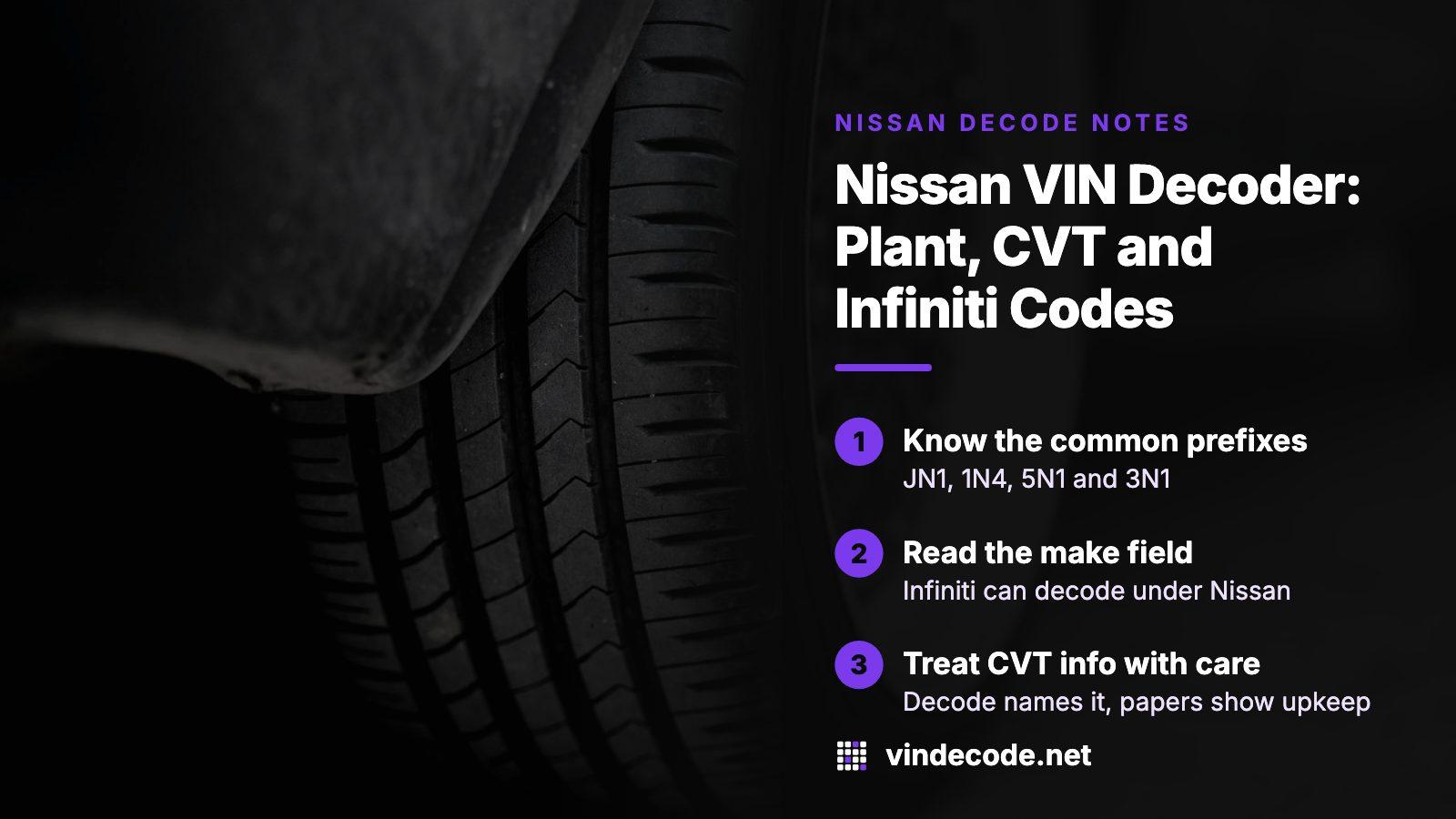
Type all 17 characters into the decoder on this page. A Nissan returns model, year, engine, drive, plant and open recalls, and sometimes the transmission type. JN1, 1N4, 5N1 and 3N1 are normal prefixes, and Infiniti shares several of them, so read the make field, not the first three characters. Title brands, crashes, mileage and transmission service are not in a decode; open the history preview before paying.
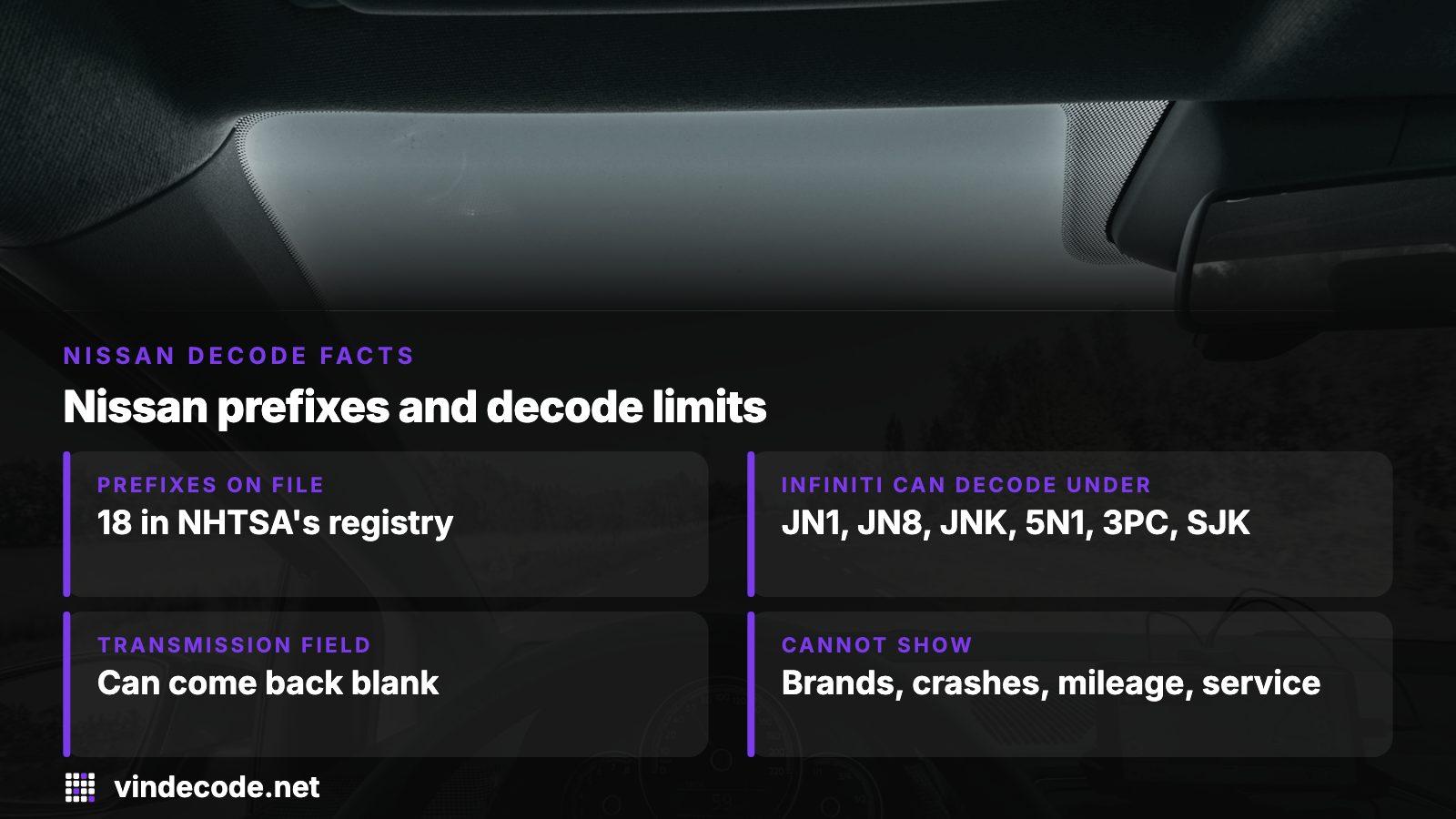
- Nissan prefixes on file
- 18 in NHTSA's registry
- Infiniti can decode under
- JN1, JN8, JNK, 5N1, 3PC or SJK
- Transmission field
- Can come back blank
- A decode cannot show
- Title brands, crashes, mileage, service
What a Nissan decode returns, and the field that can be blank
The decoder matches your number to the layouts Nissan registered in NHTSA's public vPIC database. Compare the answer with the advert line by line: an advert can be edited, the factory record cannot.
- Model, year and body class
- Engine displacement and fuel type
- Drive layout, make and plant
- Open recalls for that VIN
- Transmission type, if Nissan filed it
The transmission line is the patchy one. In NHTSA's decoder, the partial VIN from a 2017 Rogue complaint returns a CVT, while the 2014 Altima prefix returns no transmission, though that owner's complaint is about its CVT. Blank means not filed, so confirm the gearbox on the car.
Reading the number off the car
Read the number off the car, never the advert. Two copies exist, a plate you can see through the windshield from outside and a sticker in the driver's door frame; both must match the title. Position ten holds the year letter, position eleven the plant, and position nine is a check digit that flags most typing mistakes. In two Altima records decoded for this page, E then C gave a 2014 car from Smyrna, and F then N a 2015 car from Canton, Nissan's Tennessee and Mississippi plants.
JN1, 1N4, 5N1, 3N1: what the opening three characters say
NHTSA's registry holds 18 Nissan prefixes. The first character gives the country, and these are the ones a used-car shopper meets most.
| Built in | Passenger car | Multipurpose vehicle | Truck |
|---|---|---|---|
| Japan | JN1 | JN8 | JN6 |
| United States | 1N4 | 5N1 | 1N6 |
| Mexico | 3N1 | 3N8 | 3N6 |
| United Kingdom | SJK | None listed | None listed |
A Japanese prefix on a car sold in the US is ordinary, and so is a Mexican one. Match the prefix to the plant the decode reports; if they disagree, reread the characters.
Infiniti models decode under Nissan prefixes, so read the make field
Many shoppers expect an Infiniti to carry its own prefix and read a Nissan-style one as a warning. A 2014 Q50 prefix starting JN1 returns the make Infiniti, and so do a 2015 QX60 under 5N1, a 2019 QX50 under 3PC, a 2019 QX80 under JN8 and a 2017 QX30 under SJK. Only JNK and JNR list Infiniti alone.
So read the make field. An Infiniti badge on a number that decodes as Nissan, or the reverse, means the number and the car disagree and needs an answer before money moves. Shared hardware shows in recalls: 14V138000, a passenger-seat sensor software fix, names the Altima, Sentra and Pathfinder beside the Q50 and QX60.
The CVT: a decode can name it, only paperwork shows its care
Most of Nissan's recent range uses a continuously variable transmission, so its history matters most. The fluid is a scheduled service rather than a lifetime fill, and neglect is the usual road to a big bill. Ask the seller for these.
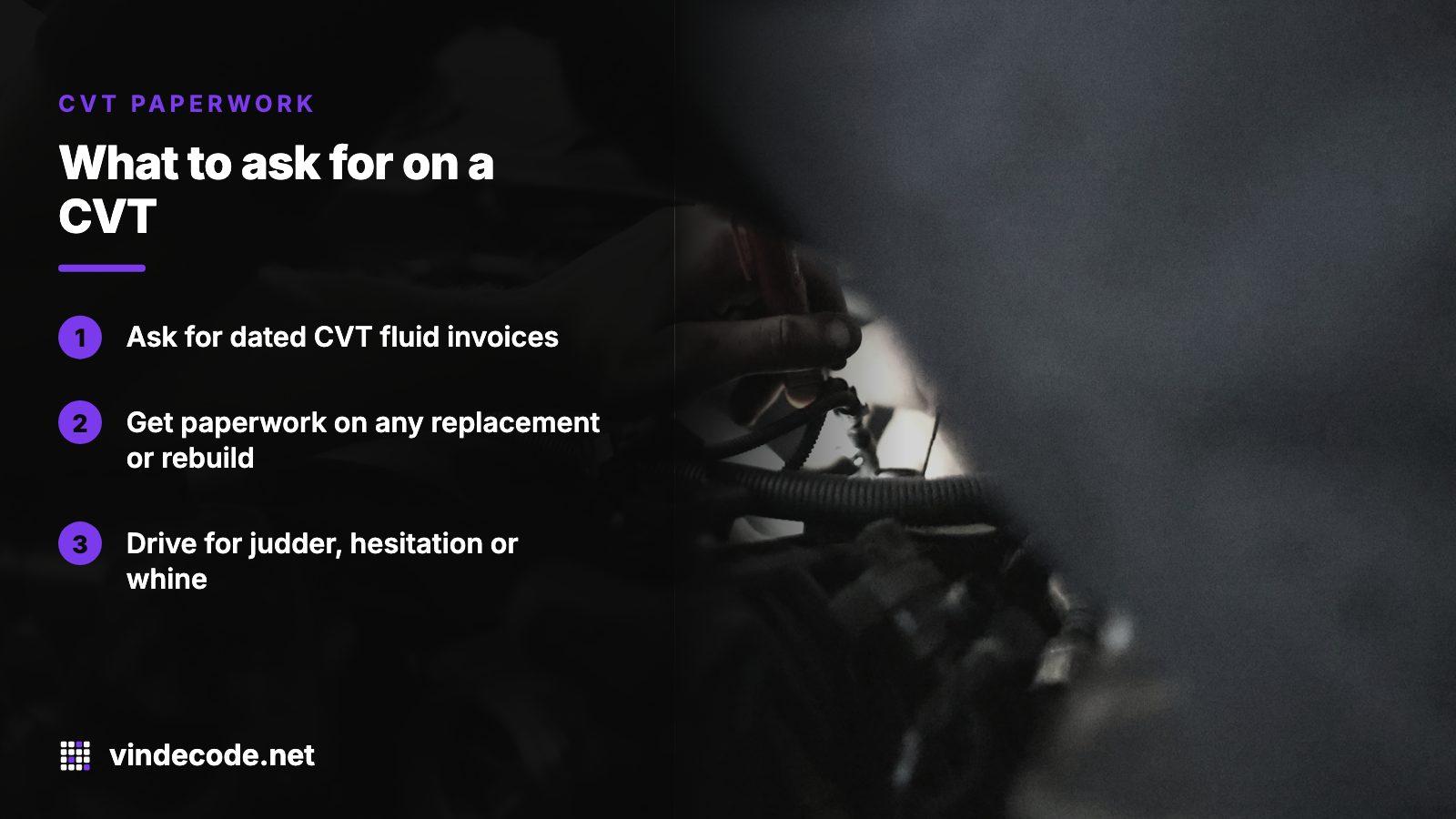
- A dated invoice for each CVT fluid service, naming the fluid
- Paperwork for any replacement or rebuild
- On your drive: judder under light throttle, hesitation pulling away, or a whine that climbs with speed
From an NHTSA owner complaint
A 2014 Altima owner, writing to NHTSA in 2021, had bought the car used and describes it as branded. That summer brought what the owner calls a recall notice to reprogram the transmission computer, plus a letter on longer CVT coverage for 2013 to 2016 Altimas. When the car began driving badly, Nissan confirmed the VIN was among those with transmission trouble and quoted $4,324.11 for a replacement, then declined help because the car was past the time and mileage limits.
A decode cannot show a title brand, but a history report's title records can, and a dealer can say within minutes whether a VIN sits inside a coverage extension.
Coverage follows the VIN, and a clean recall check says little about the gearbox
Extra CVT coverage is not set by model name; owners describe it reaching some VINs and skipping close neighbors, so a decode cannot say whether a car is inside it.
From an NHTSA owner complaint
A 2017 Rogue owner, filing in 2025, bought the car used at a Nissan dealership with 58,617 miles on it. Close to 99,000 miles the car hesitated and shuddered, and a certified Nissan dealer found a CVT judder fault, code P17F2, quoting above $6,000. The owner says the VIN missed the earlier coverage extensions and that Nissan turned down a goodwill repair. The partial VIN on the record starts JN8AT2MT, which NHTSA's decoder reads as a Japan-built 2017 Rogue with a CVT.
A clean recall lookup does not clear the gearbox either. Across NHTSA's recall records from 2009 through 2020 for the Altima, Rogue, Sentra, Versa, Pathfinder, Murano, Maxima and Juke, the only campaign naming the CVT covers certain 2013 Pathfinders built in 2012, where a cooler hose could detach (14V142000). Recalls and coverage letters are separate lists.
Recalls attach to VIN ranges: the Altima hood latch
Recalls name VIN ranges, not models, so a model-level search can list campaigns that miss your car. NHTSA's lookup answers for one VIN, and the maker repairs at no charge whoever owns the car. Campaign 20V315000 covers certain 2013 to 2018 Altimas: if the primary hood latch is released by accident, the secondary latch may have corroded and the hood could rise while driving. The remedy is a stronger release spring, a warning label and an owner's card on latch care.
From an NHTSA owner complaint
The owner of a 2015 Altima told NHTSA that the dealer who sold the car disclosed an open recall on its VIN, the hood latch campaign. The complaint says the maker was taking longer than reasonable to supply the repair, and a VIN tool showed the parts unavailable. No failure had occurred.
An open recall is not an automatic reason to walk away. Ask when the part is due.
Imported Nissans: when the number is not a VIN at all
Nissans never sold new in the US arrive once they clear the twenty-five-year import rule. A Japanese domestic car carries a chassis number in another format, not a 17-character VIN, and no US decoder or NHTSA lookup reads it, so a failed decode is expected.
- Get proof the import was cleared and that your state will title and register it
- Look the chassis code up in Japanese-market sources, not US ones
- Once titled, check the title records: brands and theft entries still apply
Where the decode stops and the history report starts
A VIN records how the car was built, nothing after. Crashes, a flood or salvage brand, wound-back mileage and money owed sit in title, damage, odometer and lien records instead.
| Question about the Nissan | Where the answer is |
|---|---|
| Is it the model, engine and drive advertised? | The decode |
| Does an Infiniti badge match its make? | The decode's make field |
| Was the CVT fluid changed on time? | The seller's invoices |
| Is there a salvage, flood or other brand? | History report: title records |
The history preview is free and needs no card. The report itself is one payment, alone or in a set of 3, 5 or 10, with nothing renewing; amounts sit on the pricing page. Decode first, collect the transmission paperwork, then open the preview before paying the seller.
Where this information comes from
- NHTSA: vPIC VIN decoder — The public database where Nissan files its VIN layouts and manufacturer prefixes, which the decode reads.
- NHTSA: recalls lookup — Open-recall check by VIN, with repairs done at no charge by the maker.
- NHTSA owner complaint 11437323 — owner experience, paraphrased
- NHTSA owner complaint 11672964 — owner experience, paraphrased
- NHTSA owner complaint 11395952 — owner experience, paraphrased
Sources and photos: Facts checked against the sources above in November 2026. Photos by engin akyurt, Mustafa Sheikhmouss and Sander Jeurissen on Unsplash; diagrams by VINDecode.
Keep reading
- VIN Decoder: Decode a VIN Number Online, Then Check Its HistoryAll 17 positions explained, check digit included.
- NHTSA VIN Decoder: What It Returns, Where It Stops, What Comes NextHow the federal database behind these results is built.
- Subaru VIN Decoder: Engine, Drivetrain, Plant and HistoryAnother CVT-heavy range with its own service questions.
- Sample reportA finished report, to see what the history adds to a decode.
Frequently asked questions
How do I decode a Nissan VIN?
Enter all 17 characters in the decoder on this page and compare model, year, engine, drive and plant with the listing. One wrong character gives an error or another car, so copy the number from the vehicle.
Can an Infiniti have a Nissan prefix on its VIN?
Yes. NHTSA's decoder returns Infiniti for models under JN1, JN8, 5N1, 3PC and SJK, which Nissan also uses, while JNK and JNR list Infiniti alone. Read the make field. Only a badge and a make field that disagree need explaining.
Does a Nissan VIN decode tell me if the car has a CVT?
Sometimes. The transmission field is filled only when Nissan filed it, and it came back blank for a 2014 Altima prefix despite that car's CVT trouble. Treat blank as unknown, confirm the gearbox on the car, and ask for dated service invoices.
How do I check a Nissan for open recalls?
Use NHTSA's recall tool with the VIN; it answers for that exact vehicle, so check again the day you buy. Recalls follow VIN ranges, so model lists mislead. The maker repairs at no charge, though parts can run short, as one Altima owner found.
Does a Nissan VIN decode show accidents, brands or mileage?
No. A decode describes the build, so crashes, salvage or flood brands, odometer readings and liens sit outside it. Those live in title, damage and mileage records, which the history preview opens up before you buy the full report.
Now check the car itself
The guide explains what to look for. The report shows what this VIN has on record.