THE SHORT ANSWER
Type all 17 characters of the Infiniti VIN into the decoder on this page. You get the model, model year, engine, drive type and plant, read from the code tables Nissan filed with NHTSA. JNK, JNR and 5N3 are listed for Infiniti alone, while seven others, among them JN1, 1N4 and 5N1, list Nissan too, so trust the make line. Accidents, brands and odometer history are not in a decode, so open the history preview before paying a seller.
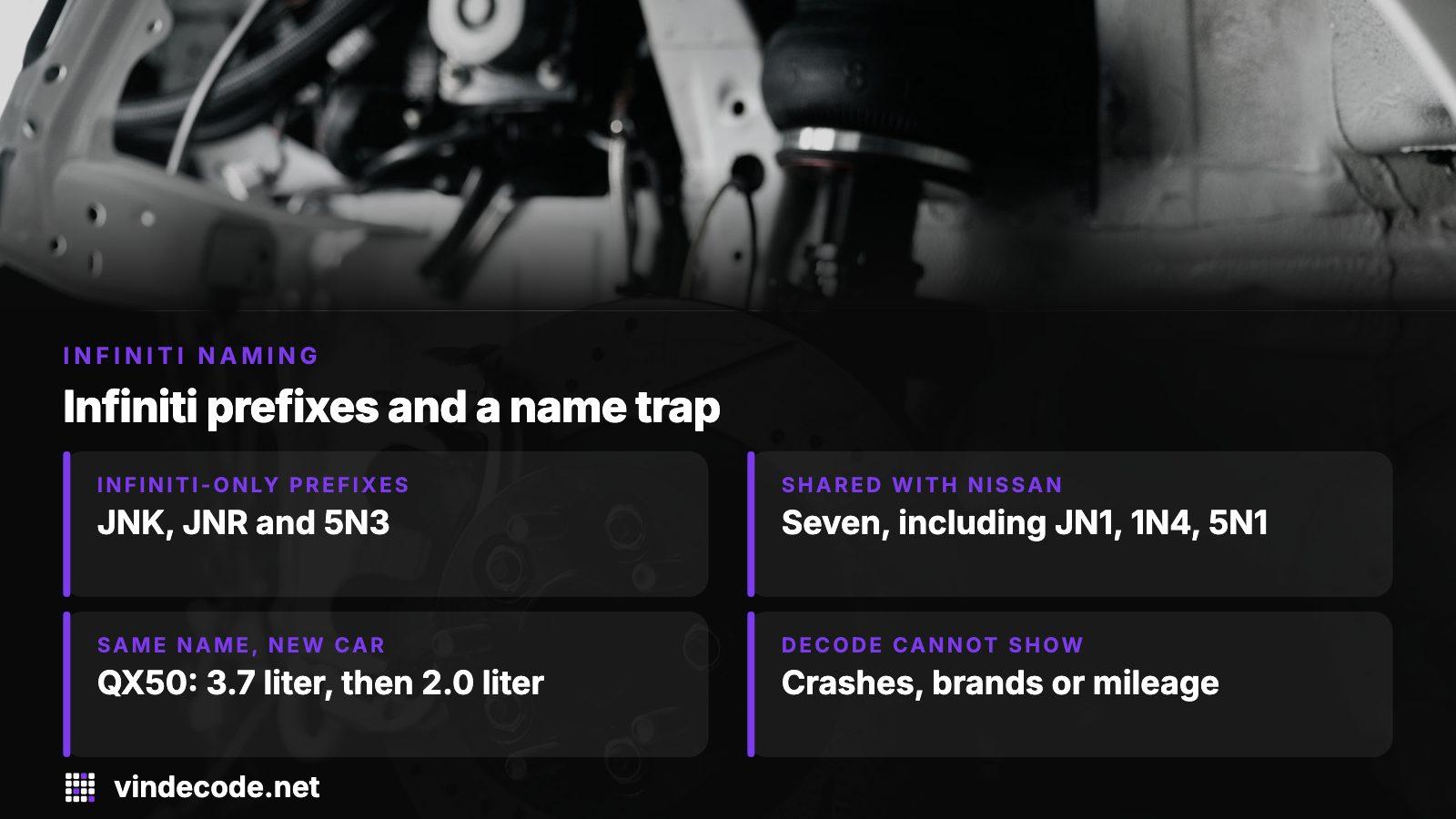
- Infiniti-only prefixes
- JNK, JNR and 5N3
- Shared with Nissan
- Seven, including JN1, 1N4 and 5N1
- Same name, new car
- QX50 is a 3.7 liter in 2014 and a 2.0 liter in 2019
- A decode cannot show
- Crashes, title brands or mileage
What an Infiniti decode actually returns
The decoder matches your number against the code tables Nissan filed with NHTSA's public vPIC database, so what comes back is the car as it left the factory. Detail varies: in six sample decodes of Infiniti VIN starts, displacement, drive type, body class and plant appeared every time, a transmission line only twice, and a cylinder count once.
- Model, model year and body style, such as sedan, wagon or crossover
- Engine size, with turbo and cylinder count when Nissan filed them
- Two-wheel or four-wheel drive, as the maker coded it
- Gearbox type, on the records that carry one
- Assembly plant, down to the city and country
The trim line came back empty on all six samples. Infiniti's own owner page runs a separate lookup that lists color and trim level, so use both tools when the trim moves the price.
The QX50 name covers two very different cars
Infiniti reuses and retires model names, so the badge in an ad settles less than the engine and plant lines do. NHTSA's database lists EX35, FX37, G37 and JX35 among its 2013 names, then Q50, QX50, QX60 and QX70 for 2014, and by 2023 the list is down to five names.
| Sample decode | Engine | Built at |
|---|---|---|
| 2014 QX50 | 3.7 liter | Tochigi, Japan |
| 2019 QX50 | 2.0 liter, CVT | Aguascalientes, Mexico |
| 2017 Q50 | 3.0 liter turbo | Tochigi, Japan |
| 2016 QX60 | 3.5 liter, 6 cylinders | Smyrna, Tennessee |
Same badge, different engine, different factory, different recalls. Decode first, then ask the seller about whichever line disagrees with the listing.
Prefixes: three are Infiniti's alone, seven are shared with Nissan
Characters one to three identify who built the car and what class of vehicle it is. NHTSA's records sort the car and crossover prefixes for Infiniti into two groups.
| Prefix | Listed under | Class, and country if listed |
|---|---|---|
| JNK | Infiniti only | Passenger car |
| JNR | Infiniti only | Multipurpose vehicle |
| 5N3 | Infiniti only | Multipurpose vehicle |
| JN1 | Nissan, Infiniti, Datsun | Passenger car, Japan |
| 1N4 | Nissan, Infiniti | Passenger car, United States |
| 3N1 | Nissan, Infiniti | Passenger car, Mexico |
| SJK | Nissan, Infiniti | Passenger car, United Kingdom |
| JN8 | Nissan, Infiniti | Multipurpose vehicle, Japan |
| 5N1 | Nissan, Infiniti | Multipurpose vehicle, United States |
| 3PC | Nissan, Infiniti | Multipurpose vehicle, Mexico |
On a shared prefix, the opening characters cannot say which badge the car should wear. The make line of the full decode does. A car badged Infiniti that decodes as a Nissan, or the reverse, deserves a plain question to the seller, because badges are easy to swap and a decode is not. Codes such as JNT and JNX sit under trucks and incomplete vehicles, not finished cars.
Why the engine and drive lines decide which recalls apply
Recalls are written against VIN ranges, and several Infiniti campaigns also name an engine or a drive type. The decode supplies both, so you can predict what the lookup should show.
| Decode line | Campaign it can decide |
|---|---|
| 2.0 liter engine in a 2016 to 2018 Q50 or a 2017 Q60 | 17V476000: fuel pump software that can starve and stall the engine |
| Two-wheel drive in a 2014 to 2018 Q50 | 24V470000: a driveshaft that can fatigue and break |
| 2.0 liter engine in a 2019 to 2022 QX50 or a 2022 QX55 | 25V437000: engine bearings, fixed with new control-module software |
The table shows scope only. The VIN decides who is actually included, so run NHTSA's recall lookup or Infiniti's own too. Infiniti's page says retailers do the repair at no charge.
From an NHTSA owner complaint
An owner of a 2003 Infiniti FX35 reported to NHTSA that the air bag warning light had come on. The symptom seemed to fit recall campaign 20V008000, but the VIN was not listed in it, and the owner says the manufacturer confirmed the car was not under recall. Mileage at the time was roughly 150,000.
Matching symptoms are not enough. Only the exact VIN settles whether a car is in a campaign.
Typing the VIN right, and what positions 10 and 11 give away
Read the number off the vehicle itself, never the advert. Federal rules say a person standing outside should be able to see it through the windshield at the driver's end, with letters and digits at least 4 mm high. Match it to the title before you enter it.
A valid VIN runs to 17 characters, and the letters I, O and Q are excluded from it. NHTSA's decoder accepts a partial number, though its records mark that kind of decode as incomplete, so supply every character. Position 9 is a check digit, there to catch transcription slips.
| Position | Holds | Seen in the Infiniti samples |
|---|---|---|
| 10 | Model year code | E 2014, G 2016, H 2017, K 2019 |
| 11 | Plant | M at Tochigi, C at Smyrna, F at Aguascalientes |
On NHTSA's own decoder, leave the model-year box empty unless you know the year. A year typed there overrides the one read from position 10, and that code is a model-year label, not the build date.
What a decode leaves out
A decode describes construction. Any VIN that passes the check returns a tidy result, whether the car wearing it has been wrecked, wound back or stolen. The Justice Department's vehicle-history site describes a ring that fitted stolen cars with VINs lifted from matching ones, which buyers, titling agencies and police could not detect.
From an NHTSA owner complaint
An owner of a 2003 Infiniti G35 told NHTSA that the used car they bought had been totaled by its previous owner. The dealer, the owner says, bought the wreck at auction, repaired it and sold it with no salvage title, and the air bag system did not work. They say they requested a history report, but it slipped their mind amid the paperwork, and on trying to return the car the next day they were turned away.
A build decode of that car would have looked ordinary. The damage sat in records a decode never reads.
| Your worry | Where it shows up |
|---|---|
| Wrong engine, drive or plant | The decode |
| Salvage, junk or flood brand | Title records |
| Mileage that does not add up | Odometer readings in the history |
| Insurer total loss, salvage-yard stop | Insurance and salvage records |
Treat a clean report as encouraging rather than conclusive: the federal title database can miss problems, and states do not brand damage alike.
What it costs, and the order to run the checks
The history preview is free, and no card is needed to open it. The full report is bought once, for one vehicle or for 3, 5 or 10 of them, and no recurring charge follows. You will find the amounts on the pricing page.
- Run the decoder and hold the result against the ad: model, engine, drive, plant.
- If the prefix is shared with Nissan, read the make line.
- Run the recall lookup for this exact VIN.
- Open the history preview, and buy the full report once title, damage and mileage look sound.
- Book an independent inspection before you hand over any money.
Where this information comes from
- NHTSA vPIC: VIN decoder — How the public decoder treats partial VINs, the year override and plant data, all reported by the maker.
- 49 CFR Part 565: VIN requirements — The federal rules for VIN length, characters, check digit, year code and where the number must be visible.
- NHTSA recalls data: Infiniti Q50 — Campaign scope, engine and drive conditions, and the free remedies for the recalls named above.
- INFINITI owner recall and VIN lookup — The maker's own lookup, which lists color and trim level alongside engine and year.
- NMVTIS consumer information (Bureau of Justice Assistance) — What title-system records can show, the VIN cloning case and the gaps in state reporting.
- NHTSA owner complaint 10280176 — owner experience, paraphrased
- NHTSA owner complaint 11415922 — owner experience, paraphrased
Sources and photos: Facts checked against the sources above in November 2026. Photos by Rafał Karoń, Masjid MABA and Erik Mclean on Unsplash; diagrams by VINDecode.
Keep reading
- Nissan VIN Decoder: Plant Codes, Infiniti Prefixes and the CVT CheckThe parent maker, whose prefixes Infiniti shares.
- VIN Decoder Year Chart: Position 10 Codes for 1980 to 2039The tenth-character year codes laid out as a chart.
- NHTSA VIN Decoder: What It Returns, Where It Stops, What Comes NextHow the public NHTSA decoder works and where its data stops.
- Sample reportA finished report, to see what the history adds beyond the decode.
Frequently asked questions
How do I decode an Infiniti VIN?
Type all 17 characters into the decoder on this page. It reads them against the layout Nissan filed with NHTSA and returns the model, year, engine, drive type and plant. One wrong character means an error or a different car, so recheck what you typed against the car.
Does an Infiniti VIN decoder show accidents or mileage?
No. A decode describes how the car was built. Crashes, salvage or flood brands and odometer readings live in title, damage and mileage records, which a history report gathers for the same VIN. Use the decode to confirm the car, and the report to see its past.
Which VIN prefixes does Infiniti use?
Among car and crossover prefixes, NHTSA lists JNK, JNR and 5N3 for Infiniti alone. Seven more, including JN1, 1N4, 3N1 and 5N1, list Nissan alongside it. A shared prefix is normal on an Infiniti, so the make line of the full decode matters more than the first three characters.
Why does my Infiniti VIN decode as a Nissan?
If the prefix is one of the shared ones, the opening characters cannot tell the brands apart, and the make comes from the rest of the number. A badge that disagrees with the decoded make is worth a written explanation from the seller, and a look at the title.
Is there a free Infiniti VIN decoder?
Yes. NHTSA's vPIC decoder and Infiniti's own VIN lookup cost nothing, and both are worth running. Neither reads title or damage records. For those, open the history preview on this site, which asks for no payment, and pay for a report only once the car checks out.
Now check the car itself
The guide explains what to look for. The report shows what this VIN has on record.