THE SHORT ANSWER
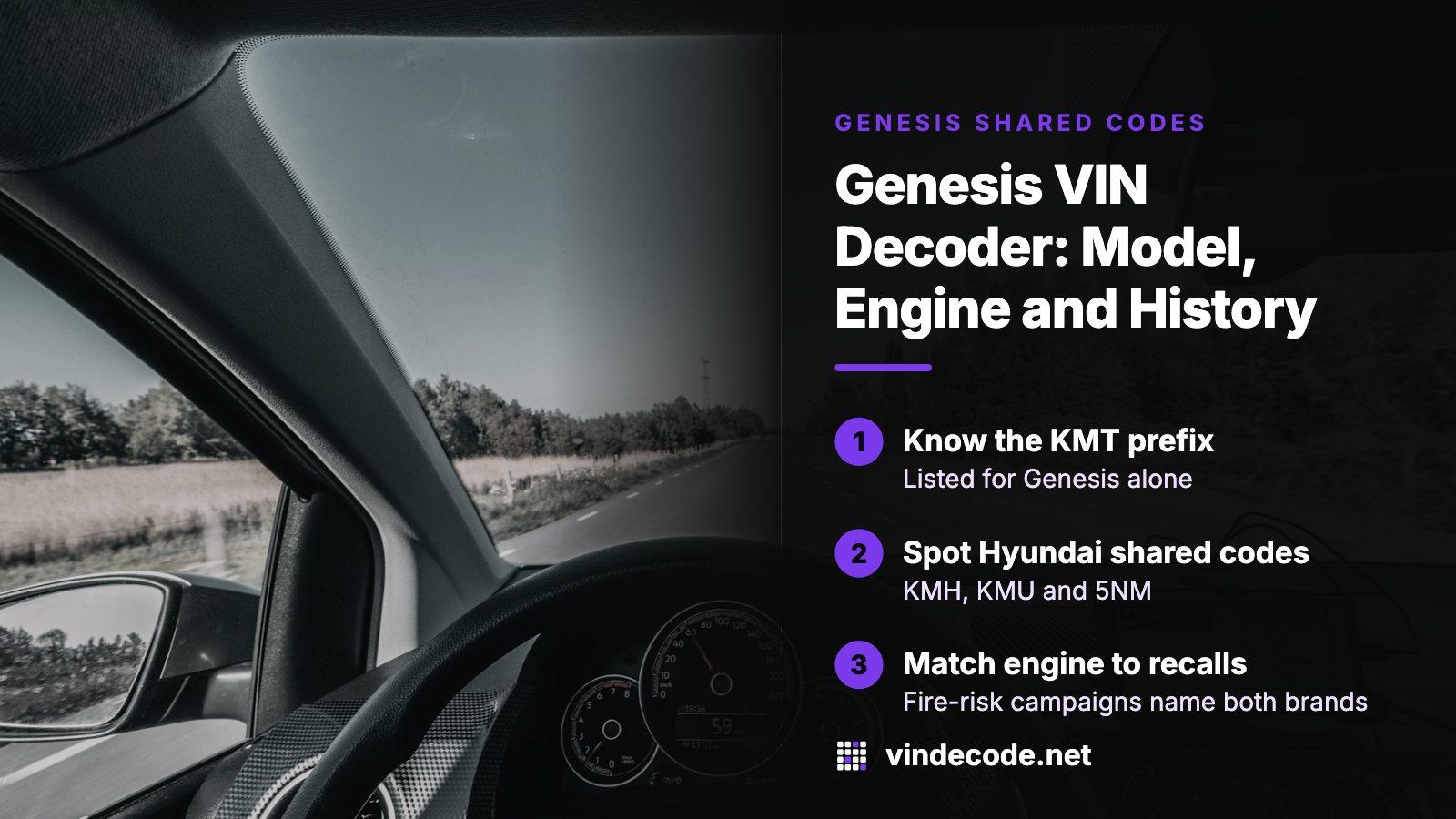
Enter all 17 characters of the Genesis VIN in the decoder on this page. It returns the make, model, year, engine, drive and plant from data Hyundai filed with NHTSA. KMT is listed for Genesis alone, while KMH, KMU and 5NM are shared with Hyundai, so trust the make line over the badge. Crashes, brands and odometer history sit outside a decode, so open the history preview before you pay a seller.
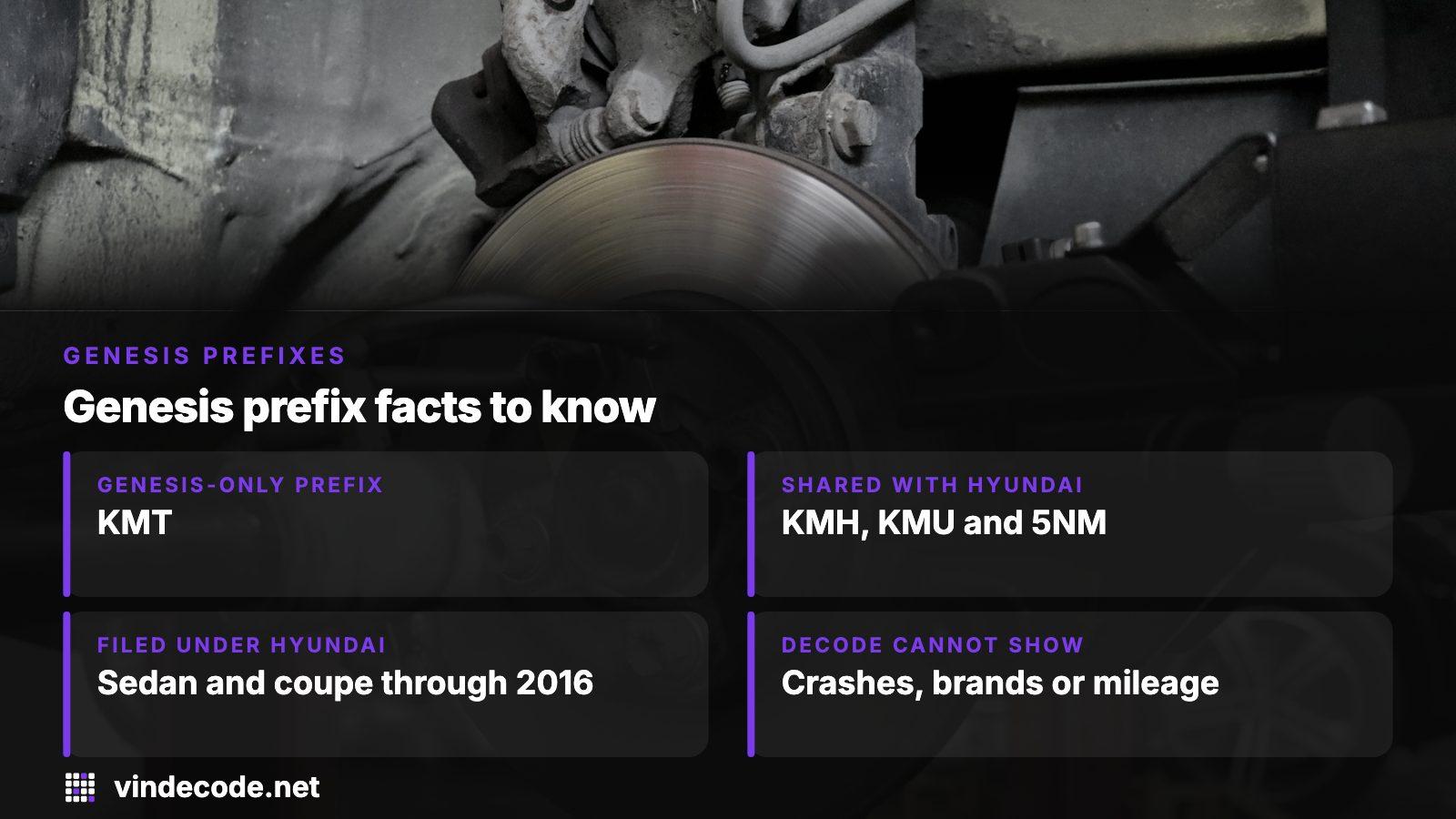
- Genesis-only prefix
- KMT
- Shared with Hyundai
- KMH, KMU and 5NM
- Filed under Hyundai
- Genesis sedan and coupe through 2016
- A decode cannot show
- Crashes, brands or mileage
What a Genesis decode puts on the screen
The decoder matches your VIN to patterns Hyundai Motor filed with NHTSA, so you get the maker's description of the car, not the seller's. Use it to catch an ad that names the wrong engine or year.
| Decoded field | Hold it against |
|---|---|
| Make, model and model year | The badge and the year on the title |
| Engine size, cylinders and turbo | The engine in the ad, since one name covers several |
| Drive type and body class | All-wheel or rear-wheel drive, sedan or SUV |
| Plant city and country | Where the car was built |
The G70, G90 and GV80 patterns checked for this page returned Ulsan, South Korea as the plant. An empty field only means NHTSA has no data, so do not read it as a missing feature, and a trim field can arrive as a list of several trims.
Two kinds of car carry the Genesis name
Through model year 2016, NHTSA files the Genesis sedan and the Genesis Coupe under the Hyundai make. The separate Genesis make starts with the 2017 G80 and G90. A listing that says only Genesis could mean any row below.
| Name in the listing | Filed under | Model years |
|---|---|---|
| Genesis sedan | Hyundai | 2009 through 2016 |
| Genesis Coupe | Hyundai | 2010 through 2016 |
| G80 and G90 | Genesis | 2017 on |
| G70 | Genesis | 2019 on |
| GV80 | Genesis | 2021 on |
| GV70 | Genesis | 2022 on |
| GV60 | Genesis | 2023 on |
Recall lists cut across that line: NHTSA has campaigns naming the 2015-2016 Hyundai Genesis and the 2017-2020 G80 together, so only the VIN says which list a car is on.
First three characters: one Genesis-only code, three shared
NHTSA's manufacturer table lists these codes. Only KMT carries the Genesis make alone; the other three can belong to a Hyundai, so let the decoded make line settle it.
| Prefix | Type in the table | Makes listed |
|---|---|---|
| KMT | Passenger car | Genesis |
| KMU | Multipurpose passenger vehicle | Hyundai, Genesis and HMC |
| KMH | Passenger car | Hyundai and Genesis |
| 5NM | Multipurpose passenger vehicle, Alabama plant company | Hyundai and Genesis |
A shared code is a reason to read on, not a warning. One 5NM pattern in NHTSA's tool came back as a Hyundai Tucson.
Why the engine line decides which recalls apply
One model name can hide several engines. EPA lists the 2019 G80 with a turbocharged 3.3 liter six, a 3.8 liter six and a 5.0 liter eight, and the 2021 G70 with a 2.0 liter turbo four or the 3.3 turbo six. Recalls can be limited by engine, as below.
| Campaign | Cars named | Limited to |
|---|---|---|
| 24V191000, turbo oil pipe | 2018-2020 G80, 2017-2022 G90, 2019-2022 G70 | 3.3 liter turbo V6 |
| 20V569000, fuel pump | 2021 G70 | 2.0 liter engine |
| 21V208000, fuel tube | 2021 G80 and GV80 | 2.5 liter turbo |
| 23V300000, driveshafts | 2023 GV60 | All-wheel drive |
The oil-pipe campaign replaces an earlier one, 19V-538, so a car fixed under the old number still needs the new repair.
Getting the 17 characters right
Take the number from the vehicle itself, because a listing can carry a typo.
- Stand at the driver's front corner and sight along the dash edge where it meets the windshield to find the plate. Then open the door and read the label in the jamb. Both must match the title.
- Enter all 17 characters. Leave any model year box empty unless you are sure of it, since NHTSA's tool prefers a year you type over the one in the VIN.
- If the result says the ninth character does not calculate, suspect a typo and read the plate again.

Red flags when the decode and the car disagree
Put each mismatch to the seller in writing before any deposit.
| What you see | What to do |
|---|---|
| Make line says Hyundai on a car sold as a newer Genesis | Ask for the title and price from the decode |
| Engine or drive differs from the ad | Ask which is right; it changes which recalls apply |
| Plate, door label and title disagree | Stop until you have a written explanation |
| A fire-risk recall is open with no repair date | Ask for a dealer's written date, or price in the wait |
| The decode comes back nearly empty | Recheck the characters, then open the history preview |
From an NHTSA owner complaint
The owner of a 2019 G70 bought certified used from a Ford dealer told NHTSA that no authorized repair center for an open recall could be found in the owner's city or state. Genesis said its site was down, callbacks never came, and two Hyundai dealerships, the owner says, refused the job.
Spotting an open recall is half the job; learn where and when it gets repaired before you sign.
What a decode leaves out
A decode is the maker's build description, so it cannot speak to anything that happened once the car rolled off the line. NMVTIS, the federal title database, can show a car's current title and brands, the most recent odometer figure on record, insurer total-loss rulings and any transfer to a salvage yard.
The consumer page itself calls the report intentionally concise and warns of false negatives, since not every entity reports yet. A history report on the same VIN adds:
- Title brands such as salvage or flood, with the damage records behind them
- Odometer readings across the car's life
- Salvage and auction history with photos
- Liens, theft records and open recalls under one VIN
What it costs, and the order to run the checks
Look at the preview first; it costs nothing. A full report is a one-off payment for one car, with bundles of three, five or ten for shoppers who are comparing. No plan renews itself, and the pricing page lists the amounts.
- Start by decoding the VIN and comparing each field with the listing.
- Run NHTSA's recall lookup and Genesis's own. Genesis says its records reach back to May 2018, so use both for an older car.
- Open the history preview, buy the full report once the build and history agree, and match the plate and door label to the title at handover.
Where this information comes from
- NHTSA vPIC: VIN decoder — The federal decoder behind these results, with its limits on partial VINs and model years stated.
- NHTSA recalls data: Genesis G80 — Campaign text for the G80 and the shared Hyundai Genesis recalls, including engine and drive limits.
- EPA fueleconomy.gov: Genesis G80 engine options — The engines listed under one Genesis model name for a single model year.
- Genesis: recall and service campaign lookup — The maker's own lookup by VIN, with the date its records start.
- NMVTIS consumer information (Bureau of Justice Assistance) — What the federal title database shows, and where it can miss.
- NHTSA owner complaint 11598802 — owner experience, paraphrased
- NHTSA owner complaint 11694324 — owner experience, paraphrased
Sources and photos: Facts checked against the sources above in November 2026. Photos by Sander Jeurissen, Dylan Michaud and Media Digital on Unsplash; diagrams by VINDecode.
Keep reading
- Hyundai VIN Decoder: Read the Build, Then Check the HistoryThe parent maker, whose codes Genesis shares and whose name sits on the older Genesis cars.
- NHTSA VIN Decoder: What It Returns, Where It Stops, What Comes NextHow the federal decoder behind these results works, and where its data stops.
- VIN Decoder Year Chart: Position 10 Codes for 1980 to 2039Year codes in the tenth position, handy at the 2016 to 2017 name change.
- Sample reportA finished history report, to see what it adds once the decode is done.
Frequently asked questions
How do I decode a Genesis VIN?
Enter all 17 characters in the VIN box on this page. The decoder checks them against Hyundai Motor's filings with NHTSA and shows make, model, year, engine, drive and plant. An error or the wrong car usually means a typo, so compare your entry with the number on the car.
Is a Genesis VIN different from a Hyundai VIN?
Same layout, different codes. KMT is listed for Genesis alone, while KMH, KMU and 5NM are shared with Hyundai. Genesis sedans and coupes through model year 2016 are filed under Hyundai, so trust the make line in the decode.
Can a decoder show open recalls on a Genesis?
No, a decode describes the build. Recalls follow VIN lists, so enter yours on NHTSA's recall lookup and on Genesis's own page, which covers safety recalls and service campaigns. The decoded engine and year then help you read which campaign applies.
Do I pay for a Genesis recall repair?
Where a fix is published, NHTSA's campaign text says dealers do it free of charge, and Genesis's page says the same. The catch is timing: owners have told NHTSA about months without a repair, so book early and keep the paperwork.
Does a Genesis decode show accidents or odometer problems?
No. Crashes, title brands and mileage sit in separate databases a decode never touches. Run the free history preview first, and move on to the full report, a one-off charge with nothing recurring, only for a car that holds up.
Now check the car itself
The guide explains what to look for. The report shows what this VIN has on record.