THE SHORT ANSWER
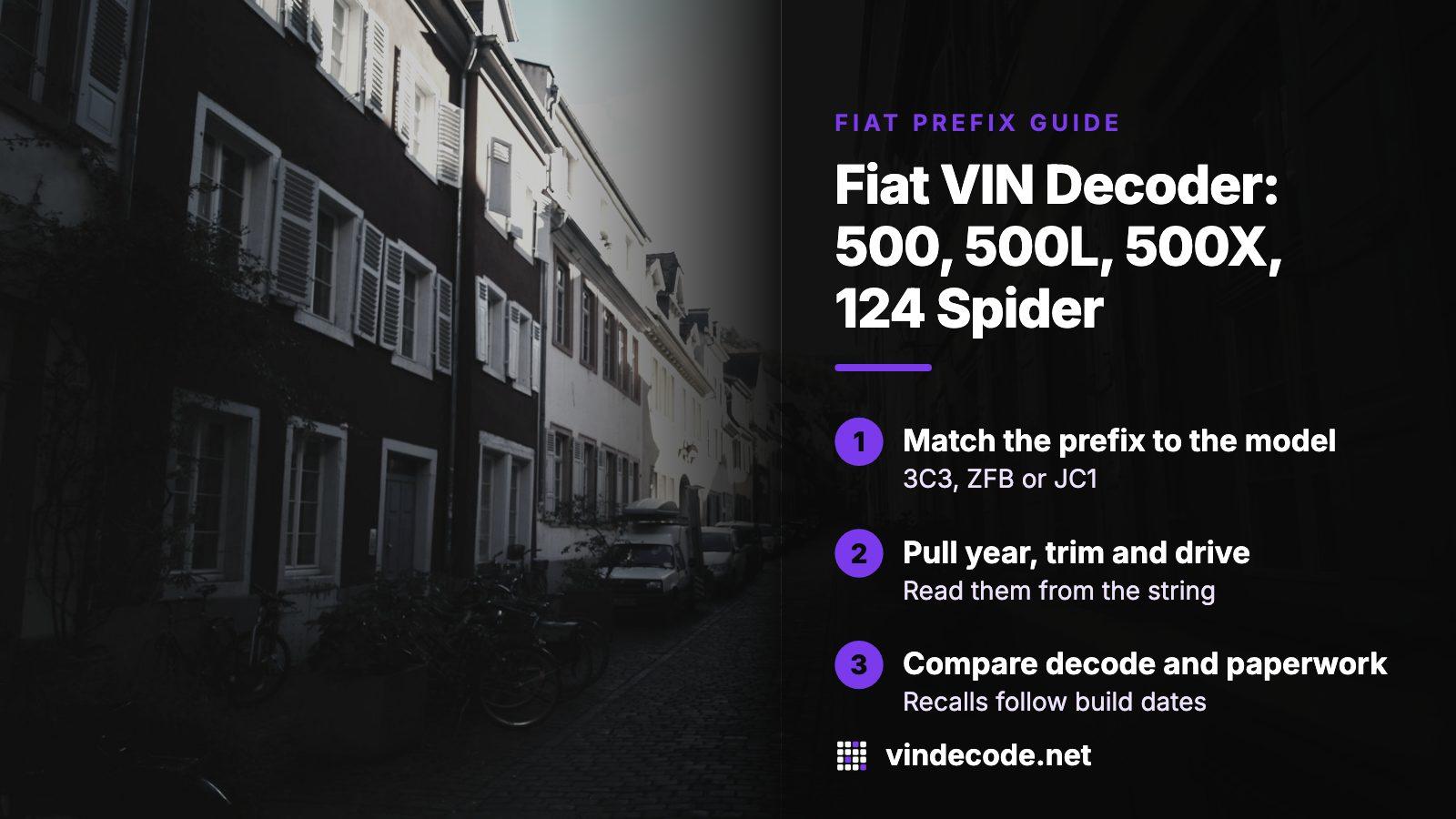
Enter the whole VIN in the decoder at the top. Fiats sold here carry 3C3 (the 500, built in Mexico), ZFB (the 500L and 500X, built in Serbia and Italy) or JC1 (the 124 Spider, built by Mazda in Japan). The decode returns year, trim, engine, drive and plant. It cannot show salvage brands, accidents or odometer history, so run the free preview of a history report and search the VIN for recalls.
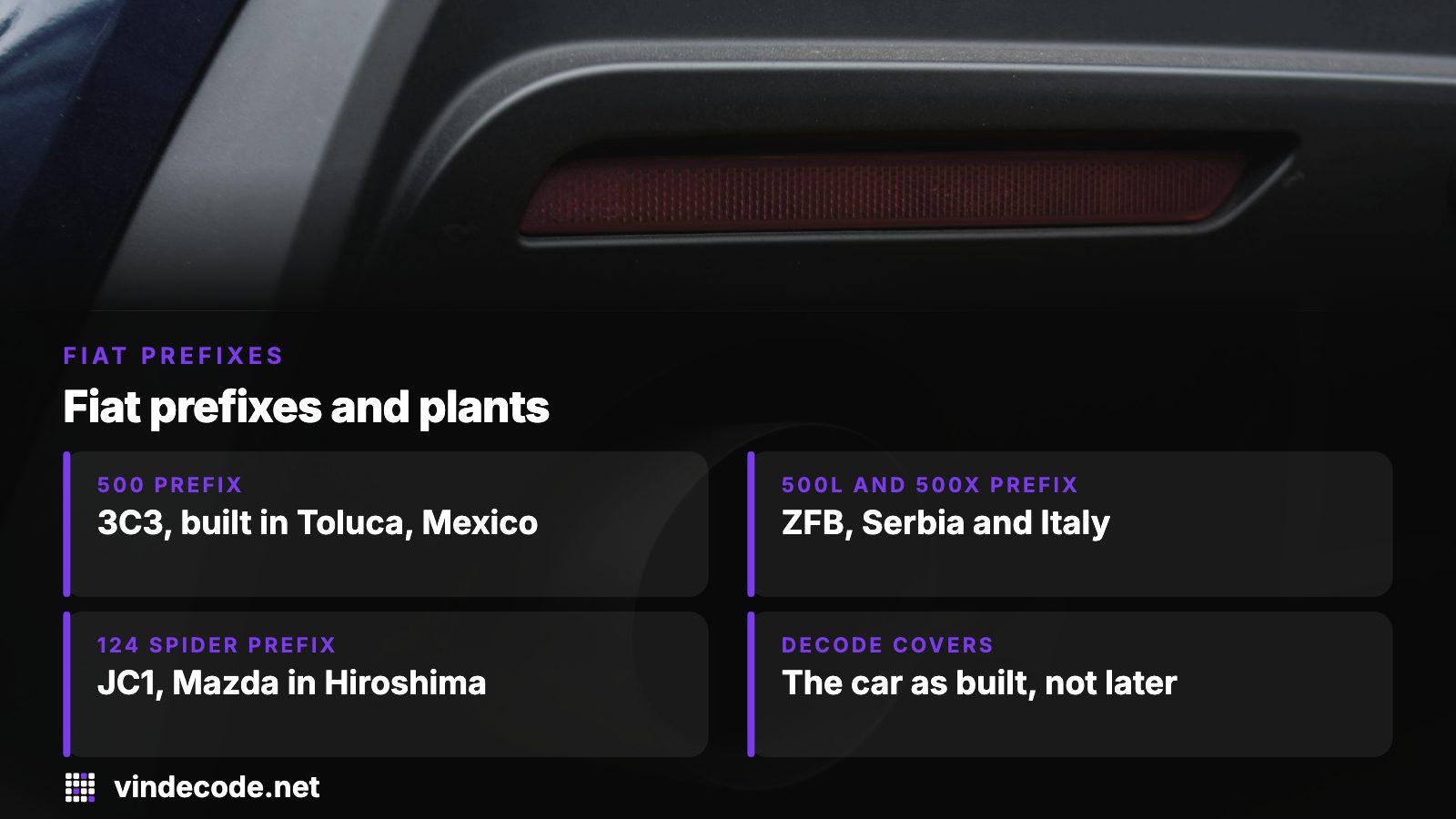
- 500 prefix
- 3C3, built in Toluca, Mexico
- 500L and 500X prefix
- ZFB, Serbia and Italy
- 124 Spider prefix
- JC1, Mazda in Hiroshima
- Decode covers
- The car as built, not its later life
Three prefixes, one badge
Most brands keep one identifier for a decade. Fiat does not. Searching NHTSA's manufacturer table for the name Fiat returns nothing at all, so the lookup has to go through the first three characters of the VIN instead.
Those three characters name a factory and a filer. 3C3 belongs to Chrysler de Mexico at Toluca, under FCA US. ZFB belongs to Stellantis Europe and is shared with Jeep and Ram. JC1 belongs to Mazda Motor Corporation. A Fiat with an unfamiliar start is not automatically suspicious, but the decode should agree with the badge on the trunk lid.
What the federal decoder returned for real Fiats
I took short prefixes from owner complaints filed with NHTSA, one set per model, and fed them to the public decoder. Each answer was flagged as an incomplete VIN, which is normal when only 11 characters go in.
| Car | Starts | Engine | Drive | Plant |
|---|---|---|---|---|
| 2012 500 Lounge convertible | 3C3 | 1.4 L four | Front-wheel | Toluca, Mexico |
| 2012 500 Abarth | 3C3 | 1.4 L four, turbo | Front-wheel | Toluca, Mexico |
| 2014 500L Easy | ZFB | 1.4 L four, turbo, 165 hp | Front-wheel | Kragujevac, Serbia |
| 2016 500X Trekking | ZFB | 2.4 L four, 184 hp | All-wheel | Melfi, Italy |
| 2018 124 Spider | JC1 | 1.4 L | Not returned | Hiroshima, Japan |
The blank drive field on the last row is worth remembering. A decoder repeats what the maker supplied, so an empty box means ask the seller.
Pulling year, trim and drive out of the string
The tenth character is the model year. In the decodes above, C gave 2012, E gave 2014, G gave 2016 and J gave 2018. The position after it is the assembly plant code, and on the Mexican cars it was T every time I looked.
- Characters 1 to 3: who built it, which settles the country.
- Characters 4 to 8: the model, body, engine and restraint details. This is where trim and drive come from.
- Character 9: the check digit, which flags a mistyped VIN.
- Character 10: model year. Character 11: plant.
Two 2016 500X prefixes began the same way up to a point, yet one decoded as front-wheel drive and one as all-wheel drive. The model name alone never tells you the drivetrain.
When the decode and the paperwork disagree
Fiat trims are a common place for confusion, because some trim fields carry labels for more than one market in a single string. The 500X decode for one prefix reads Easy for the US and Mexico and Sport for Canada.
From an NHTSA owner complaint
The owner of a 2016 500X wrote that they were told they bought a Trekking, but the paperwork said Lounge 2. They added that two different VIN searches returned two different models. NHTSA's own decoder returns Trekking for that prefix.
Take from it that you line the decode up with the title and the sales paperwork before any money moves. If one source says something else, ask which document is wrong and get the answer in writing.
Recalls attach to build dates, not to the model name
Fiat campaigns are narrow. The clutch recall for 2012 to 2016 manual 500s covers cars built between June 2010 and January 2016. The shifter cable recall covers only 2012 and 2013 cars with the six-speed automatic. A 2012 500 owner could be inside one and outside the other.
From an NHTSA owner complaint
A 2012 500 owner filed that the transmission failed to shift at about 25 mph and the car lost drive power. The dealer and the maker both told them the VIN was not under recall. The failure came at roughly 187,000 miles, and nobody was hurt.
That is the reason to search the exact VIN on NHTSA's recall page every time. A decode tells you which campaigns might apply; the search tells you whether yours does.
A few campaigns to know by model
- 2012 500: contaminated brake fluid in cars built over three days in October 2011, plus the clutch spring and shifter cable campaigns above.
- 2014 500L: engine control software that could hold the car at idle speed, a driver knee air bag folding fault, and a delayed shift lever response in certain temperatures.
- 2016 500X: a nine-speed transmission sensor campaign that also covers Jeep and Ram vehicles.
- 2018 124 Spider: a 2024 air bag control module software error that could deploy the front air bags with excessive force.
Treat the list as a map of what to ask about, not a verdict on any one car. Ask the dealer to confirm in writing which campaigns your VIN shows.
What the build record cannot tell you
A decode describes a car on the day it left the line. Anything after that is outside it. The federal title system behind NMVTIS holds title details, the newest odometer figure, any brand a state applied (junk, salvage, flood) and now and then theft data.
- A 500 that was totaled and rebuilt decodes exactly like one that never was.
- A cluster swapped late in life will not show up in a build record.
- A lien or an auction appearance sits in separate files, not in the factory data.
On a used car, those gaps matter more than the engine size.
Running the decode and the history together
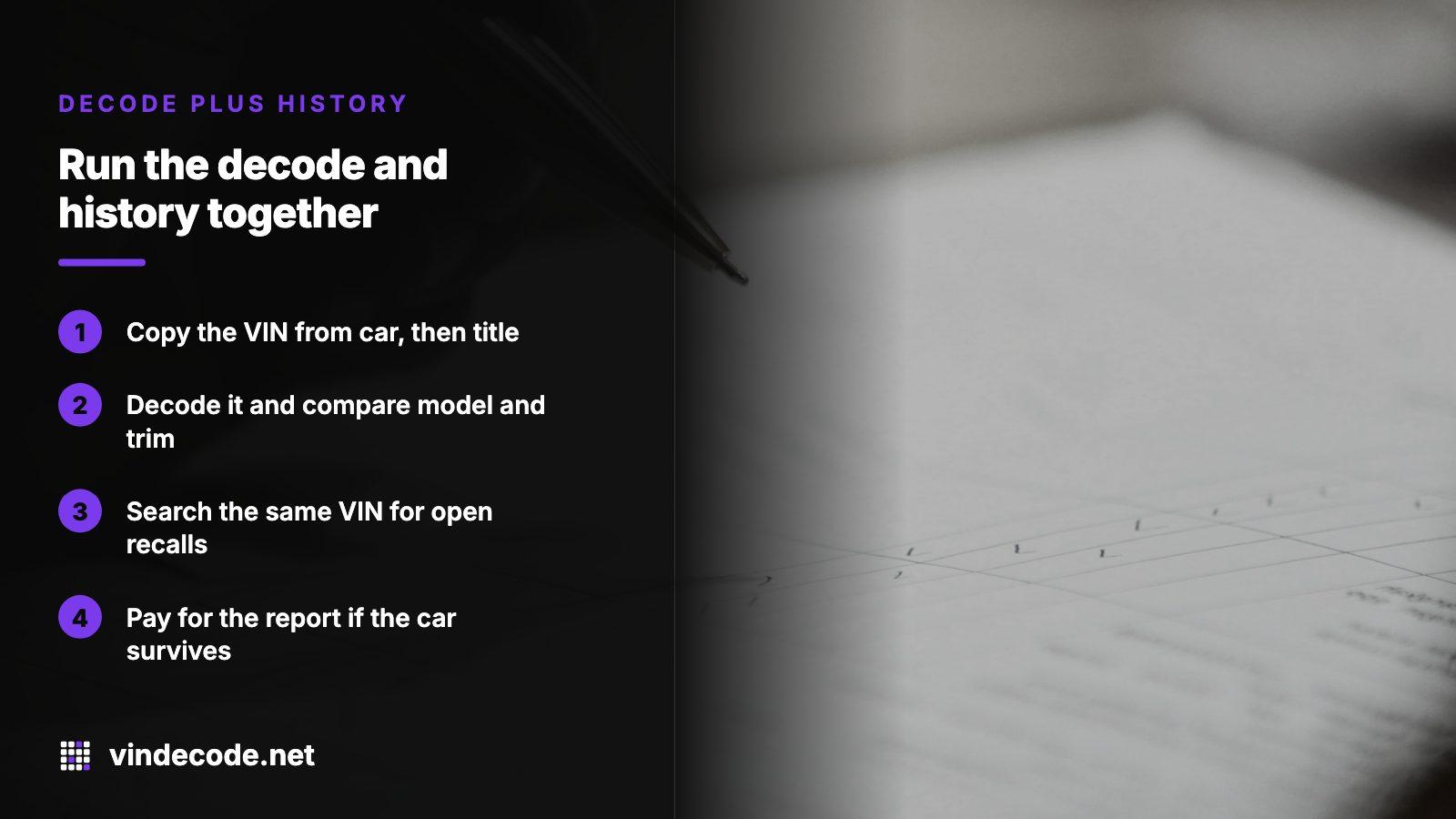
- Copy the VIN from the car itself, then from the title, and confirm both strings are identical.
- Decode it above and compare model, year, trim, engine and drive with the listing.
- Search the same VIN for open recalls on NHTSA's site.
- Run the free preview of a history report to see whether brands or records exist.
- Pay for the full report only when the car survives those steps.
If the listing shows no VIN, or hides a few characters, treat that as the first red flag on the car.
Cost and what happens after the preview
The decoder and the preview cost nothing. One payment buys the full report for a single vehicle, and bigger packs exist for shoppers comparing several Fiats. Nothing renews. See the pricing page for amounts.
If the preview shows a clean history and the recall search is clear, you have two public-record checks agreeing with the seller. If either one disagrees, you have a reason to walk, or to ask for a lower price with the documents in hand.
Where this information comes from
- NHTSA vPIC: Vehicle API documentation — Where the decoder, the partial-VIN rule, the maker lookup by prefix and the model list come from.
- NHTSA recalls — The VIN recall search and the campaign records for each model year cited here.
- BJA NMVTIS for consumers — What the federal title system holds and what a brand means.
- NHTSA owner complaint 11350898 — owner experience, paraphrased
- NHTSA owner complaint 11540187 — owner experience, paraphrased
Sources and photos: Facts checked against the sources above in November 2026. Photos by Karwin Luo, Masjid MABA and Dain Lindo on Unsplash; diagrams by VINDecode.
Keep reading
- Alfa Romeo VIN Decoder: Giulia and Stelvio Decoded, Then CheckedAnother Italian brand, with its own prefixes and an open fuel pump recall.
- Jeep VIN Decoder: Read a Wrangler, Gladiator or Compass BuildJeep shares the ZFB prefix with the 500X through Stellantis.
- VIN Decoder Explained: What Decoding a VIN Means and How It WorksThe full position-by-position method behind every decoder.
- VIN Decoder Year Chart: Position 10 Codes for 1980 to 2039Check the tenth-character year letter against a chart.
Frequently asked questions
How do I decode a Fiat VIN?
Enter all 17 characters in the decoder at the top of this page. It returns model year, model, trim, engine, drive and assembly plant as filed with NHTSA. Compare each field with the listing and title, then search the same number for open recalls before you spend money on the car.
Why do Fiat VINs start with different letters?
Fiat built its US models at different factories. The 500 came from Toluca in Mexico under 3C3, the 500L and 500X from Serbia and Italy under ZFB, and the 124 Spider from Mazda in Japan under JC1. Each prefix names the builder, so three starts can all be genuine.
Does a VIN decode show if a Fiat was in an accident?
No. A decode reads the build data the maker filed, so a wrecked and rebuilt 500 decodes the same as an untouched one. Accidents, salvage brands and odometer readings sit in title and insurance files, which a history report gathers.
Can I check Fiat recalls with the VIN?
Yes, NHTSA's recall page takes a VIN and tells you whether an open campaign applies to that exact car. This matters because Fiat campaigns are limited by build dates and equipment, and one owner was told by the dealer that their VIN had no recall.
Is the Fiat VIN decoder and report free?
The decoder and the history preview are free. The full report is bought once, for one vehicle or as a pack, and never renews; the pricing page lists amounts. You only pay if the preview and decode leave the car worth a deeper look.
Now check the car itself
The guide explains what to look for. The report shows what this VIN has on record.