THE SHORT ANSWER
Every Ducati VIN starts with ZDM for Italian-built bikes or ML0 for Thai-built ones. Position 10 is the model year and position 11 is the plant. The decoder turns those into a model, year and engine size. Crash damage, title brands, mileage readings and theft sit in other records, so run a report on the same VIN before paying for a used bike.
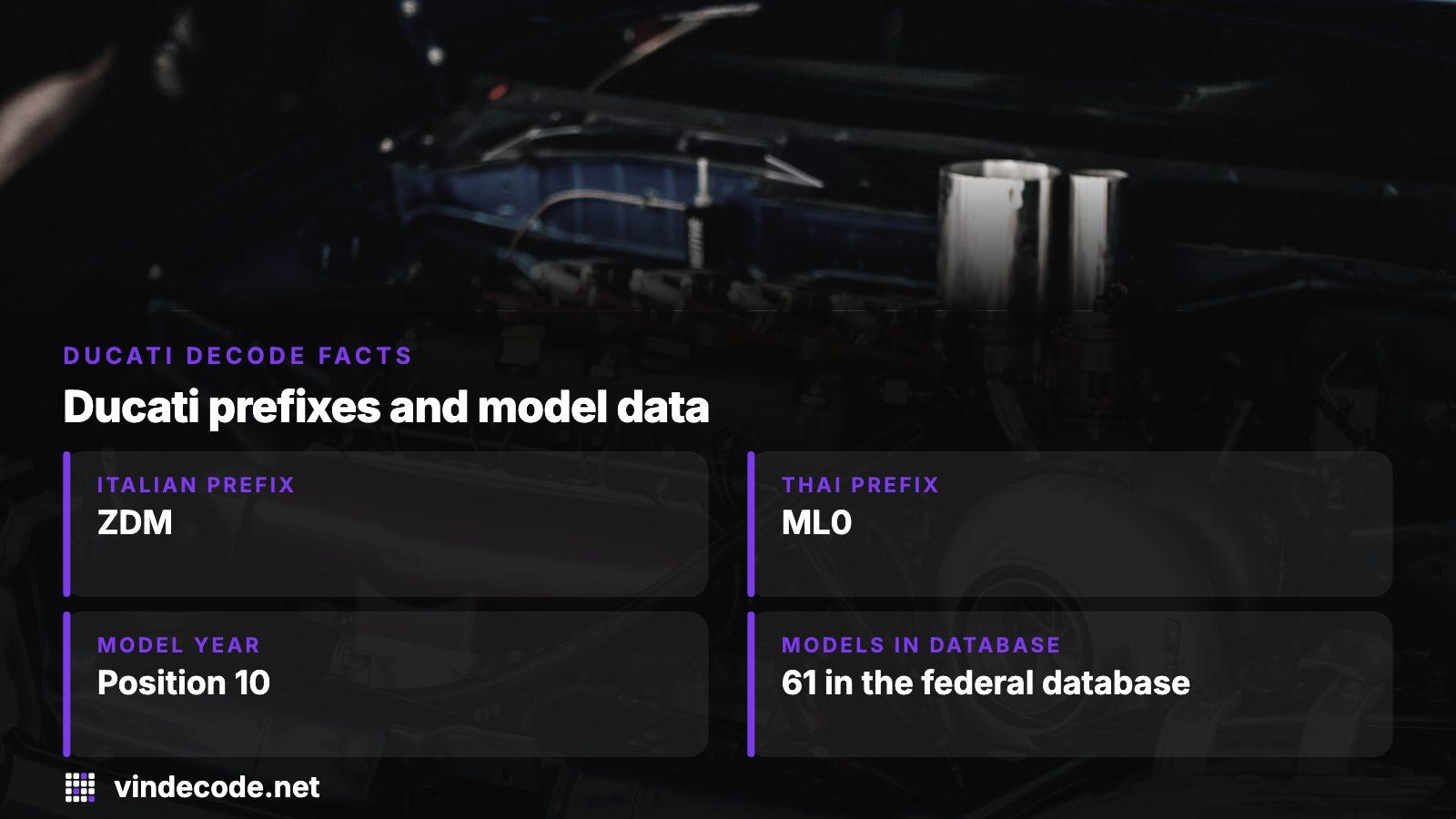
- Italian prefix
- ZDM
- Thai prefix
- ML0
- Model year
- Position 10
- Models in the federal database
- 61
What the Ducati decode gives you
The decoder here reads the VIN against the federal vehicle database and lists what that database holds for the bike. For a Ducati the useful lines are short:
- Maker and country of the factory
- Model year, taken from the tenth character
- Model family, such as Monster, Diavel, Scrambler or Desert X
- Engine displacement and cylinder count
- A rough power figure, with caveats covered further down
Every line describes the motorcycle as it rolled off the line. That is a solid starting point for catching a listing that claims the wrong year or the wrong engine. Nothing after that day is covered.
Two factory prefixes, two plants
The federal database lists two Ducati manufacturer codes, and a bike you are looking at will carry one of them in its first three characters.
| Prefix | Registered to | Plant shown by the decoder |
|---|---|---|
| ZDM | Ducati Motor Holding S.p.A. | Bologna, Italy |
| ML0 | Ducati Motor (Thailand) Co., Ltd. | Amphur Pluakdaeng, Thailand |
In my own test decodes, the Scrambler turned up under both. A 2016 Scrambler 800 stub starting ZDM read as Bologna, while a 2015 Scrambler 800 stub starting ML0 read as Thailand. Neither is a red flag. It simply means the plant has to be read from the number itself, because the model name will not tell you.
Reading the characters yourself
A decoder is quicker, but knowing the layout lets you spot a transcription slip. Federal rules fix the frame at seventeen characters and leave three letters out, I, O and Q, so anything round is a zero. The first three name the maker. Characters 4 to 8 describe the model and engine in the maker's own code. Position 9 is a check digit that exists to expose typing mistakes.
Then comes the part that matters for a buyer. Position 10 is the model year and position 11 is the plant, and a Ducati's last four characters are digits, as federal rules require for motorcycles.
| Position 10 | Model year | Example stub |
|---|---|---|
| G | 2016 | ZDM15ANM1GB |
| K | 2019 | ML0KAFCP2KT |
| N | 2022 | ZDMFAKNW4NB |
| P | 2023 | ZDMXANDT8PB |
The eleventh character was B on every Bologna stub above and T on the Thai ones. The model year is a maker designation, not a build date, so a bike can carry a year code ahead of the calendar year it was assembled.
Where a Ducati decode is loose
Federal rules only ask that characters 4 to 8 let someone work out the engine type and power with the maker's information. They do not force a neat public lookup, so the database sometimes gives a coarse answer. When I decoded stubs of a 2022 Streetfighter and another V4 bike, both came back at 137 horsepower and 1103 cc. Ducati's own US page lists 205 horsepower for the current Streetfighter V4. Use the decoded number to confirm the engine family, then take performance figures from the maker.
Model names are loose too. The database groups some bikes under its own label, so what comes back may not match the badge on the tank.
From an NHTSA owner complaint
A rider who filed with NHTSA in 2009 had bought a used Ducati the previous April with 1,200 miles on it. NHTSA files the complaint under a 2008 1098, but the owner describes the bike as a Sport Classic Sport 1000. Within 2 months, the owner says, the plastic fuel tank distorted and came off its mount. Takeaway: compare the decoded model with the title, the badge and the seller's wording before you trust any one of them.
Getting the number off the bike
Ducati points owners to two places: the registration document and the bike itself. Federal rules say the number must sit on a part that stays on through repairs, or on a plate or label fixed to that part for good. Start near the steering head and rake a flashlight beam across the metal, since paint and road grime hide stamped digits.
Photograph the number and type it from the photo, not from memory. Then set it beside the title and the insurance card. One different character means a different bike, or a typo that will make every lookup come back empty.
Be cautious with a VIN pasted into a classified ad. Ask for a fresh picture of the frame stamping, taken the same day.
The recall check that follows
Once the decode is done, feed the same VIN to NHTSA's recall lookup. The result lists a recall still waiting for its repair. It leaves out one already fixed, a recent recall whose VINs are still being loaded, a recall more than 15 years old, and a recall on an international vehicle. Ducati has its own VIN lookup for safety and updating campaigns, with a window of 15 calendar years.
From an NHTSA owner complaint
A 2016 Diavel owner told NHTSA in October 2020 that a side stand sensor dropped off, and the engine cut out mid-ride. Ducati reportedly cited a recall for that model year, but the rider's number was absent from the recall list. When I read NHTSA's recall records for a 2016 Diavel, they returned no campaigns. Takeaway: a missing match is not proof of a clean bike, so ask the dealer to check the VIN directly.
What a decode cannot see
Motorcycles get dropped, and a low-side slide can bend a frame without leaving much to see. None of that lives in a build record. Free tools fill part of the gap: NICB VINCheck shows insurer reports of theft, salvage and flood, but only from participating insurers, and the NICB page carries its own warning against relying on it alone. The federal title system adds brand records, the newest mileage entry and some theft data.
The history report on this site pulls those title, salvage, theft and odometer records together for the VIN you decoded. You get a free preview first, then one payment for the full report; the pricing page has the details.
Red flags worth walking away over
- The decoded year or engine size disagrees with the listing, and the seller has no explanation
- The frame stamping looks reworked, uneven or different in style from the plate
- Characters on the title, the frame and the paperwork do not match each other
- A branded or salvage title appears in the history for a bike sold as clean
- The recall lookup shows open campaigns and the seller says the bike was never at a dealer
- The seller will not let you photograph the number
A sensible order of checks
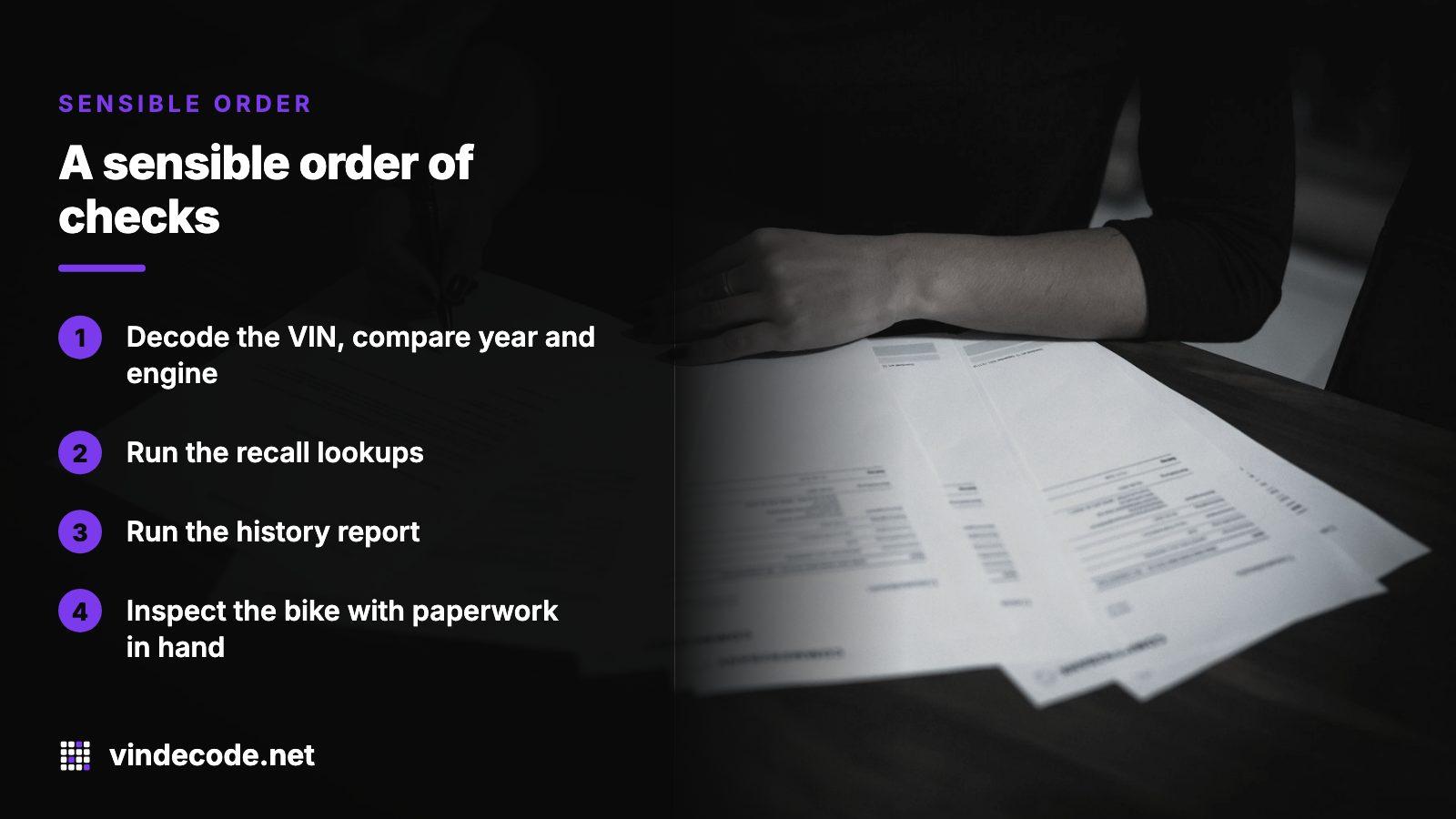
- Decode the VIN here and compare year, plant and engine with the ad
- Run the NHTSA and Ducati recall lookups
- Try the free NICB lookup for theft and salvage flags
- Run the history report for title, damage and odometer records
- Inspect the bike with the paperwork in your hand, and negotiate from what you found
Where this information comes from
- NHTSA: vPIC manufacturer list for Ducati — Source for the two Ducati prefixes and the factory country behind each.
- eCFR: 49 CFR Part 565 — The federal rules for what each VIN position holds and where the number must appear.
- NHTSA: recall lookup by VIN — Explains what an unrepaired-recall search shows and what it leaves out.
- Ducati North America: recall campaigns — The maker's own VIN lookup and its coverage window.
- NICB: VINCheck — A free insurer-based theft and salvage lookup, with its stated limits.
- NHTSA owner complaint 11365430 — owner experience, paraphrased
- NHTSA owner complaint 10295793 — owner experience, paraphrased
Sources and photos: Facts checked against the sources above in November 2026. Photos by Steve Smith, Dimitri Karastelev and Willian Cittadin on Unsplash; diagrams by VINDecode.
Keep reading
- How to Decode a Motorcycle VIN: Year, Engine and Build PlantHow bike VINs differ from car VINs across makers.
- VIN Decoder Year Chart: Position 10 Codes for 1980 to 2039The full list of position 10 year codes.
- NHTSA VIN Decoder: What It Returns, Where It Stops, What Comes NextScope of the federal data feeding these results.
- Sample reportA completed report, so you can see what the next step looks like.
Frequently asked questions
How do I decode a Ducati VIN?
Put all 17 characters in the tool above. It reads the maker prefix, the year code in position 10 and the plant code in position 11, then returns model family and engine size. Check the output against the title and the badge on the bike. If one detail disagrees, ask the seller before paying.
Does a Ducati VIN show if the bike was crashed?
No. The VIN identifies the bike as built. Accident and damage records, salvage history and title brands live in separate databases and appear in a vehicle history report. A decode that looks perfect can still belong to a rebuilt bike, so decode first and then check the history.
Why does my Ducati VIN start with ML0 instead of ZDM?
ML0 is the code registered to Ducati's Thailand company, while ZDM belongs to the Italian maker. Some Scramblers decode under ML0 with a Thai plant. It is a normal prefix, not a sign of a fake. Confirm that the decoded plant fits the bike's market and paperwork.
Can I check Ducati recalls with the VIN?
Yes, in two places. NHTSA's recall search shows unrepaired recalls for the VIN, and Ducati's US page has its own lookup for safety and updating campaigns. Neither goes back past 15 years in its default view, and a recent recall may not list every VIN yet, so ask a dealer when in doubt.
Is the decoded horsepower the real rating?
Treat it as a rough figure. The database returned the same number for several different V4 bikes in my tests, and one of those figures sat far below the maker's listed rating. Federal rules only ask that encoded power stay within 10 percent of the true figure. Use the decode to confirm the engine family and read the rating from Ducati.
Now check the car itself
The guide explains what to look for. The report shows what this VIN has on record.