THE SHORT ANSWER
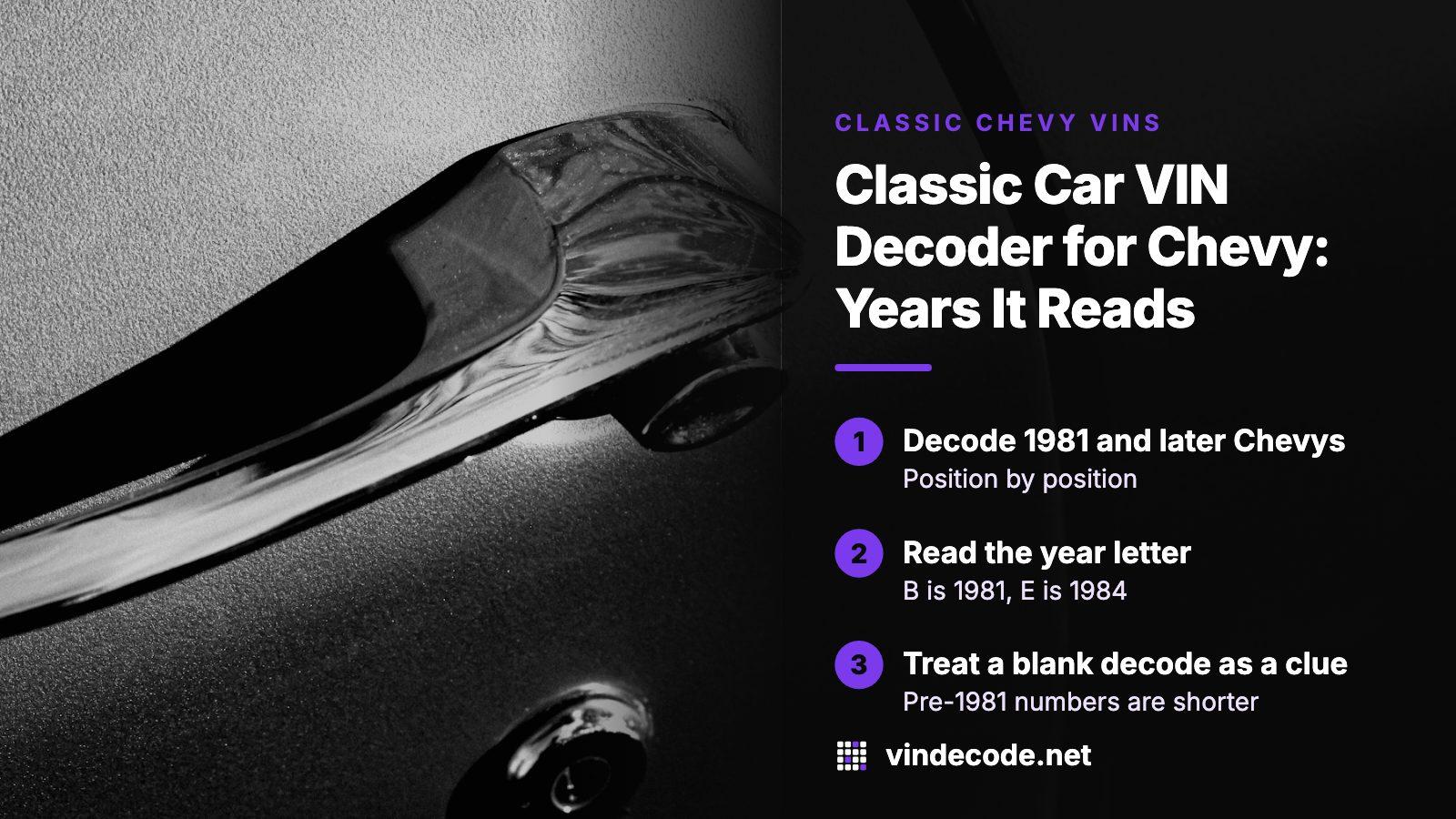
A classic Chevy VIN decoder reads 17-character numbers, meaning model year 1981 and later; type yours in above for model, body, engine and plant. The same tool covers other classic GM cars from 1981 on. A Chevrolet from before 1981 has a shorter number that NHTSA's decoder refuses, so the result is blank. For those, read the plate and tags and search recalls by make, model and year.
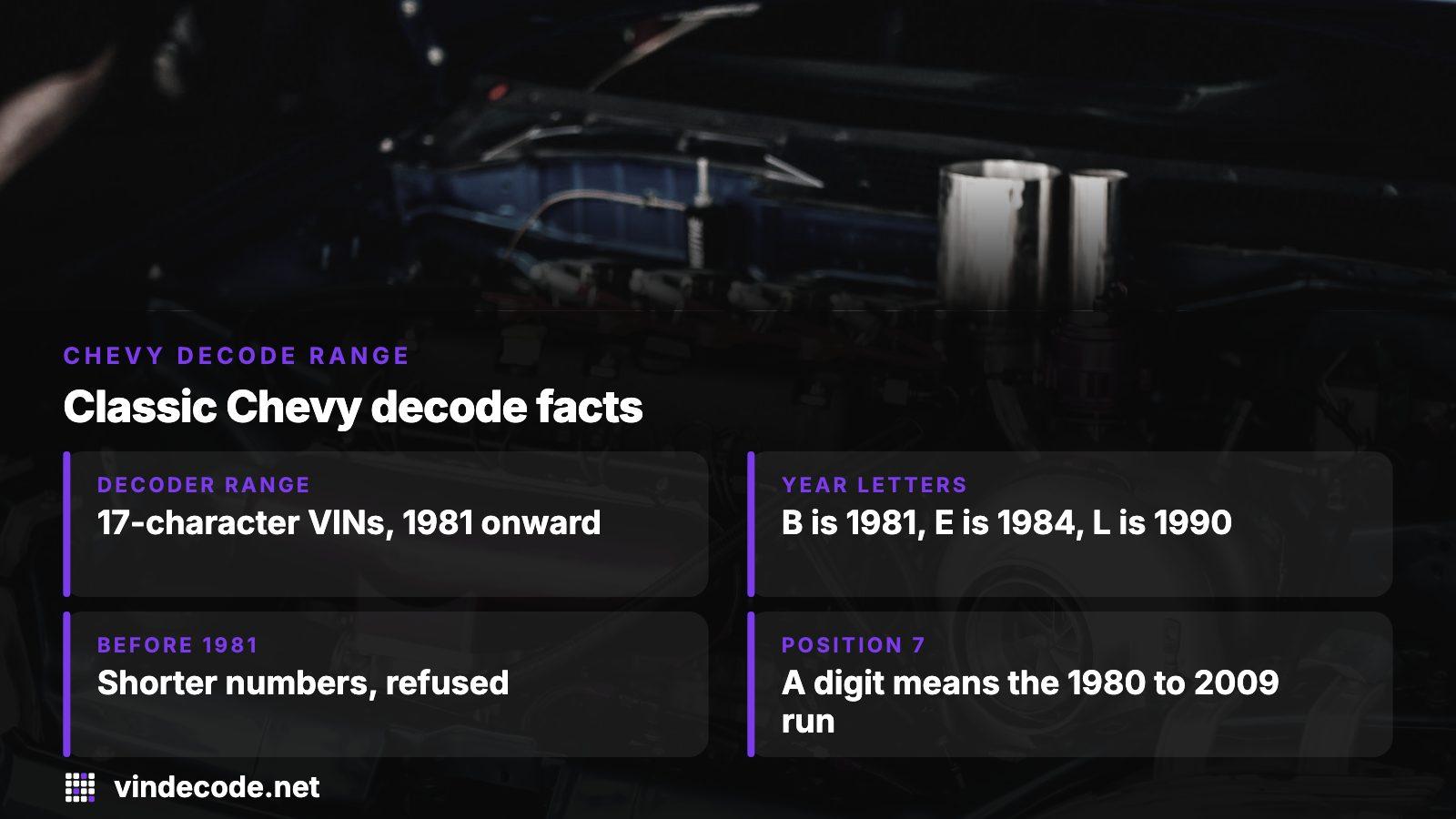
- Decoder range
- 17-character VINs, model year 1981 onward
- Year letters
- B is 1981, E is 1984, L is 1990
- Before 1981
- Shorter numbers, refused by NHTSA's decoder
- Position 7
- A digit places the year code in the 1980 to 2009 run
Which classic Chevys the decoder can read
The decoder works from the number, so the character count matters more than the badge on the fender. NHTSA built its public tool for model year 1981 and forward. A Chevrolet from that year on, whether Camaro, Corvette, C/K pickup, El Camino or Monte Carlo, wears a 17-character number and decodes. Other General Motors makes decode too: in NHTSA's decoder, 1980s Pontiac, Oldsmobile, Buick, GMC and Cadillac patterns resolved under General Motors LLC, so the tool works as a classic GM VIN decoder too.
| Number on the car | What the decoder does | What to do next |
|---|---|---|
| 17 characters, 1981 model year or later | Model, body, engine and plant, where Chevrolet filed them | Run the history report on that number |
| Shorter number, 1980 or earlier | An error: NHTSA refuses years before 1981 | Read plate and tags, search recalls by year |
| 17 characters, no result | Usually one misread character | Retype it from the metal, not the advert |
A 1981-or-later Chevy number, position by position
Federal rule 49 CFR 565 fixes the layout for these years and leaves positions 4 to 8 to the maker.
| Positions | What they hold |
|---|---|
| 1 to 3 | Maker and vehicle type; NHTSA's decoder read 1G1 as a Chevrolet car and 1GC as a Chevrolet truck |
| 4 to 8 | Chevrolet's own descriptors: line, series, body, engine and restraints on a car; cab, chassis, engine, brakes and weight rating on a truck |
| 9 | A check digit that validates the number against typing slips |
| 10 | Model year, a letter or a digit |
| 11 | Where the car was assembled |
| 12 to 17 | That car's own serial number, with the final five digits on cars and light trucks |
NHTSA's decoder resolved numbers built to 1980s patterns to Bowling Green for a Corvette, Janesville for a C/K pickup and Van Nuys for a Camaro. Fields Chevrolet never filed return blank, which NHTSA says means no data, not a missing feature.
The year letter, 1981 through 1991
Position 10 holds the model year, and the letters ran in sequence through the 1980s. The letters I, O and Q are left out of the alphabet VINs use, so the run skips from H to J. The cycle repeats, so look at position 7 first. For cars and light trucks, a digit in that spot places the year code in the 1980 to 2009 run, while a letter places it from 2010. B next to a digit is 1981; B next to a letter is 2011.
| Letter | Model year |
|---|---|
| B | 1981 |
| C | 1982 |
| D | 1983 |
| E | 1984 |
| F | 1985 |
| G | 1986 |
| H | 1987 |
| J | 1988 |
| K | 1989 |
| L | 1990 |
| M | 1991 |
A Chevy from before 1981: what a blank decode means
A 1969 Camaro or a 1975 Corvette will not decode. NHTSA's decoder page carries an error for years before 1981, and its Chevrolet model list is empty through 1980 yet full from 1981. An old-style number gets an incomplete-VIN error. A blank means the car predates the data, and says nothing about whether the number is genuine.
- Photograph the plate and every tag on the car before forming a view.
- Count the characters and compare them with the title, one by one.
- Search NHTSA recalls by make, model and year, which works even when the decoder cannot read the number.
- Put build questions to Chevrolet; NHTSA's decoder page refers users to the maker and says a label on the vehicle may hold details the number lacks.
Old campaigns are on file: a 1969 Camaro motor mount, number 71V235000, was reported in December 1971 for a mount that could separate and let the engine lift.

Recalls on a classic Chevy: look up the exact car
NHTSA lists a seat belt buckle campaign, 90V105000, from May 1990 on the 1984 Camaro, and a retractor campaign, 91V143000, from September 1991 on the 1987 Corvette. Owners in NHTSA's files describe dealers saying their VIN fell outside a group, or that the car was too old. A decode and a recall search answer different questions, so run both.
From an NHTSA owner complaint
A buyer of a used 1987 Corvette told NHTSA in April 2009 that the belts were malfunctioning and the 91V143000 recall had never been done. Chevrolet said the car's age meant it could not tell from the VIN whether the fix had happened, and asked for payment. The earlier owner had never been notified, and the car had been sold at auction.
Take from it that recall status on an older Chevy can turn murky at the parts counter. Search NHTSA by year first, keep a dated screenshot, and settle it before you pay.
What a decode cannot tell you about a classic Chevy
A decode reports the car as Chevrolet filed it. It does not inspect the car in front of you.
- Whether the engine in the bay is the one installed at the plant.
- Paint and trim, which sit on tags and labels, not in the number.
- Whether the car was hit, flooded or burned.
- Whether a brand such as salvage or rebuilt has been applied.
- Whether the mileage climbs believably.
A match with the advert shows the listing agrees with itself, a start and not proof of originality. At a collector's price, a specialist settles authenticity.
Titles and paperwork on an older Chevy
The federal title database, NMVTIS, says certain states do not title vehicles past a set age, so an older car can arrive with a thin paper trail. A consumer report from it covers the current title and brand history, the latest odometer reading, any insurer's total-loss or salvage decision and any move to a salvage yard.
From an NHTSA owner complaint
A Camaro buyer told NHTSA in June 2006 about a 1983 car bought from a private party who had not handed over the bill of sale, and the buyer had no title.
Take from it that a signed bill of sale showing the VIN, and a title whose number matches the plate, should be in your hands before the money is.
What the history report adds after the decode
The report searches records the decode never reaches, using the same 17 characters.
| Record | What it settles on a classic Chevy |
|---|---|
| Title brands | Whether salvage, rebuilt or flood was ever recorded |
| Accident and damage | Whether it was hit, and where |
| Odometer readings | Whether recorded mileage rises plausibly |
| Salvage and auction | Whether it sold at auction, and the photos |
| Liens and theft | Whether a lender or a theft report attaches |
From an NHTSA owner complaint
A Corvette owner told NHTSA in November 1995 that the rear impact bar extension was partly missing from an accident before the purchase. The dealership refused the repair, saying the part posed no safety issue.
A decode shows how a Corvette was built, not how it was treated. Accident and auction records are where earlier damage turns up.
Cost and a sensible order for a classic Chevy
A preview of the 17-character VIN you enter needs no payment and no card details. Buying is a one-off charge for one report, or for a set of 3, 5 or 10, with no subscription. Amounts sit on the pricing page. For a car from before 1981, begin with the tags, the title and the recall search.
- Decode the number as read from the car, not the advert.
- Run NHTSA's recall search for that year and note campaign numbers.
- Check the preview, then order the report if the car stacks up.
- Match the title's number to the plate.
- Have a mechanic you pick inspect the car before payment.
Where this information comes from
- NHTSA: vPIC VIN decoder — Where NHTSA states the 1981-and-forward range, refuses earlier years and sends questions to the manufacturer.
- eCFR: 49 CFR Part 565 — The federal rule behind the 17-character layout, the year letters and the position 7 note.
- NHTSA: recalls — Recall records by make, model and year, including campaigns from 1971 through 1991 on the cars named here.
- NMVTIS: consumer information — What a title-database report holds, and the note that some states exempt older vehicles from titling.
- NHTSA owner complaint 10266694 — owner experience, paraphrased
- NHTSA owner complaint 974631 — owner experience, paraphrased
- NHTSA owner complaint 10161559 — owner experience, paraphrased
Sources and photos: Facts checked against the sources above in November 2026. Photos by Linus Belanger, Carrie Allen www.carrieallen.com and Willian Cittadin on Unsplash; diagrams by VINDecode.
Keep reading
- Chevrolet VIN Decoder: Decode a Chevy, Then Check Its HistoryPrefixes, the engine character and the plant for every Chevy built since 1981.
- Classic Car VIN Decoder: Which Years It Reads and What Comes AfterHow the tool treats short pre-1981 numbers across all makes, and what to read instead.
- VIN Decoder Year Chart: Position 10 Codes for 1980 to 2039The full year-letter cycle, beyond the 1981 to 1991 run shown here.
- Sample reportA finished report, to see what the history adds after the decode.
Frequently asked questions
How do I decode a classic Chevy VIN?
Read all 17 characters off the car and enter them in the decoder above for a 1981 or later Chevrolet. With an older, shorter number, work from the plate, tags and title, and search NHTSA recalls by make, model and year.
Why does my 1969 Chevy VIN return nothing?
NHTSA's decoder covers model year 1981 and forward and refuses earlier years, and older numbers are shorter. The blank means the car predates the data, not that your number is wrong.
Which letter is my classic Chevy's model year?
Position 10, once position 7 is confirmed as a digit. Then B is 1981 and L is 1990, as in the table above. A letter in position 7 sends the same characters to 2010 and later.
Does the decoder work for other classic GM cars?
For 1981 and later, yes. NHTSA's decoder resolved 1980s Pontiac, Oldsmobile, Buick, GMC and Cadillac patterns under General Motors LLC. Older GM numbers fall outside it, as Chevrolet's do.
Does a decode show accidents or title brands?
No. It describes the build. Accident entries, brands, mileage readings and auction photos come from the history report, whose preview costs nothing.
Now check the car itself
The guide explains what to look for. The report shows what this VIN has on record.