THE SHORT ANSWER
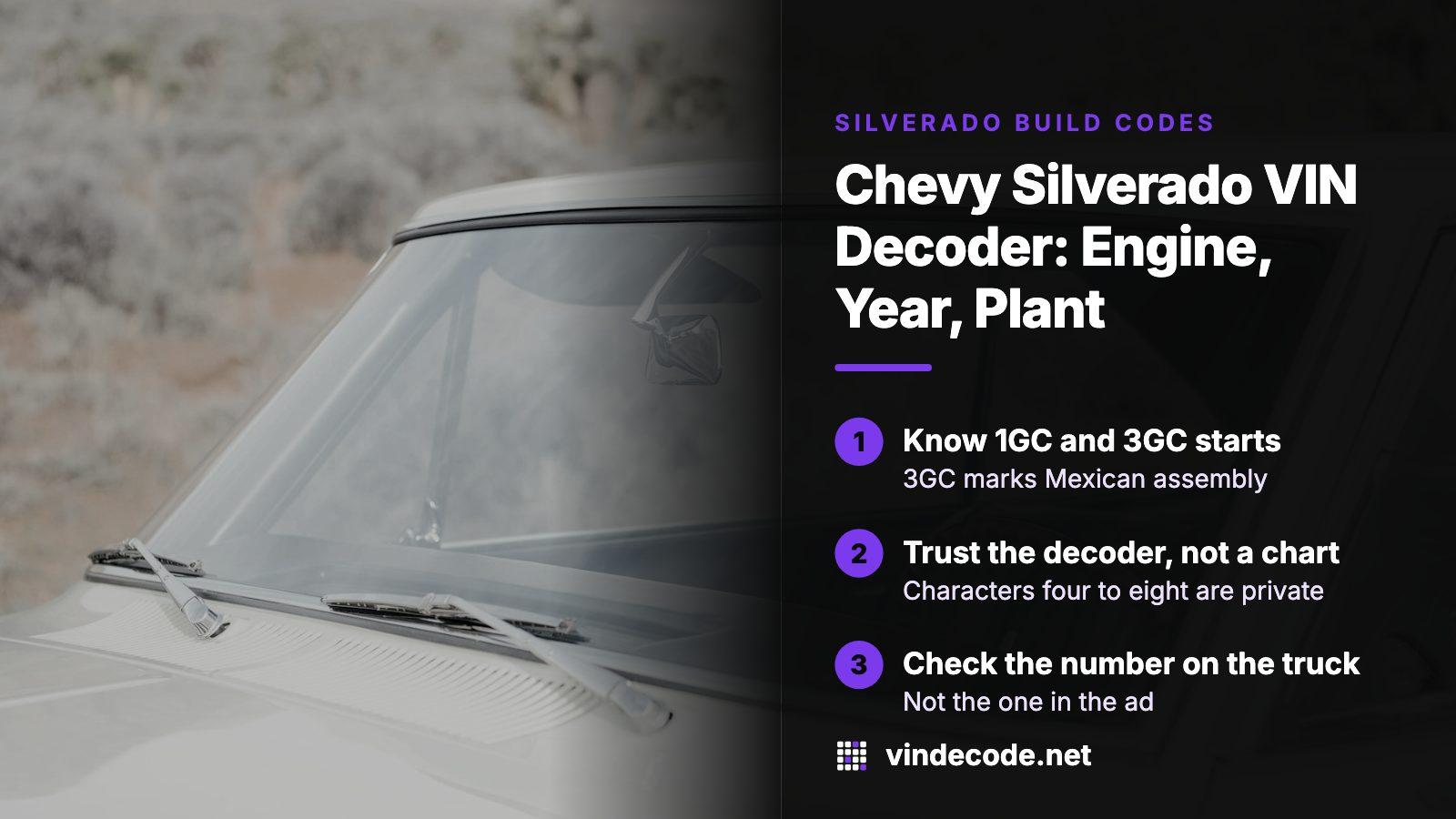
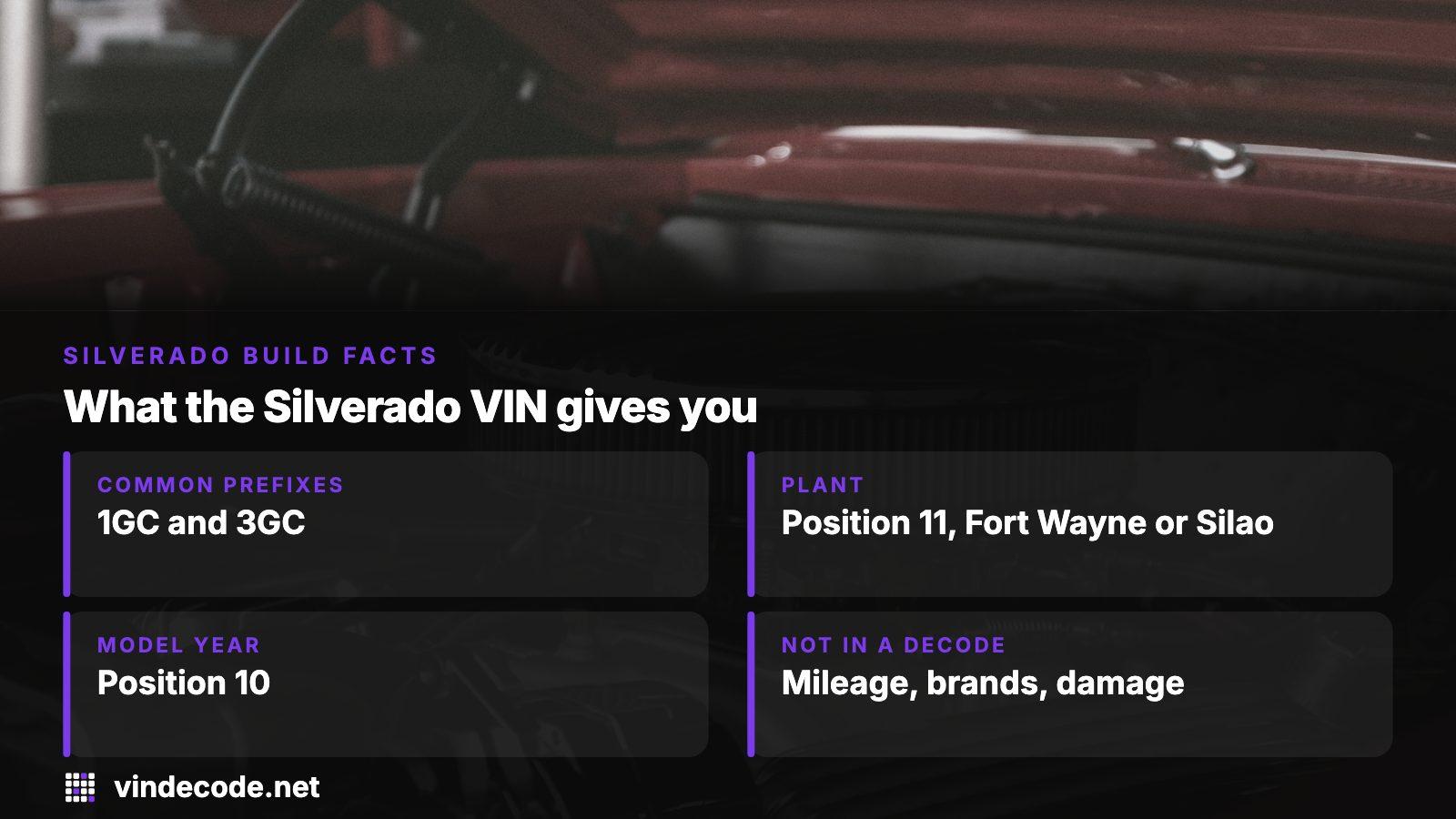
Use the whole VIN. Silverados mostly begin 1GC, with 3GC for trucks assembled in Mexico. Character ten carries the year and character eleven the plant. Characters four through eight are GM's private code for series, cab, drive and engine, so rely on what the decoder returns, not a printed chart. Nothing in a decode speaks to mileage, damage or title brands.
- Common prefixes
- 1GC and 3GC for Silverado pickups
- Plant
- Position 11, such as Fort Wayne or Silao
- Model year
- Position 10, a letter or digit
- Not in a decode
- Mileage, title brands, damage
What the decoder says about a Silverado
The Silverado is sold as a half-ton 1500 and as heavier 2500 and 3500 models, so one name covers very different trucks. NHTSA's public decoder separates them. I ran invented strings, each with a recomputed check digit, through it, and every one came back clean.
| Test string | Year and series | Engine | Plant |
|---|---|---|---|
| 1GCUYDED9MZ100001 | 2021, 1500 | 5.3-liter V8, gasoline | Fort Wayne, Indiana |
| 1GCPYDEK4MZ100001 | 2021, 1500 | 2.7-liter four-cylinder, gasoline | Fort Wayne, Indiana |
| 1GCUYGELXLZ100001 | 2020, 1500 | 6.2-liter V8, gasoline | Fort Wayne, Indiana |
| 1GC4YREY7MF100001 | 2021, 2500 | 6.6-liter V8, diesel | Flint, Michigan |
| 1GC1YLE78MF100001 | 2021, 2500 | 6.6-liter V8, gasoline | Flint, Michigan |
The weight class moves too: the diesel string landed in class 3, above 10,000 pounds, while the 1500s sat in classes 2E and 2F.
Take the number from the truck, not the ad
A listing can carry a typo or a number that belongs to a different truck. For a pickup of this weight, the federal rule is that the VIN must be inside the cab and legible from outdoors by daylight, close to the left windshield post.
- Stand at the driver's front corner and photograph the plate through the windshield.
- Open the door and photograph the label on the pillar, which repeats the number.
- Compare the title or registration with both photos, one character at a time.
- Decode the number all three share. If you spot an I, O or Q, you misread something, because those letters are barred from VINs.
If the plate is missing, damaged or looks newly riveted, stop there. That is a conversation for the seller before any money moves.

The prefix and the plant tell you where it was built
Characters one to three identify the manufacturer and vehicle type. For these Silverados the decoder showed GM's U.S. truck code, 1GC, and a 3GC string with the same body characters resolved to Silao, Mexico, still a 2021 Silverado 1500 with the 5.3-liter V8.
- 1GC with a plant letter for Fort Wayne: the 1500 strings above.
- 1GC4 or 1GC1 in the first four characters: heavier trucks from Flint in the tests.
- 3GC: a Silverado assembled in Mexico, which is no mark against it.
An older truck follows the same idea with different codes. A 2014 string resolved to Roanoke, Indiana, with the 5.3-liter engine and active fuel management. Set the plant against the build date on the door label, and let any conflict prompt a few pointed questions for the seller.
Where a Silverado decode runs thin
GM alone decides what characters four to eight mean, so no one chart fits every year. Newer test strings returned a trim such as LT, LTZ, Work Truck or High Country. The two 2004 strings returned an engine and a series but no trim at all, and a 2008 string gave the trim LS, the drive and the plant, with the engine field empty.
Treat blanks as open questions
An empty engine or trim does not mean the VIN is bad. It means the maker's filing did not resolve that field. Read the engine cover, the label and the paperwork yourself, and note any engine swap, since it matters to insurance and resale.
Even when a trim comes back, treat it as the maker's record of the build, not proof of what bolted on later. Wheels, grilles and badges are easy to swap.
Red flags when the decode and the truck disagree
A decoder will happily describe a truck from a mistyped number. When I changed only the ninth character on the 2021 test string, NHTSA flagged that the check digit did not calculate, but it still listed a 2021 Silverado 1500, the 5.3-liter engine and Fort Wayne. Cut the string to 16 characters and it flagged an incomplete VIN yet returned the same build. Read the status line before you trust the fields.
- A check-digit warning or an incomplete-VIN note: retype from the plate.
- A model year that disagrees with the listing.
- A series, drive or engine the truck in front of you does not have, such as a diesel decode on a gas truck.
- A dash plate, door label and title that differ by even one character.
What a decode cannot see, and what a report adds
A decode stops at the factory gate. The federal NMVTIS site lists the records that follow the truck afterward: where it is titled now, brands like salvage and flood, odometer entries and total-loss history. It also says a buyer should add a mechanic's inspection to the paperwork.
From an NHTSA owner complaint
An owner of a 2018 Silverado 1500 told NHTSA the truck read 30,434 miles when bought in a private sale. Afterward the owner ran the VIN through several history services, and they put the true figure at 134,000.
From an NHTSA owner complaint
A would-be buyer of a 2020 Silverado 1500, found through a Facebook Marketplace ad listing 63,000 miles, filed a complaint after a bank loan check turned up a history report showing 203,000. The record gives no outcome.
No decoder could have shown either mileage gap. One buyer learned the truth after paying, the other before. Pull the history before the deposit.
Recalls attach to VINs, not to model years
NHTSA's file shows 8 campaigns on the 2021 Silverado 1500, 12 on the 2020 and 10 on the 2019. Almost every notice names only certain trucks. One 2021 campaign involves a driver's air bag module that may lack metal tabs holding the cover. A newer one covers 2021 to 2024 trucks with the 6.2-liter V8 and a connecting rod problem.
So a year and a model say little. Only the full VIN shows whether a campaign reaches one truck, and NHTSA's own lookup takes a VIN at no charge. Do that check on the exact number you photographed, since an open repair can also change what you offer.
What it costs and the order to do things in
Your first look, the preview, costs nothing once the VIN is in. Going further means one purchase: a single truck, or a bundle of 3, 5 or 10 lookups if you are shopping around. Nothing renews, so there is nothing to cancel. Amounts are on the pricing page.
- Photograph both tags and decode whatever number they have in common.
- Compare year, series, drive and engine with the listing, and walk away if they differ.
- Check the same VIN against NHTSA's recall lookup.
- Read the preview first. Spend on the whole report once the build story holds.
- Pay a shop of your choosing to inspect the frame and the drivetrain.
Where this information comes from
- NHTSA: vPIC VIN decoder — The federal decoder behind every build detail in the test strings.
- NHTSA: vPIC API documentation — Explains sending a model year with the request and how partial VINs are handled.
- eCFR: 49 CFR Part 565, VIN requirements — The federal rule on the 17-character format, the check digit, excluded letters and where the VIN must be readable.
- NHTSA: recall data for the Chevrolet Silverado 1500 — Campaign counts by model year and which trucks each one names.
- NMVTIS: Understanding an NMVTIS Vehicle History Report — The federal description of title, brand, odometer and total-loss records, plus its advice on inspections.
- NHTSA owner complaint 11708897 — owner experience, paraphrased
- NHTSA owner complaint 11670525 — owner experience, paraphrased
Sources and photos: Facts checked against the sources above in November 2026. Photos by Wesley Tingey, Owen Michael Grech and Victor Hughes on Unsplash; diagrams by VINDecode.
Keep reading
- Chevrolet VIN Decoder: Decode a Chevy, Then Check Its HistoryEvery Chevrolet prefix, with cars, SUVs and trucks side by side.
- Chevy Truck VIN Decoder: Read the Build, Then Check the HistoryOlder Chevy trucks, where the VIN formats and the places to read them differ.
- VIN Decoder Year Chart: Position 10 Codes for 1980 to 2039The tenth-character year codes laid out in one chart.
- Sample reportA finished report, so you can see the odometer and title sections before you buy.
Frequently asked questions
How do I decode a Chevy Silverado VIN?
Copy the dash plate's number, check it against the pillar label and the title paperwork, and only then type it into the box above. Compare the year, series, engine and plant with the truck. A check-digit warning usually points to a typo, so retype before you rely on anything.
What does a 1GC or 3GC VIN mean on a Silverado?
Each prefix marks a GM truck. In the tests, 1GC resolved to U.S. plants such as Fort Wayne and Flint, while 3GC resolved to Silao, Mexico. The prefix points to the maker and region, and the later characters carry the series and engine.
Can a decoder tell a 1500 from a 2500?
Yes, for the test strings it did: series 1500 for the half-tons and 2500 for the heavier trucks, with weight classes to match. Confirm the series on the door label too, because it changes towing ratings, parts and price.
Does a Silverado VIN decode show accidents or mileage?
No. It describes the build only. Odometer entries, brands, crashes and liens are filed in different databases, and a history report queries them using the VIN. Run both steps, then book an inspection with a mechanic you trust.
Why does the decoder still show a truck when my VIN has an error?
NHTSA's decoder reports an error code but still fills in what it can. A wrong check digit or a missing character did not stop it from listing the 2021 Silverado, engine and plant in the tests. Always read the status message before the fields.
Now check the car itself
The guide explains what to look for. The report shows what this VIN has on record.