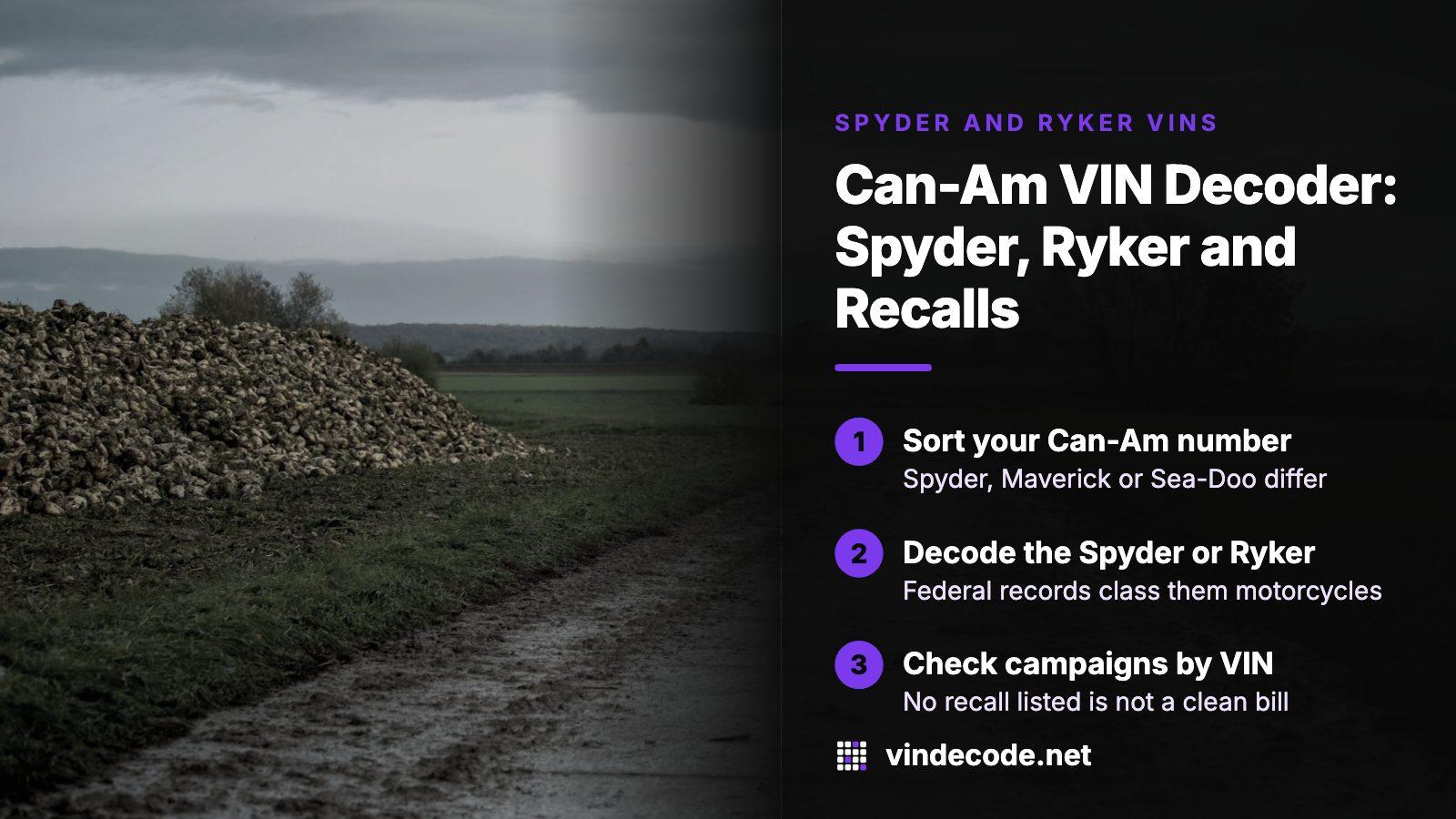
THE SHORT ANSWER
Type the full 17 characters from a Spyder or Ryker into the decoder above. Federal records classify these three-wheelers as motorcycles, so the decode and NHTSA's recall lookup both apply. A Maverick or Defender answers to another agency, and a Sea-Doo wears a 12-character hull number the decoder cannot read. The result describes the machine as built. Damage, title brands, liens and mileage need a history report.
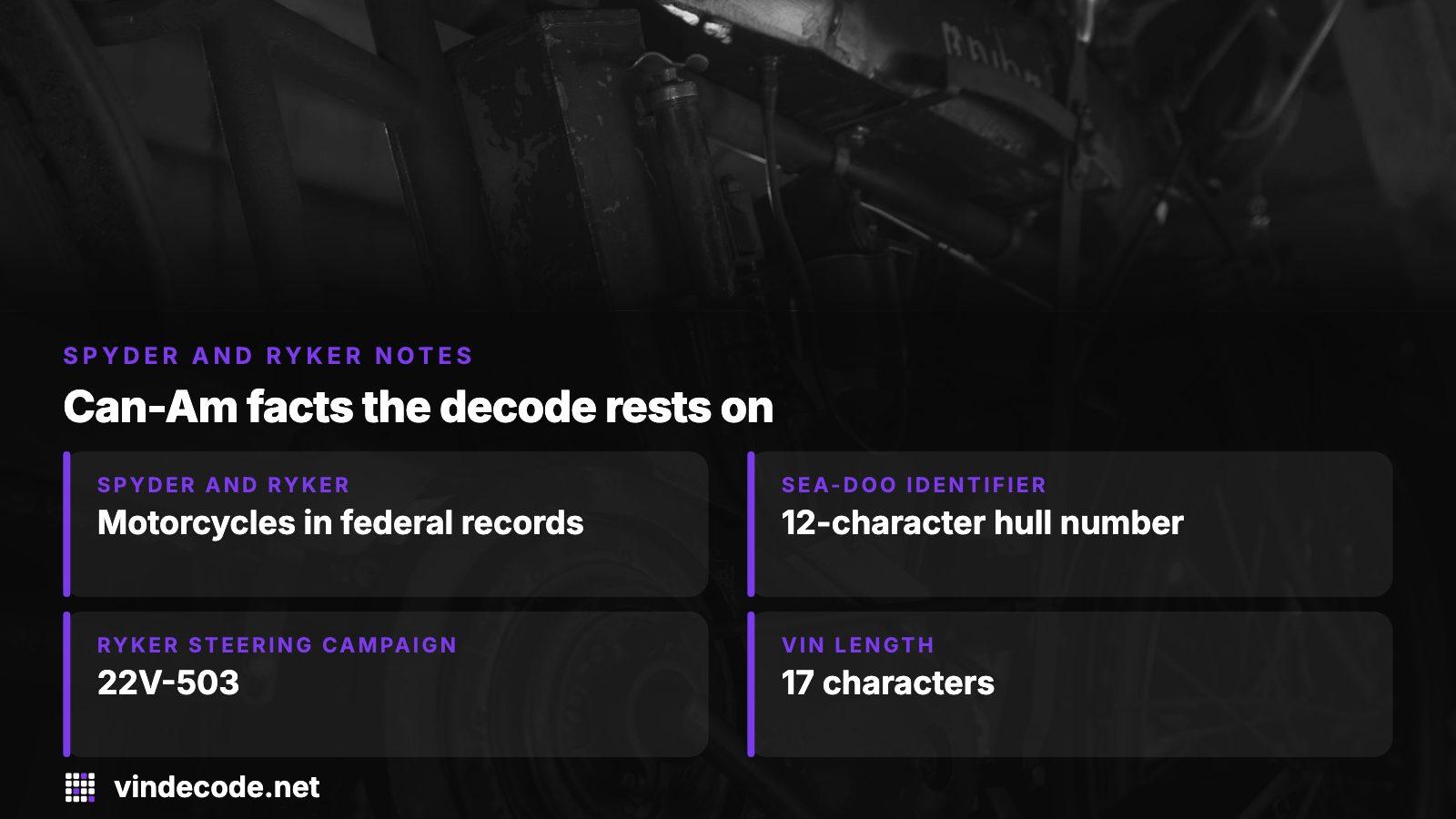
- Spyder and Ryker
- Motorcycles in federal records
- Sea-Doo identifier
- 12-character hull number
- Ryker steering campaign
- 22V-503
- VIN length
- 17 characters
Spyder, Maverick or Sea-Doo: which number are you holding
Can-Am is a badge on products that live under different rulebooks, and the decoder fits only one of them well. Sort the machine first, because that decides which lookups can answer you at all.
| Machine | Its identifier | Where safety campaigns are filed | Decoder above |
|---|---|---|---|
| Spyder and Ryker, on-road three-wheelers | 17-character VIN | NHTSA, as a motorcycle | Built for this |
| Maverick, Defender and other off-road units | A number in the same style, outside the federal vehicle system | Generally CPSC, as a consumer product | Do not rely on it |
| Sea-Doo watercraft | Hull number, 12 characters | Coast Guard marine rules | Not applicable |
One dealer can sell all three, which is how a hull number ends up typed into a VIN box and the buyer decides the machine does not exist. A format mismatch tells you about the product, not about the seller.
Copying the number off the machine
Work from the machine, not the listing. On the road-going three-wheelers the number is stamped into the frame around the steering head, with a label elsewhere in the frame area that repeats it. Think of a motorcycle, where identification lives in the structure and not on a bolt-on part.
- Off-road units usually carry it on a frame rail, often the left one, sometimes behind a panel or close to the suspension.
- Expect mud and paint over the stamping. A photo taken in raking light is easier to read than your eye.
- Count the characters before you key them in. Seventeen is the target for a Spyder or Ryker; twelve means you are reading a hull number.
- Compare the stamping with the title, character against character.
A stamping that looks ground down, filled or restamped is a different problem from a misread letter. Stop there and call the police, not the seller.
What a decode of a Spyder or Ryker VIN returns
The decoder lines the characters up against NHTSA's public vehicle database, so the answers are the ones the maker filed for that machine.
- Builder, from the opening three characters
- Model year, from the tenth character
- Assembly plant, from the eleventh
- Model, body and engine coding from positions four to eight, where the maker supplied it
Real records show the pattern. In NHTSA's owner-complaint data, a 2022 Ryker carries a VIN that opens 3JB with N in the tenth place, while a 2020 Spyder RT opens 2BX with L there. Two Can-Am three-wheelers, two different openers, so do not expect one prefix to stand for the whole badge. Judge a result by whether year and model agree with the badge on the machine and the line on the title.
The campaigns a Spyder or Ryker VIN can pull up
NHTSA's recall lookup ties campaigns to a VIN. Three campaigns from the same stretch overlap, so one machine can return more than one result.
| Campaign | Machines | Units | Defect on record |
|---|---|---|---|
| 22V-503 | 2022 Ryker | 9,353 | Handlebar stem bolt can break, risking sudden loss of steering control |
| 23V-175 | 2020 to 2023 Spyder RT, 2022 and 2023 Ryker | 34,457 | Brake lamps can remain lit with the pedal released |
| 23V-053 | 2022 Spyder F3 and F3-S | 2,077 | Rearview mirror lens can come loose |
The first is the serious one. Filed on July 13, 2022, it came with advice to stop riding until the repair was done. The fix is a short job: clean the threads in the steering column and fit a new bolt.
From an NHTSA owner complaint
A 2022 Ryker owner told NHTSA in September 2022 that a notice for the steering campaign had arrived, but the local dealer confirmed the repair part had not reached it. No failure had happened yet. The owner thought the maker was taking too long, and the record closes with the note "Parts distribution disconnect."
Take from this that a campaign match is the start of the job. Ask whether the repair was actually carried out, and ask to see the invoice.
A VIN that is not on a recall list is not a clean bill
Campaigns cover the VIN ranges a maker lists. Sharing a symptom with a campaign does not put a machine on its list.
From an NHTSA owner complaint
The owner of a 2022 Ryker told NHTSA in March 2026 that the machine stalled twice while riding, shut off at the roadside and went on failing after a restart, at roughly 600 miles. A dealer tied the fault to a fuel system campaign, 23V855000, but the record notes that this VIN was not included in that recall. The machine was left unrepaired and the maker was told.
If a lookup returns nothing and the machine still misbehaves, keep the dealer's diagnosis in writing and report the fault to the maker and to NHTSA. Run the lookup again at handover as well, since campaigns keep being issued after a machine is built.
What the decode will not say about a used Can-Am
A decode describes the machine as built. It carries no crash damage, no title brand, no lender's claim and no record of distance or hours. Used powersports machines are often sold privately, which leaves fewer records behind, and a recall letter sent to the first registered owner can easily stop short of whoever sits across from you.
Licensing is another gap the number cannot close, because states do not agree on what a three-wheeler is. Broadly, they take one of three approaches:
- A full motorcycle endorsement
- An endorsement valid only on three wheels
- A separate autocycle category, sometimes ridden on an ordinary driver license
The answer can change when you move or cross a state line, so confirm it with your own licensing agency before you pay.
Where a history report fits once the decode checks out
For a titled, road-going Spyder or Ryker, a history report searches records filed under the same VIN. Three of its sections matter most on a three-wheeler that has been ridden hard or traded around.
| Record | The question it answers |
|---|---|
| Title brands | Was a salvage or rebuilt brand ever placed on it |
| Accident and damage entries | Did it go down, and which part took the hit |
| Salvage and auction history, with photos | Did an insurer write it off and sell it, and what did it look like |
A report works from records, so it suits titled on-road machines. For an off-road unit or a Sea-Doo, lean on the seller's paperwork and the maker's own recall channel instead.
The order to run the checks, and what it costs
The preview that follows a VIN entry is free. Paying is one transaction: a lone report, or a pack in sizes of 3, 5 or 10, with nothing renewing. The pricing page lists current figures.
- Decide whether you hold a Spyder or Ryker, an off-road unit or a Sea-Doo.
- Photograph the stamping and key the VIN into the decoder above.
- Compare year and model with the badge, the title and the advert.
- Run NHTSA's recall lookup, or the CPSC database for an off-road machine, and NICB's VINCheck.
- Ask for the dealer invoice behind any recall repair, especially on a 2022 Ryker.
- Open the preview and, if the machine still adds up, buy the report. Get a technician to inspect it before any money moves.

Where this information comes from
- NHTSA: do-not-ride recall for Can-Am Ryker motorcycles — The agency's own notice on the Ryker steering campaign, and how it describes these machines.
- NHTSA: recalls lookup — Searches open campaigns by VIN, which is how the Ryker and Spyder campaigns surface.
- NHTSA: vPIC VIN decoder — The public database for checking what an on-road Can-Am VIN describes.
- CPSC: recalls — Where safety campaigns on off-road machines are generally published.
- NICB: VINCheck — A no-cost theft and salvage lookup fed by insurers; a clean result is not proof.
- NHTSA owner complaint 11483960 — owner experience, paraphrased
- NHTSA owner complaint 11727600 — owner experience, paraphrased
Sources and photos: Facts checked against the sources above in November 2026. Photos by Andrew Dawes, Anastasiia Nelen and Haberdoedas on Unsplash; diagrams by VINDecode.
Keep reading
- NHTSA VIN Decoder: What It Returns, Where It Stops, What Comes NextWhat the federal database behind this decode covers, and where its answers thin out.
- Harley Davidson VIN Decoder: Year, Family and EngineAnother road-going maker where the frame number is the legal one.
- KTM VIN Decoder: Builder, Plant and Model Year From the Frame NumberA powersports brand whose VIN prefix can name three different builders.
- Sample reportA finished report laid out, so you can see what comes after the decode.
Frequently asked questions
How can I decode the VIN on a Can-Am?
Enter all 17 characters from a Spyder or Ryker into the decoder above, then check the tenth character against the model year on the title. Off-road Can-Am machines carry a number in a similar style, but they sit outside the federal vehicle system, so the result may be thin.
Do federal records call a Spyder a motorcycle or a car?
In federal records it is a motorcycle. NHTSA's recall filings describe Spyder and Ryker models that way, so their campaigns turn up in the vehicle recall database. Your state may license it differently, so ask the licensing agency before you buy.
Will a Sea-Doo decode as a VIN?
No. Watercraft count as boats, and a boat gets a 12-character hull identification number under Coast Guard rules. A vehicle database cannot read it, and it has nothing in common with the number stamped on a Spyder frame.
Why does my Can-Am VIN show no recalls?
Three explanations cover most cases: the machine is off-road and its campaigns sit with CPSC, a character was misread, or the VIN was never in the listed range. One 2022 Ryker owner reported a fuel fault tied to a campaign that did not list that VIN.
Was there a do-not-ride recall on the Ryker?
Yes. Campaign 22V-503, filed July 13, 2022, covered 9,353 model year 2022 Rykers. A handlebar stem bolt could break, risking sudden loss of steering control, and owners were told to stop riding until the repair was done.
Now check the car itself
The guide explains what to look for. The report shows what this VIN has on record.