THE SHORT ANSWER
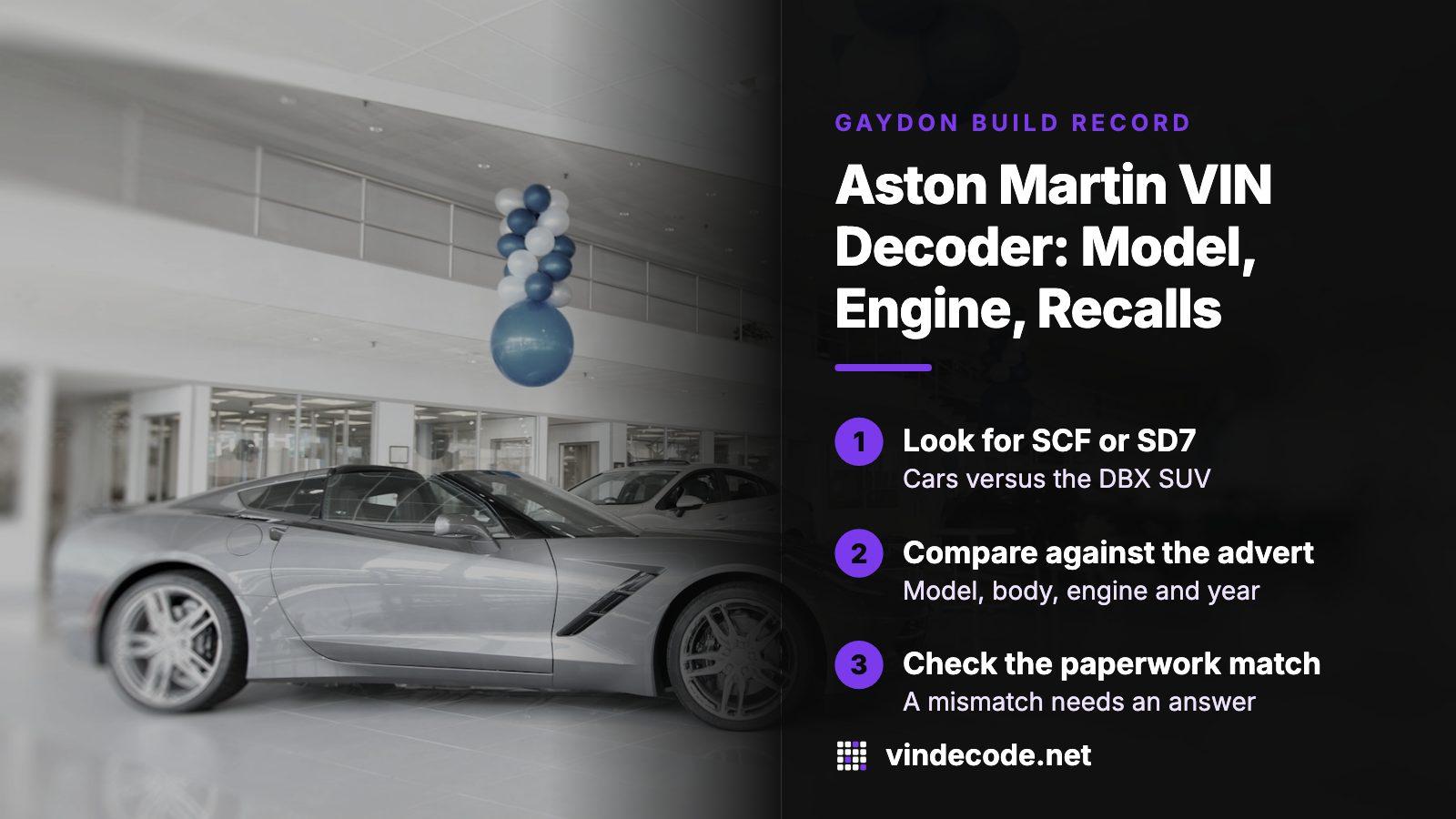
Type the complete VIN into the box above. Aston Martin cars start with SCF and the DBX SUV with SD7. Hold model, body, engine and year up against the advert, and do not be surprised by empty fields. The result describes how the car was built, nothing more. A vehicle history report holds the title brands, damage, mileage trail and theft entries, and its preview costs nothing.
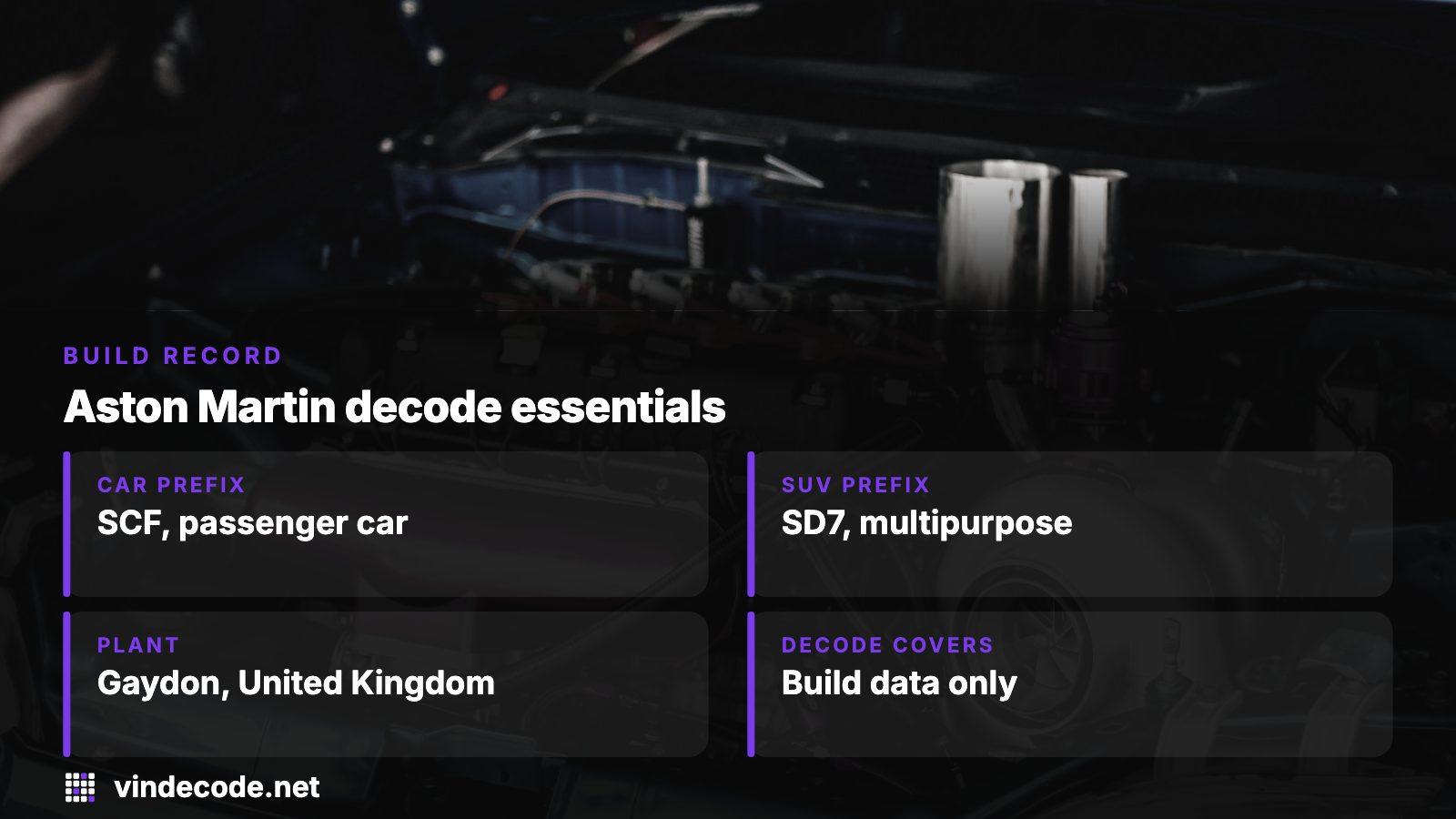
- Car prefix
- SCF, filed as a passenger car
- SUV prefix
- SD7, filed as a multipurpose vehicle
- Plant on all seven decodes I ran
- Gaydon, United Kingdom
- Decode covers
- Build data, not later history
What an Aston Martin decode looks like, 2007 to 2014
The rows below come from VINs that owners typed into NHTSA complaints. I cut each one to its first 11 characters, sent it to NHTSA's decoder with the model year, and wrote down what came back.
| Car | Model returned | Engine | Body | Gearbox field |
|---|---|---|---|---|
| 2007 DB9 | DB9 | 5.9 L, 12 cylinders | Coupe | Automatic |
| 2007 DB9 | DB9 | 5.9 L, 12 cylinders | Convertible | Automatic |
| 2010 V8 Vantage | V8 Vantage | 4.7 L, 8 cylinders | Hatchback style | Automated manual |
| 2012 Rapide | Rapide | 5.9 L, 12 cylinders | Sedan | Automatic |
| 2014 DB9 | DB9 | 5.9 L, 12 cylinders | Convertible | Automatic |
Every one named Gaydon as the plant, and every one left drive type empty. Because I used only the first 11 characters, each answer carried an incomplete-VIN warning. A full number gives a firmer result.
SCF for the cars, SD7 for the SUV
NHTSA's manufacturer table lists two identifiers for Aston Martin Lagonda Limited of the United Kingdom. SCF is filed as a passenger car. SD7 is filed under the multipurpose passenger vehicle type, the category the DBX falls into. No DBX owner complaint turned up in the records I searched, so I never ran an SD7 number and have no sample to show.
Each SCF number I ran came back as an Aston Martin built at Gaydon. Should a car sold as an Aston open with any other three characters, get the seller's answer in writing first and discuss money afterward.
- SCF: DB9, Vantage, Rapide and the other coupes and saloons
- SD7: the DBX
- Any other start: a typo, a mismatch or a question for the seller
Why the same Vantage carries different names
NHTSA's list of Aston Martin models changes by year. For 2008 and 2019 the entry reads Vantage. For 2012 and 2016 it reads V8 Vantage, alongside a separate V12 Vantage. The DB9 appears in 2005 and runs into the 2016 list, then drops away, while the DB11 shows up by 2019 and the DBX by 2021.
A recall search punishes loose spelling. A search for a 2007 model typed as plain Vantage returned no records. A 2010 search typed as V8 Vantage returned three. If a lookup comes back empty, try the other spelling before you decide the car has no campaigns.
| Model year | Models NHTSA lists |
|---|---|
| 2005 | DB9, Vanquish |
| 2012 | V8 Vantage, V12 Vantage, DBS, DB9, Rapide, Virage |
| 2019 | DBS, Rapide, DB11, Vantage, Vanquish Zagato |
| 2024 | Seven names, from DBS and DB11 up to DB12, Valour and Valiant |
When the decode disagrees with the paperwork
One 2007 complaint sits under DB9 in NHTSA's list, yet the VIN decoded as a Vantage with a 4.3 L, 8-cylinder engine and a manual gearbox, and the owner's own words describe a Vantage. Here the decode fit the car, and the complaint label was the odd one out.
A 2009 DB9 number did something else: it returned the model and body but left engine size and cylinders blank, with three warning codes at once, including a note that NHTSA lacked data for some characters. Blanks are common on partial numbers. They are not proof the car is wrong, only a reason to read the full VIN against the door pillar and the title.
- A blank engine field: compare with the engine bay and the registration
- A different model than advertised: ask for the title and a photo of the VIN plate
- A warning about the ninth character: re-type the number before you blame the car
Recalls that follow the model, not the owner
A 2010 V8 Vantage shows three campaigns on NHTSA's recall data: a 2014 accelerator pedal replacement, a late 2014 seat heater circuit fix, and a 2015 software change that turns off the double locking feature. A 2009 DB9 shows five, adding a battery cable routing fix and a transmission software update from 2017.
The newer SUV has its own list. A 2021 DBX returns four records, from a 2020 headliner foam recall through 2024 campaigns on loose driveline fasteners and battery fuse box cables to a March 2026 rear suspension pin recall. Open recalls are fixed free of charge, but only a lookup on the exact VIN tells you which are still open.
From an NHTSA owner complaint
An owner of a 2010 V8 Vantage wrote to NHTSA in 2014 that the accelerator pedal campaign letter had been sitting at home for months. The dealer said the replacement parts were not in stock, and Aston Martin could not give a date. Nothing had gone wrong with the car at that point.
What a buyer should take from it: a recall letter is not a completed repair. Ask to see the work order.
What no decoder can tell you about a used Aston
A decoder reads a build record. It cannot spot a cloned number, a car that sat in a flood, or a rolled-back odometer. Federal justice officials tell of a theft ring that put real VINs, taken from matching cars, onto stolen ones. It also says a saltwater soaking leaves wiring and airbag sensors prone to failing later.
| Question | Decode | History report |
|---|---|---|
| Salvage, junk or flood brand? | Silent | Title brands where states recorded them |
| Ever crashed? | Silent | Damage and auction records, where held |
| Odometer history consistent? | Silent | Readings over the years |
| Stolen, liened or impounded? | Silent | Theft, lien and impound records, where filed |
No source is complete. That same federal page concedes a title search can come back clean when a brand exists, since some data providers have not started reporting, and every state draws its own line for branding a car.
What an owner meets when the car turns out difficult
Most buyers never read the complaint database until something breaks. A 2009 DB9 owner described the car stalling at low speed and refusing to restart for several minutes while the dash stayed lit. The dealer could not make it happen again and, by the owner's account, would not diagnose it despite an extended warranty.
From an NHTSA owner complaint
The same owner wrote that the selling dealer eventually bought the car back. The stall, as described, left the car dead with the instrument lights still on and no fault stored in the computer.
A history report, a recall lookup and a pre-purchase inspection by a specialist who knows these cars each catch a different slice of the risk.
Ordering the history report after the decode checks out
Enter the VIN here and the preview appears at no cost. To read everything you pay once and nothing renews: one report or a multi-report pack (3, 5 or 10). Prices live on the pricing page, and a finished sample report is there to browse.
- Decode the full number and match model, engine and plant to the listing.
- Search recalls under each spelling of the model name.
- Look over the preview first, and only then decide whether the car still deserves the full report.
- Book an inspection with an Aston specialist before any money moves.
On a car with parts and labor priced like these, one report is small money next to a surprise repair.

Where this information comes from
- NHTSA vPIC: Aston Martin manufacturer identifiers — Source for the SCF and SD7 prefixes and how each is filed.
- NHTSA vPIC: Aston Martin models by model year — Shows how model names such as Vantage and V8 Vantage change by year.
- NHTSA recalls data: Aston Martin V8 Vantage, 2010 — The three campaigns on a 2010 car and their remedies.
- NHTSA recalls data: Aston Martin DBX, 2021 — The four DBX campaigns, from 2020 to 2026.
- NMVTIS consumer information — What title and brand data covers, its gaps, and the cloned VIN and flood warnings.
- NHTSA owner complaint 10576422 — owner experience, paraphrased
- NHTSA owner complaint 10667358 — owner experience, paraphrased
Sources and photos: Facts checked against the sources above in November 2026. Photos by Richard R, Anastasiia Nelen and Willian Cittadin on Unsplash; diagrams by VINDecode.
Keep reading
- VIN Decoder Explained: What Decoding a VIN Means and How It WorksPosition-by-position reading of the 17 characters for marques without their own page.
- Bentley VIN Decoder: Read the Build, Then Check the Car's PastAnother British luxury marque whose model names shift between filings.
- Lamborghini VIN Decoder: ZHW, ZPB, Model, Engine and PlantA low-volume exotic with its own prefixes and decode quirks.
- VIN Decoder Year Chart: Position 10 Codes for 1980 to 2039The year characters laid out, handy for checking the tenth position.
Frequently asked questions
How do I decode an Aston Martin VIN?
Type all the characters into the box above. Model, body, engine and plant come back from the maker's filing to NHTSA. Set each field beside the advert and the car itself, search recalls on that number too, and read a history report before any money changes hands.
What does an Aston Martin VIN start with?
Cars start with SCF and the DBX SUV starts with SD7, both registered to Aston Martin Lagonda Limited. Every Aston I decoded began SCF. If a car sold as an Aston starts with anything else, get a written explanation from the seller.
Why is my Vantage decoded as something else?
Filing labels are imperfect. One 2007 number sat under DB9 in the complaint list yet decoded as a Vantage, matching the owner's description. NHTSA also files the model as Vantage in some years and V8 Vantage in others. Trust the full VIN against the car, not the label.
Does the decoder show accidents or a salvage brand?
No. It reproduces the manufacturer's build data. Crashes, salvage or flood brands, odometer readings, theft and liens come from title, insurance and auction records, which a history report gathers. The preview costs nothing, then pay once if you want the whole thing.
Can I check Aston Martin recalls by VIN?
Yes. NHTSA runs a free recall lookup, and the model spelling matters. A plain Vantage search returned nothing for 2007, while V8 Vantage returned campaigns for 2010. Search with the full VIN and the alternate model names, then ask a dealer for written proof any open recall was repaired.
Now check the car itself
The guide explains what to look for. The report shows what this VIN has on record.