THE SHORT ANSWER
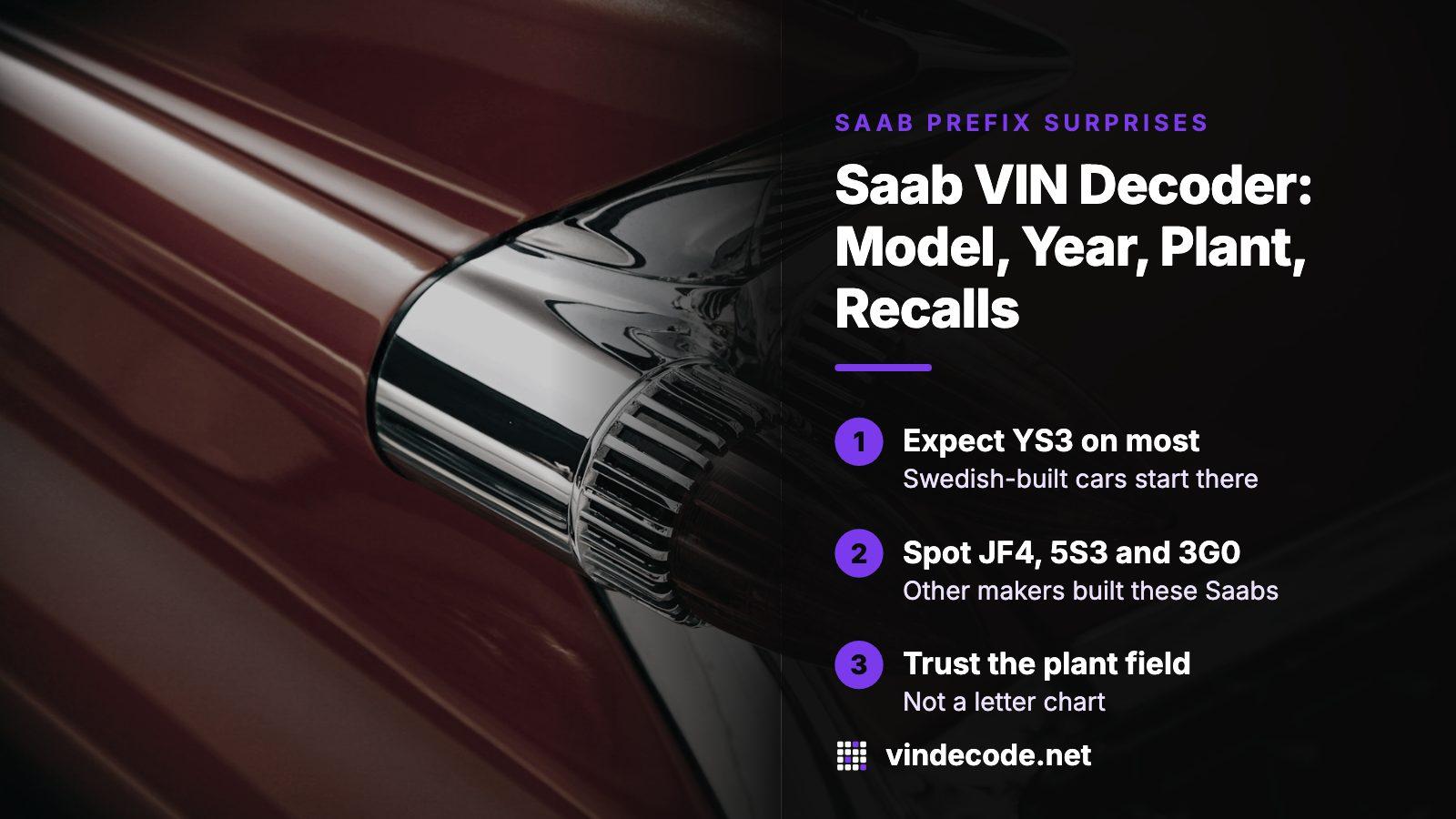
Type all 17 characters into the decoder above. Most Saabs begin YS3, but the 9-2X begins JF4, the 9-7X begins 5S3 and the 9-4X begins 3G0, because other companies built those. The tenth character carries the model year, and the seventh settles which era it belongs to. A decode shows the car as built, so title brands, crashes, mileage and theft need a history report, and its preview is free.
- Usual prefix
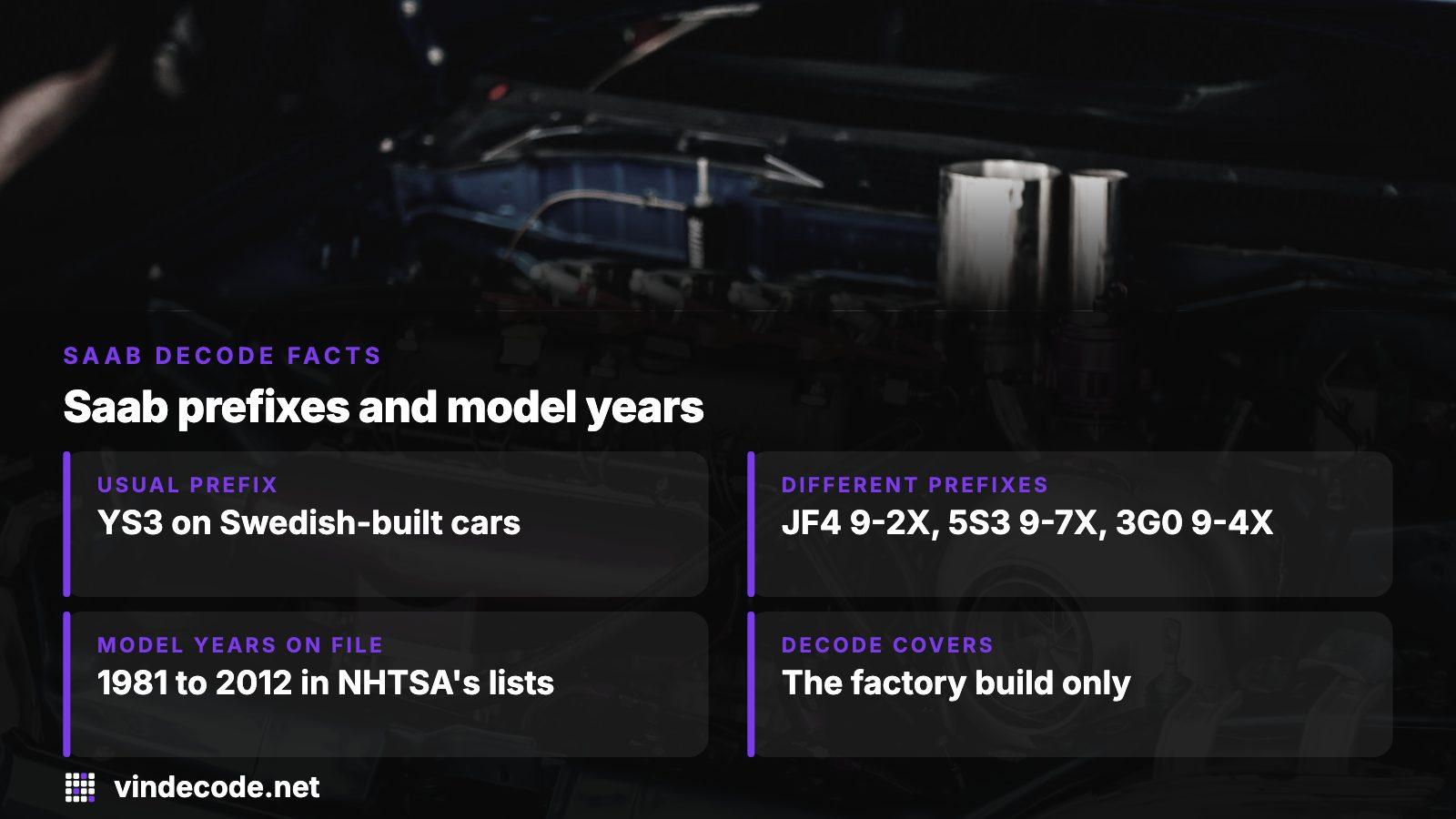
- YS3 on the Swedish-built cars
- Different prefixes
- JF4 (9-2X), 5S3 (9-7X), 3G0 (9-4X)
- Model years on file
- 1981 to 2012 in NHTSA's lists
- Decode covers
- The factory build, not later history
What the decoder returns for a 900, a 9-5 or a 9-3 convertible
Each row below starts from a real VIN prefix printed in NHTSA's owner-complaint records, fed to NHTSA's own decoder. Only 11 characters went in, so every answer carried an incomplete-VIN flag. Typing the whole number gives the decoder more to work with.
| Saab | Starts | Engine | Body | Plant returned |
|---|---|---|---|---|
| 1991 900, S | YS3 | 2.1 L | Hatchback | Malmo, Sweden |
| 1994 900, SE | YS3 | 2.5 L, 6 cylinders | Hatchback | Trollhattan, Sweden |
| 1999 9-5, SE | YS3 | 2.3 L | Sedan | Trollhattan, Sweden |
| 2004 9-3, Linear | YS3 | 2 L | Sedan | Trollhattan, Sweden |
| 2004 9-3 convertible | YS3 | 2 L | Convertible | Graz, Austria |
| 2010 9-5, Aero | YS3 | 2.8 L, 6 cylinders, AWD | Sedan | Trollhattan, Sweden |
Gaps are normal on the older cars. A 1989 9000 Turbo came back with no engine size, and the decoder noted that it had corrected one position and could not read others. A thin result on a 1980s Saab is not a warning sign by itself.
Typing the number so the decoder can read it
Stand outside the driver's door, shoot a photo of the plate in the glass corner, and copy the number from that picture later at a desk. The registration card carries the same characters, and the insurance card sometimes does. Lay the photo beside the paperwork before you submit anything.
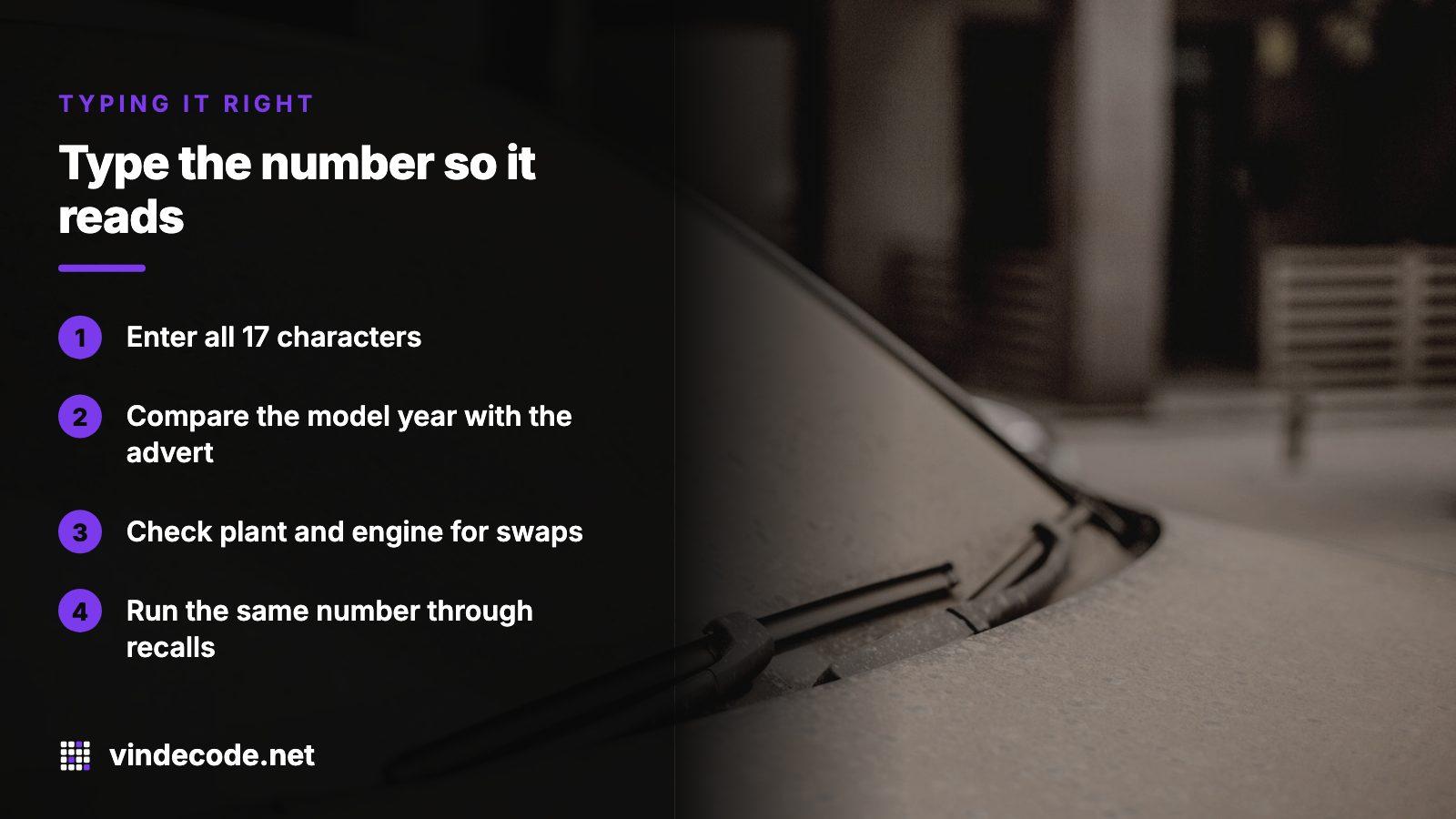
- Enter all 17 characters. NHTSA's decoder will take a shorter number with a star for each unknown, but the answer gets vaguer.
- Read the model year in the result and compare it with the advert.
- Look at the plant and engine fields, which tend to expose a swapped or mislabeled car.
- Put the same number into NHTSA's recall lookup before moving on.
Position 9 is a check digit, built by federal rule to verify that a number was copied correctly. If a decode complains about it, suspect your typing before you suspect the car.
YS3 on most Saabs, but four different makers behind the badge
NHTSA files YS3 to Saab Cars North America, a Swedish passenger-car identifier, and the owner records for the 900, 9000, 9-3 and 9-5 are full of it. Saab also has a Finnish entry, YK1, filed to Saab Valmet. The badge-engineered models break the pattern, and a decode that names another company on one of them is correct.
| Model | Starts | Manufacturer in the decode | Plant returned |
|---|---|---|---|
| 9-2X, 2005 | JF4 | Fuji Heavy Industries, for Subaru of America | Gunma, Japan |
| 9-7X, 2006 | 5S3 | General Motors LLC | Moraine, United States |
| 9-4X, 2011 | 3G0 | General Motors LLC | Ramos Arizpe, Mexico |
The reverse is the red flag. A car sold as a 9-5 that starts with something other than YS3 needs a convincing explanation, and a 9-3 that decodes as a different make is a different car.
Position 10 is the year, position 7 picks the era
The year codes repeat on a long cycle, so the letter M means 1991 and also 2021. Federal rules settle it with position 7: a number there puts position 10 in the range 1980 to 2009, while a letter puts it in 2010 to 2039.
| Saab sample | Position 7 | Position 10 | Year it means |
|---|---|---|---|
| 900, S | Number | M | 1991, not 2021 |
| 9-3, 2.0 liter hatchback | Number | Y | 2000 |
| 9-3, Linear | Number | 8 | 2008 |
| 9-3, 2.0T | Letter | B | 2011 |
Saab stopped listing models in NHTSA's data after 2012, so no genuine Saab should decode to a later year. An advert for a 2014 Saab is wrong about something.
Trollhattan, Graz, Malmo: trust the plant field, not a letter chart
Position 11 is the plant, but the decoder does the translating. In my 14 test decodes, four different digits in that spot, 1 through 4, all resolved to Trollhattan on the cars built in Sweden. The one 1991 900 with a 5 there resolved to Malmo.
The most useful surprise is the 2004 9-3 convertible. Three different prefixes from owner records all decoded to Graz, Austria, while the 9-3 sedan of the same year decoded to Trollhattan. If an advert shows a drop-top and the decode says Sweden, ask why.
When the advert and the decode disagree
- Year off by one: a model year is a maker's label, not a build date, so confirm against the registration before calling it a lie.
- Wrong model name: a 9-3 and a 9-5 look similar in photos, and the decode names the one the factory built.
- Engine mismatch: a 2.8 L six on a car sold as a four-cylinder points to a swap or a mislabeled trim.
- Trim blank: older records are patchy, so ask the seller for service papers, not just another decode.
NHTSA's lists hold the 900 from 1981 to 1998, the 9000 from 1984 to 1998, the 9-3 and 9-5 from 1999 to 2012, and the 9-2X and 9-7X from 2005 to 2009. A name outside its window deserves a direct question.
Recalls follow the VIN, and a Saab can fall just outside one
The 2004 9-3 alone carries six recall records at NHTSA, three of them for front seat belt retractors. A 2010 notice covered certain 2004 sedans, and a 2014 notice covered convertibles built from July 30, 2003 to February 15, 2011. Air bag inflators followed in 2016 for 2006 to 2011 cars built up to February 15, 2011.
From an NHTSA owner complaint
In 2014, the owner of a 2004 9-3 reported that the driver's belt would no longer retract. After reading online about two retractor recalls, the owner went to the dealer that serviced Saabs and was told this VIN was not included in either one.
From an NHTSA owner complaint
Another 2004 owner got an air bag recall notice in March 2016, phoned Saab about parts and heard back that the letter was a mailing error and the VIN had dropped out of the campaign. A second notice was promised. The owner said the car no longer felt safe to drive.
Take from this that a model name proves little. Enter the full VIN in NHTSA's recall search. It lists only unrepaired recalls, skips campaigns older than 15 years unless Saab or its successor extended the coverage, and cannot see a repair a previous owner already paid for.
What a decode cannot show, and the report that can
A decode is a copy of what the factory filed, and it never changes. It is silent on whether the car was totaled, flooded or auctioned. NMVTIS, the federal title database, exists because states label cars with brands such as salvage, junk and flood, and because stolen cars get re-registered under VINs lifted from clean ones.
That gap is where the VINDecode history report comes in. Fed the same VIN, it returns title brands, crash and damage history, mileage readings and theft entries. The free preview shows what turns up first. If you buy the full Saab report you pay once, with no subscription attached, and rates are listed on the pricing page.
For a Saab more than a decade old, this matters more than usual. A cheap 9-3 with a clean decode and a tidy advert tells you nothing about a past salvage sale, and a test drive will not turn up a title brand.
Where this information comes from
- NHTSA vPIC: Vehicle API documentation — Source of the decoder behavior, the partial-VIN rule, the Saab maker table, the model lists by year and the numbered error messages.
- NHTSA: check for recalls — Says where the VIN sits and what a recall search leaves out, including repaired and older campaigns.
- NHTSA recalls data: Saab 9-3, model year 2008 — The records behind the belt retractor and air bag inflator campaign dates and build ranges.
- eCFR: 49 CFR 565.15 VIN requirements — Sets the check digit, the year codes and the position 7 rule.
- NMVTIS: information for consumers — Explains title brands, odometer and theft data, and how cloned VINs disguise stolen cars.
- NHTSA owner complaint 10595949 — owner experience, paraphrased
- NHTSA owner complaint 10863998 — owner experience, paraphrased
Sources and photos: Facts checked against the sources above in November 2026. Photos by Clem Onojeghuo, JavyGo and Willian Cittadin on Unsplash; diagrams by VINDecode.
Keep reading
- GM VIN Decoder: Decode Any GM VIN, Then Check Its HistoryGeneral Motors built the 9-7X and 9-4X, and its prefixes work differently from Saab's own.
- Subaru VIN Decoder: Engine, Drivetrain, Plant and HistoryThe 9-2X was a Subaru underneath, and this page decodes that side of the family.
- VIN Decoder Year Chart: Position 10 Codes for 1980 to 2039Every year character in one table, with the position 7 rule that separates the eras.
- Sample reportA finished history report, to see what the step after the decode adds.
Frequently asked questions
How do I decode a Saab VIN?
Enter all 17 characters in the decoder at the top of this page. It returns model year, model, trim, engine, body and plant from the maker's filing. Compare each field with the advert and the paperwork, then put that identical VIN into NHTSA's recall search.
Do all Saab VINs start with YS3?
No. YS3 covers the Swedish-built cars. The 9-2X starts JF4 and decodes to a Japanese plant under Fuji Heavy Industries, for Subaru of America. The 9-7X starts 5S3 and names General Motors, and the 9-4X starts 3G0 and decodes to a plant in Mexico.
Can I tell a Saab 9-3 convertible from the VIN?
The decoder reports the body class. On the 2004 convertible prefixes I checked, the plant came back as Graz, Austria, while the sedan came back as Trollhattan, Sweden. A mismatch between body, plant and what the seller says is worth a question.
Does a Saab VIN decode show open recalls?
No, a decode reads the build. NHTSA's recall search accepts the same 17 characters and shows unrepaired campaigns, though not repaired ones or those older than 15 years. A dealer or the maker's customer line can cover what that search leaves out.
Will a Saab decode show a salvage title or an accident?
No. The decode reads the factory build, which never changes. Title brands, damage, odometer readings and theft records attach to the VIN later and appear in a history report. Previewing costs nothing, and buying the report is one payment.
Now check the car itself
The guide explains what to look for. The report shows what this VIN has on record.