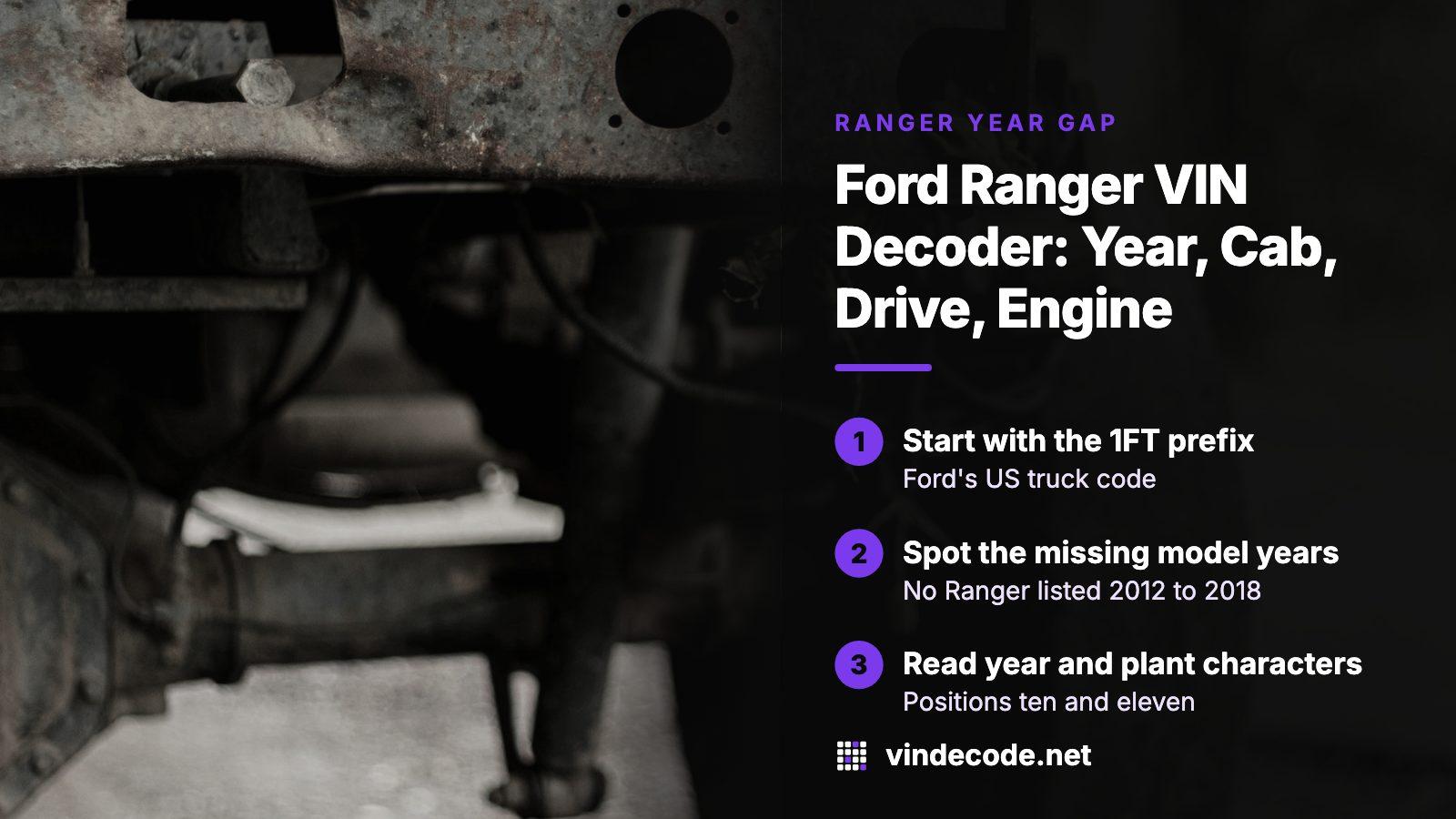
THE SHORT ANSWER
Enter all 17 characters above. Ranger strings open with 1FT, Ford's US truck prefix. Character ten gives the year, character eleven the assembly plant, and character seven says whether that year falls before 2010 or after. NHTSA's model list has no Ranger for 2012 through 2018, so a listing that claims one needs checking. The decode gives the build; mileage, title brands and damage live in a history report.
- Prefix
- 1FT on the strings tested
- Model years in NHTSA's list
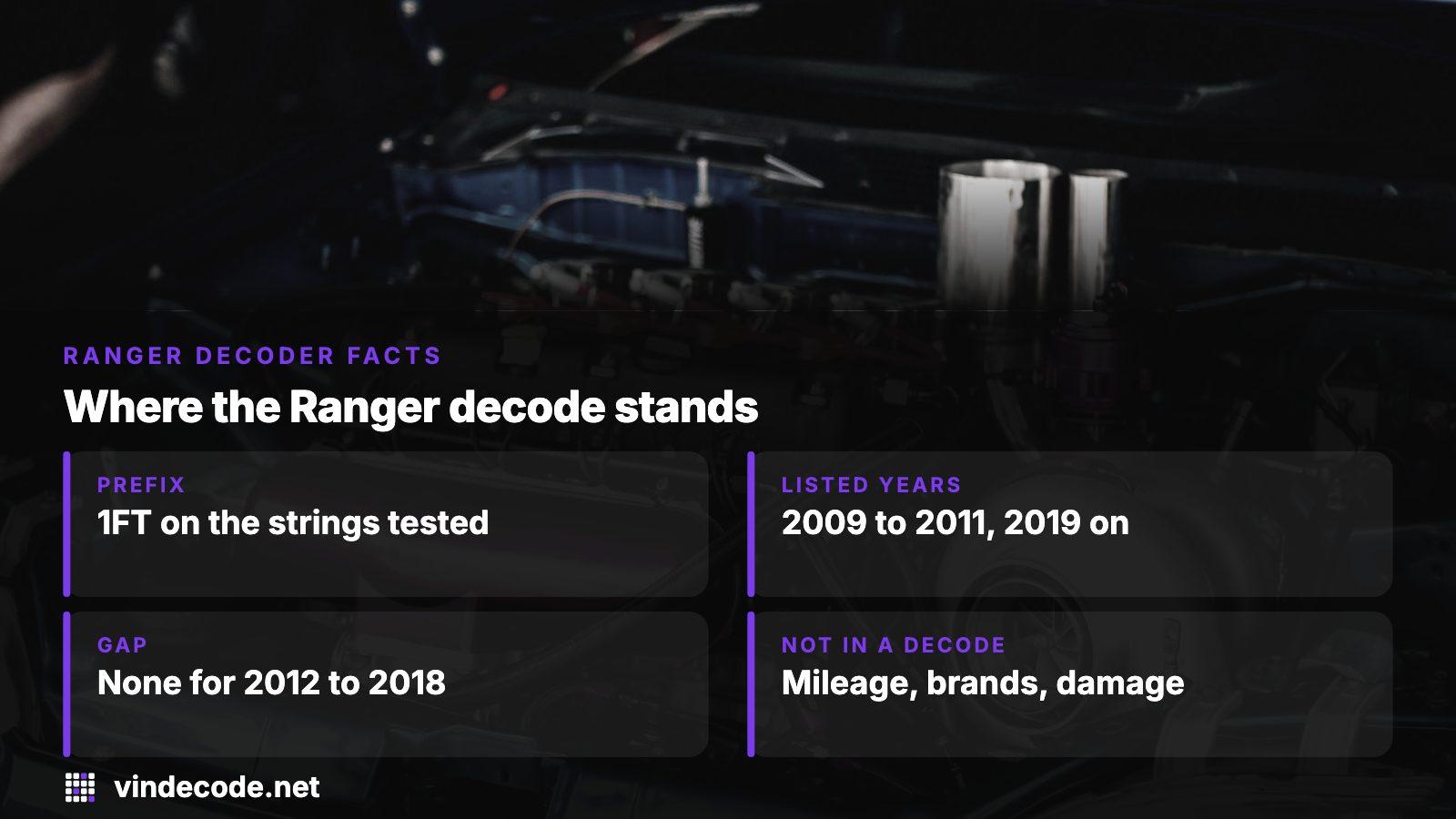
- 2009 to 2011 and 2019 on; none 2012 to 2018
- Newer engine
- 2.3 L turbo, per fueleconomy.gov for 2021
- Not in a decode
- Mileage, title brands, damage
Two Rangers, and a seven-year hole between them
NHTSA's decoder keeps a list of Ford models by model year. It names a Ranger for 2009, 2010, 2011 and 2019 onward, and returns nothing for 2012 through 2018. So a 2016 Ranger ad is a mislabeled truck or something outside NHTSA's filings. The decoder's answers to made-up strings from each era follow.
| Test string | Year | What the decoder returned |
|---|---|---|
| 1FTYR10U5XU100001 | 1999 | Two-wheel drive, V6 of 3.0 L, 150 hp |
| 1FTZR15E4XR100001 | 1999 | Four-wheel drive, V6 of 4.0 L, 210 hp, two-door |
| 1FTKR1AD2AP100001 | 2010 | Two-wheel drive, 2.3 L four, 143 hp |
| 1FTLR4FE1BP100001 | 2011 | Four-wheel drive, V6 of 4.0 L, 207 hp, four-door |
| 1FTER4FH9KL100001 | 2019 | 4WD, 2.3 L gasoline, no series or trim |
| 1FTER4FH5ML100001 | 2021 | SuperCrew, 4WD, 2.3 L gasoline |
The federal fuel economy site lists one choice for the 2021 Ranger, in 2WD and 4WD alike: a 2.3-liter turbo four with a 10-speed automatic. A newer string that decodes to a V6 deserves a question to the seller.
Reading the number off the truck, not the ad
Federal rules make a light truck carry its VIN inside the cab, readable through the glass by the driver's-side pillar. The alphabet used skips I, O and Q, so one you think you spot is a misread.
- Photograph the plate through the windshield from the driver's front corner.
- Find the same number on the title or registration and compare it character by character.
- A VIN texted by the seller is a claim until it matches your photo.
- Decode the string that every source agrees on.
One 2021 Ranger string, split into its parts
Take 1FTER4FH5ML100001. The tail end is numbers invented for the test, so no real truck wears it.
| Positions | Characters | Decoder's reading |
|---|---|---|
| 1 to 3 | 1FT | Ford truck, made for the US |
| 4 to 8 | ER4FH | Ranger, cab, drive and engine, coded by Ford |
| 9 | 5 | Check digit, calculated correctly |
| 10 | M | Model year 2021 |
| 11 | L | Wayne, Michigan |
| 12 to 17 | 100001 | Sequence number, invented |
Positions 4 to 8 belong to Ford, which only has to file a key with NHTSA, so no chart is universal. Two small changes inside it show how much it carries.
| 2021 test string | Cab | Drive |
|---|---|---|
| 1FTER1EH5ML100001 | SuperCab | 4x2 |
| 1FTER4EH3ML100001 | SuperCrew | 4x2 |
| 1FTER4FH5ML100001 | SuperCrew | 4WD |
In these strings the sixth character separated the two cabs and the seventh separated two-wheel from four-wheel drive.
The year and plant characters deserve a second read
Codes for 2019 through 2024 run K, L, M, N, P, R, then S for 2025 and T for 2026. Earlier, 9 means 2009, A means 2010 and B means 2011. A letter can point at two eras, so the seventh character breaks the tie: a number there means a year from 1980 to 2009, a letter means 2010 or later. The 1999 test strings carry a 0 in that spot, while the 2010 string carries an A.
The plant answer is simpler than it looks. Take the 1999 string above and change only the eleventh character, and the decoder named Louisville, Wayne or Kansas City. It maps that one letter and nothing else, so a misread plant letter gives a confident wrong answer. Read both twice.
Newer trucks decode with gaps, and that is normal
The 2024, 2025 and 2026 test strings came back with error code 14, a note that the maker's filing does not explain every character. The 2024 string returned no drive type at all. Treat a blank as unresolved, not as a fault.
Changing only the seventh character of the 2024 string moved the answer between trims: XL with 4WD, XLT with 4x2, Lariat with 4x2 and Raptor with all-wheel drive. Those are readings of made-up strings, so confirm trim on the truck itself.
When the screen disagrees with the string you typed
The decoder fills in a build even from a flawed number, so read the status line first.
- A wrong check digit: the 2021 string with a changed ninth character still showed Ranger, 2.3 L and 4WD, but the status said the digit does not calculate.
- Letter O typed for zero in the sequence: flagged as invalid characters, with exclamation marks in the suggested VIN.
- Sixteen characters: reported as an incomplete VIN.
- An invented eighth character: the decoder offered a corrected string and an 11.1-liter heavy-truck engine. A suggestion like that is a guess, so retype from the plate instead.
Recalls are filed by build, so the full VIN matters
NHTSA lists 11 campaigns for the 2019 Ranger, 6 for 2021 and 13 each for 2024 and 2025. The older trucks carry 8 for 2009, 9 for 2010 and 6 for 2011. Counts say little about one truck, because campaigns name subsets: one covered 11,134 model year 2009 4x2 Rangers, and another reached 2011 trucks built within a few months at the Twin Cities plant.
From an NHTSA owner complaint
A 2009 Ranger owner told NHTSA that the engine shroud cut into a fuel line under high pressure, spraying fuel. The owner tied it to an earlier recall of the same fault and wrote that the truck's VIN was left out, so Ford would not cover the repair. No outcome is recorded.
Whether that owner is right is for NHTSA and Ford to settle. The point is that coverage is decided per VIN. NHTSA's recall lookup takes the full number at no charge, and a recall repair costs the owner nothing.
What the decode cannot see, and where it shows up
A decode describes a truck on its first day. A used truck may have worked hard, and the records below sit outside the decode.
| History record | The Ranger question it answers |
|---|---|
| Odometer readings | Does the mileage fit the age of the truck? |
| Title brands | Did any state label it salvage, junk or flood? |
| Damage and total-loss entries | Was it ever written off or hit hard? |
| Ownership and use | One household, or a fleet or rental? |
| Liens and impounds | Does anyone else still hold a claim? |
From an NHTSA owner complaint
A 2020 Ranger owner bought it used in 2024 with 44,000 miles. Hard shifting, slipping and lurching into gear began at 79,000 miles, and the cause was put down to a factory fault in the 10-speed automatic. The owner says Ford put out service bulletins yet gave no assistance.
No decoder could have predicted that. A report and a shop inspection before purchase show how the truck was used and what has been replaced; the federal title database itself urges an independent inspection.
Running the check, and what comes after it
The preview opens as soon as you enter the VIN. The report is a one-time purchase for this truck, or you can buy 3, 5 or 10 at once. No plan renews, and the pricing page lists amounts.
- Decode the VIN from the plate and confirm the year against the 2009 to 2011 and 2019 onward pattern.
- Compare cab, drive and engine with the truck; a mismatch ends the talk.
- Check recalls for the same VIN on NHTSA's own lookup.
- Open the preview first; pay for a report once the build checks out.
- Pay a mechanic you choose to check the frame, transmission and any repaired panels.
Where this information comes from
- NHTSA: vPIC VIN decoder — Federal decoder and model list behind the test strings, the model-year gap and the status codes quoted here.
- eCFR: 49 CFR Part 565, VIN requirements — The federal rule for the 17-character format, year codes, the seventh-character rule and where a light truck's VIN must be readable.
- Fuel Economy: fueleconomy.gov — Federal listing of the engine and transmission offered on the 2021 Ranger.
- NHTSA: recall data for the Ford Ranger — Campaign counts by model year and the build and size limits written into individual recalls.
- NMVTIS: Understanding an NMVTIS Vehicle History Report — What the federal title database holds, where its data comes from, and its advice to add an independent inspection.
- NHTSA owner complaint 11363183 — owner experience, paraphrased
- NHTSA owner complaint 11708536 — owner experience, paraphrased
Sources and photos: Facts checked against the sources above in November 2026. Photos by Zoshua Colah, Thibault Valjevac and Willian Cittadin on Unsplash; diagrams by VINDecode.
Keep reading
- Ford VIN Decoder: Decode a Ford VIN, Then Check Its HistoryThe Ford prefixes, with what 1FA, 1FM and 1FT cover across cars, SUVs and trucks.
- Ford Bronco VIN Decoder: Confirm the Build, Then Check What Happened SinceA Ford SUV that appears alongside the Ranger in several recall campaigns.
- VIN Decoder Year Chart: Position 10 Codes for 1980 to 2039Every tenth-character letter by model year, with the seventh-character rule.
- Sample reportA finished report, so you can see the odometer and title sections before paying.
Frequently asked questions
How do I decode a Ford Ranger VIN?
Take all 17 characters from the dash plate, match them to the title, and type them into the decoder above. Look at the status line first, since a check-digit warning usually means a typo. Then compare year, cab, drive and engine with the truck itself.
Was there a Ford Ranger in 2012 through 2018?
NHTSA's Ford model list shows no Ranger for those seven years, and its recall data returns none either. A US listing claiming one deserves questions: ask for the VIN, decode it, and check whether the year character matches the ad before discussing price.
Does the eighth character tell me the Ranger's engine?
Often, but it is Ford's own code, so a chart built for one year can mislead on another. In the 2019 to 2026 test strings an H there decoded to the 2.3-liter engine. Trust the decoder's answer for that exact year, and treat a blank as unresolved.
Can a decoder show if a Ranger was in an accident?
No. Decoding only describes the build. Damage, total-loss entries, title brands and odometer readings sit in other records, which a history report searches by VIN. Run both before paying, then have a mechanic you pick inspect the truck.
Is a Ranger recall tied to the model year or the VIN?
To the VIN. Campaigns name particular trucks, sometimes by build dates, plant, cab or drive. A truck from a named year can fall outside a recall, and an owner can find the opposite. NHTSA's lookup takes the full number, and recall repairs cost the owner nothing.
Now check the car itself
The guide explains what to look for. The report shows what this VIN has on record.